


Oregon Road Signs Test

4.8 out of 5 (205 votes)
80% Passing score
10 Questions
2 Mistakes allowed
Oregon’s DMV permit test is a full Class C knowledge test, and that matters because road signs are not handled as a separate topic. They are folded into the same test as traffic laws, highway signs and signals, and the safe-driving material from the Oregon Driver Manual. So this Oregon DMV practice test is useful for one very direct reason: it gives you focused practice on the sign knowledge you will still need when the official test starts mixing everything together. The real Oregon Class C knowledge test has 35 multiple-choice questions. You need 28 correct answers to pass, which means an 80% score. There is no separate missed-question rule just for road signs, no special sign-only threshold, none of that. A missed road sign question counts the same as any other missed question, and the overall limit is 7 wrong answers. That is where practice starts to matter, especially with signs that feel familiar at a glance but require a more exact reading once they appear in test-question form. This Oregon DMV signs practice test uses 20 multiple-choice questions to help you work through the road sign portion in a more focused way. It covers the kinds of signs Oregon drivers need to recognize without overthinking them: regulatory signs, warning signs, guide signs, highway signs, and the everyday markers that quietly do a lot of work on city streets, rural roads, mountain routes, and long open highways. And, well, Oregon gives you plenty of each. Portland traffic is one thing; a curve sign on a wet road outside the metro area is another. The practice test is not a leaked version of the official DMV permit test. Oregon does not publish the exact knowledge test questions, so any site claiming otherwise deserves a raised eyebrow. What this Oregon road signs test does instead is mirror the format and general phrasing of the real exam while giving you room to slow down, miss something, look at it again, and actually learn it before money and attempts are involved. The official knowledge test costs $7 per attempt. At a DMV office, a same-day retest may be possible if testing resources are available. Online, you can take the knowledge test twice in 24 hours and up to four total times before later attempts have to be made at a DMV office. Using a free Oregon road signs practice test before all that is simply the better move — no fee, no time limit, and no official score sitting there judging you while you figure out which sign means what.
FREE DMV Practice Test App
Study for your Oregon permit test or driver’s license with the NextDoorDriving app. 700+ DMV questions and answers, 100% free!
Download on the App Store

Sample Oregon Permit Test Questions

Question 1

An orange diamond sign showing a worker holding a shovel warns that:

This sign means that:
  1. A. A volunteer litter crew is always present
  2. B. Road workers may be on or near the roadway ahead
  3. C. Children may be playing near the road
  4. D. A pedestrian crosswalk is ahead

Correct answer: B. – Road workers may be on or near the roadway ahead

The Workers sign warns that road work personnel may be on or close to the roadway. The Oregon Driver Manual explains that orange traffic control devices identify work zones, where workers and construction equipment may be near moving traffic. Follow signs, cones, flaggers, and other traffic-control devices.

Source: OAR 734-020-0005 – Traffic Control Devices, Manual on Uniform Traffic Control Devices, 11th ed., W21-1 – Workers, Oregon Driver Manual — Sharing the Road, “Work Zones”
Question 2

In Oregon, orange signs and cones on a freeway indicate that you should:

  1. A. Change lanes immediately without reducing speed
  2. B. Expect workers, equipment, and changes in traffic flow
  3. C. Assume your lane ends at the next cone
  4. D. Accelerate through the area

Correct answer: B. – Expect workers, equipment, and changes in traffic flow

Orange traffic control devices define a work zone. Workers and construction equipment may be close to traffic, and lanes may be narrower, fewer in number, or shifted. Pay attention, follow all temporary traffic controls, and be prepared to merge or stop as directed.

Source: Oregon Driver Manual — Sharing the Road, “Work Zones”

Question 3

After stopping at a stop line, your view of cross traffic is blocked. What should you do next?

  1. A. Wait five seconds and then enter
  2. B. Sound the horn before moving
  3. C. Listen with the windows open and proceed
  4. D. Ease forward, scan for traffic and pedestrians, and proceed when safe

Correct answer: D. – Ease forward, scan for traffic and pedestrians, and proceed when safe

Oregon law requires the initial stop at the clearly marked stop line. After stopping, the driver manual permits you to pull forward slightly and scan when the view to the left and right is blocked. Yield to vehicles that are in the intersection or close enough to create an immediate hazard before proceeding.

Source: ORS 811.260(15) – Appropriate driver responses to traffic control devices, Oregon Driver Manual — Turns and Intersections, “Intersections”

Question 4

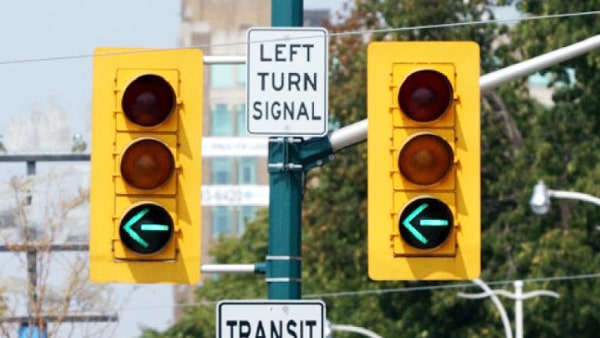
A steady green arrow pointing left permits you to:

On the intersection, if you see a green arrow pointing to the left, you can:
  1. A. Travel in any direction
  2. B. Make the left-turn movement shown by the arrow
  3. C. Turn left or continue straight regardless of other signals
  4. D. Turn only after the circular signal also becomes green

Correct answer: B. – Make the left-turn movement shown by the arrow

A steady green arrow permits a driver to enter the intersection cautiously and make the movement indicated by the arrow. Other movements are allowed only when another signal permits them. Continue watching for vehicles or other road users who have not yet cleared the intersection.

Source: ORS 811.260(2) – Appropriate driver responses to traffic control devices, Oregon Driver Manual — Signs and Traffic Signals, “Green Arrow”

Question 5

Your signal turns green, but vehicles are still occupying the intersection. What should you do?

  1. A. Enter and wait behind the vehicles
  2. B. Drive around them within the intersection
  3. C. Wait until the intersection is clear before entering
  4. D. Enter because the green signal gives absolute right of way

Correct answer: C. – Wait until the intersection is clear before entering

Oregon law requires a driver facing green to yield to vehicles already within the intersection. It also prohibits entering when there is not enough space beyond the intersection to avoid obstructing traffic or pedestrians. Wait until the vehicles clear and sufficient space is available before proceeding.

Source: ORS 811.260(1) – Appropriate driver responses to traffic control devices, ORS 811.290 – Obstructing cross traffic; penalty, Oregon Driver Manual — Turns and Intersections, “Intersections”

Question 6

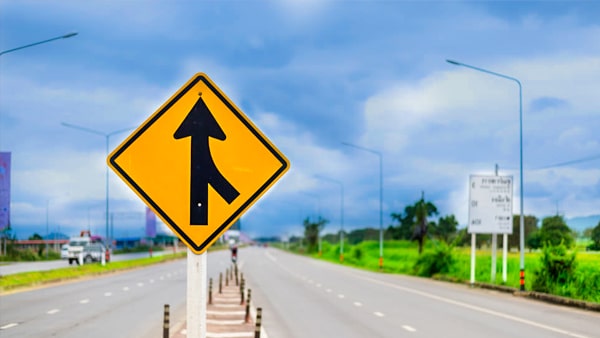
A yellow merge sign with a curved line joining from the right warns that:

This sign means:
  1. A. Two-way traffic begins ahead
  2. B. Your lane narrows and shifts right
  3. C. Traffic will merge from the right ahead
  4. D. A divided highway begins

Correct answer: C. – Traffic will merge from the right ahead

The Merge warning sign alerts drivers on the main roadway that merging movements may occur where another roadway converges with it. The symbol is oriented to show the side from which traffic enters. It is different from a lane-ends or added-lane sign.

Source: OAR 734-020-0005 – Traffic Control Devices, Manual on Uniform Traffic Control Devices, 11th ed., § 2C.45 – Merge Signs and Plaque, Oregon Driver Manual — Signs and Traffic Signals, “Merge”