Oregon Road Signs Test 2

4.8 out of 5 (146 votes)
80% Passing score
20 Questions
4 Mistakes allowed
Oregon folds road signs into the regular Class C knowledge test, which is worth knowing before you start studying the wrong thing. There is no separate road-sign-only exam for the standard permit or noncommercial license. The signs show up inside the same 35-question test as traffic laws, safe driving rules, highway signs, signals, and the rest of the material pulled from the Oregon Driver Manual. To pass, you need 28 correct answers. That is 80%, and road sign questions count toward that same score like everything else. This Oregon road signs practice test gives you a focused place to work on that part of the exam without pretending signs are the whole story. It includes 20 multiple-choice questions covering the signs Oregon drivers are expected to recognize quickly: regulatory signs, warning signs, informational signs, stop and yield signs, no-parking signs, and those familiar highway markers that are easy to overlook when you only study the obvious ones. There is no time limit, so you can actually look at the sign, think through what it means, and notice the difference between “I know this” and “I have seen this before, probably, maybe.” And, yes, repetition helps. You can take this Oregon DMV practice test as many times as you need, which is exactly how sign recognition tends to stick. Miss one, see the explanation, miss it again because apparently your brain had other plans, and then finally remember it. The goal is not to fake your way through a cheat sheet. It is to get steady enough with road signs that the real Oregon DMV permit practice test material feels familiar instead of weirdly new. For teen drivers, the knowledge test is only one piece of the Oregon licensing process. Drivers ages 15, 16, and 17 start with a Provisional Instruction Permit, which requires the knowledge test, vision test, identity and address documents, a parent or legal guardian signature, the required fee, and the usual DMV photo. While driving with that permit, a teen must have a licensed driver at least 21 years old seated beside them. Before moving to a provisional license, the teen must hold the permit for at least 6 months and complete either an approved traffic safety education course plus 50 supervised driving hours, or 100 supervised hours without the course. Those supervised hours need to be with someone at least 21 who has had a valid license for at least 3 years. Adults have a cleaner route, though not a paperwork-free one. At 18 or older, an Oregon applicant may get an instruction permit or apply directly for a driver license. Adults are not tied to the teen permit holding period, supervised-hour requirement, provisional passenger limits, nighttime restrictions, or the under-18 mobile-device rule. They still need to satisfy DMV requirements for documents, vision screening, testing, fees, and the drive test when required. So this Oregon DMV sign test is best treated as targeted preparation. It sharpens the road sign piece, supports your broader Class C knowledge test study, and gives you a calmer, more reliable way to practice before the real exam.

FREE DMV Practice Test App
Study for your Oregon permit test or driver’s license with the NextDoorDriving app. 700+ DMV questions and answers, 100% free!
Download on the App Store

Sample Oregon Permit Test Questions

Question 1

A yellow diamond sign displaying a bicycle warns that:

This sign means:
  1. A. A playground is nearby
  2. B. Bicycle rentals are available
  3. C. A park entrance is ahead
  4. D. Bicycles may enter or cross the roadway ahead

Correct answer: D. – Bicycles may enter or cross the roadway ahead

Under Oregon’s adopted sign standards, the bicycle warning symbol alerts drivers to locations where bicycles may unexpectedly enter or cross the roadway. The sign does not identify a bicycle rental facility or park. Watch the roadway and surrounding area for bicycle traffic as you approach.

Source: OAR 734-020-0005 – Traffic Control Devices, Manual on Uniform Traffic Control Devices, 11th ed., § 2C.54 – Vehicular Traffic Warning Signs

Question 2

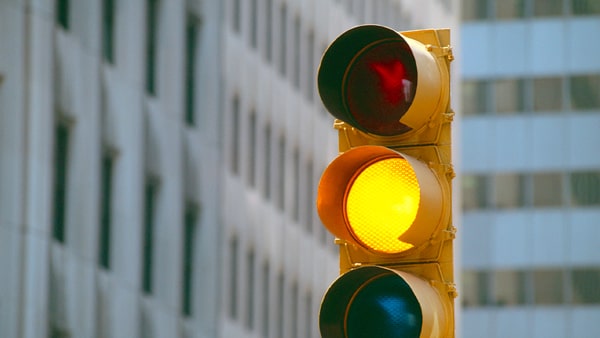
A steady traffic signal changes from green to yellow as you approach. What should you do?

As you near an intersection, the traffic light changes from green to yellow. Your best action would be to:
  1. A. Accelerate before the signal turns red
  2. B. Brake abruptly, regardless of traffic conditions
  3. C. Plan to stop within the intersection
  4. D. Stop before entering if you can do so safely

Correct answer: D. – Stop before entering if you can do so safely

Oregon law states that a steady yellow signal warns that the related right of way is ending. Stop at the marked stop line, crosswalk, or intersection boundary. If you cannot stop safely, you may proceed cautiously through the intersection rather than braking suddenly.

Source: ORS 811.260(4) – Appropriate driver responses to traffic control devices, Oregon Driver Manual — Signs and Traffic Signals, “Steady Yellow”

Question 3

Immediately before entering an intersection after stopping, which areas should you scan?

  1. A. Ahead and to the left
  2. B. Only to the left and right
  3. C. To the left, right, and ahead
  4. D. Ahead and to the right

Correct answer: C. – To the left, right, and ahead

The Oregon Driver Manual directs drivers to check left, front, right, and left again before entering an intersection while turning. Scanning all three areas helps you identify cross traffic, oncoming traffic, pedestrians, and other roadway users. Enter only after completing the required stop and determining that the movement is clear.

Source: Oregon Driver Manual — Turns and Intersections, “Right Turns” and “Left Turns”, Oregon Driver Manual — Turns and Intersections, “Intersections”

Question 4

A yellow diamond-shaped sign reading “DIP” warns of:

This sign means:
  1. A. A sharp depression in the road ahead
  2. B. A soft roadway shoulder
  3. C. A pedestrian crossing
  4. D. A required stop

Correct answer: A. – A sharp depression in the road ahead

The DIP warning sign is placed in advance of a sharp depression in the roadway profile. It is different from a soft-shoulder sign, pedestrian warning sign, or stop sign. Be prepared for the change in the road surface and follow any accompanying advisory-speed plaque.

Source: OAR 734-020-0005 – Traffic Control Devices, Manual on Uniform Traffic Control Devices, 11th ed., § 2C.26 – BUMP and DIP Signs

Question 5

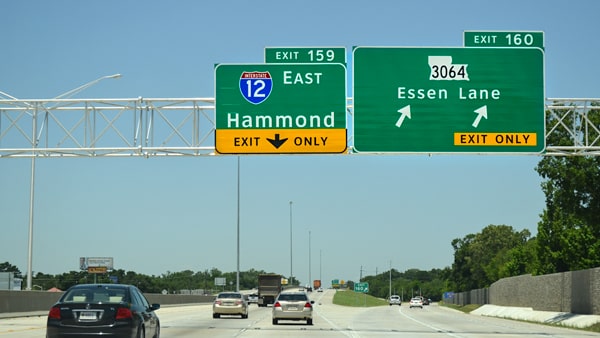
A yellow “EXIT ONLY” panel is displayed above your freeway lane. What does it indicate?

If you see this sign above your lane, you:
  1. A. The lane cannot be used to exit
  2. B. The lane continues through and also serves the exit
  3. C. The lane continues through the interchange
  4. D. The lane leaves the freeway at the exit

Correct answer: D. – The lane leaves the freeway at the exit

Oregon’s adopted freeway-signing standards use an EXIT ONLY panel for a lane-drop situation. The marked lane becomes the exit rather than continuing along the main freeway. A driver who remains in that lane must follow it onto the exit ramp.

Source: OAR 734-020-0005 – Traffic Control Devices, Manual on Uniform Traffic Control Devices, 11th ed., § 2E.28 – Interchange Lane Drop Signing, Oregon Driver Manual — Lane Travel, “Dotted White Line”

Question 6

Why should you check cross traffic before moving into an intersection on a green signal?

  1. A. A traffic signal may not stop every approaching driver
  2. B. You should look only straight ahead after entering
  3. C. Cross traffic always receives a green arrow at the same time
  4. D. Pedestrians on the cross street always have the right of way

Correct answer: A. – A traffic signal may not stop every approaching driver

A green signal permits you to proceed, but it does not make an unsafe intersection clear. The driver manual advises defensive drivers not to assume that a traffic signal will stop every approaching vehicle. Scan for cross traffic and yield to any vehicle already within the intersection.

Source: ORS 811.260(1) – Appropriate driver responses to traffic control devices, Oregon Driver Manual — Turns and Intersections, “Intersections”