Oregon Road Signs Test Simulator

4.9 out of 5 (143 votes)
80% Passing score
25 Questions
5 Mistakes allowed
A good Oregon DMV practice test should do more than toss a few sign pictures on the screen and call it preparation. The real Oregon Class C Knowledge Test has 35 questions, and you need 28 correct answers to pass, which puts the passing score at 80%. That gives you room to miss 7, but not much room to drift, second-guess, or vaguely remember something from a handbook page you skimmed three nights ago. This Oregon DMV practice test focuses on road signs, one of those areas that seems simple until you realize how much meaning Oregon expects you to pull from shape, color, placement, and wording. Each round uses 20 randomized questions, so you are not just memorizing the order of answers. You get a fresh mix every time, and that matters. Repetition helps, obviously, but repetition with slight changes helps more because the actual permit test is not interested in whether you recognized question number 12 from yesterday. It wants to know whether you understand the sign. There is no time limit here, which is worth taking seriously rather than treating as a throwaway feature. Slow down on the first few attempts. Read the choices. Notice why the wrong answers are wrong. Then, once the signs start feeling familiar, pick up the pace a little. That is usually where the learning settles in — not in a dramatic way, just in the quiet, useful way where you stop arguing with yourself over a warning sign. For teen drivers, this practice test also fits into the bigger Oregon licensing process. You can apply for a Provisional Instruction Permit at 15, and if you are under 18, you must hold that permit for 6 months before applying for a provisional license. Oregon also requires supervised driving practice: 50 hours with an ODOT-approved driver education course, or 100 hours without one. The supervising driver must be at least 21 and have been licensed for at least 3 years. And then, because licensing always comes with a few practical details, there are fees and requirements to keep in mind. The knowledge test costs $7 each time. An instruction permit is $30, a Class C license is $58, and the DMV drive test is $45. Oregon also checks vision, including visual acuity and field of vision standards, with corrective lenses allowed when needed. Start with the road signs practice test, use it more than once, and do not rush the early rounds. Passing the Oregon permit test is the immediate goal, sure. But knowing the signs well enough to react correctly on an actual road is the part that matters after the screen goes dark.
FREE DMV Practice Test App
Study for your Oregon permit test or driver’s license with the NextDoorDriving app. 700+ DMV questions and answers, 100% free!
Download on the App Store

Sample Oregon Permit Test Questions

Question 1

When red warning lights flash at a railroad crossing, you must:

  1. A Stop only when a train is visible
  2. B Stop exactly 10 feet from the signal
  3. C Stop and proceed only after the warning ends and crossing is safe
  4. D Reduce speed without stopping

Correct answer: C – Stop and proceed only after the warning ends and crossing is safe

Oregon law requires you to stop at the stop line when a railroad signal warns of an approaching train. If no line is present, stop between 15 and 50 feet from the nearest rail. Do not proceed until the warning has ended and you can cross the tracks safely.

Source: ORS 811.455(1)(a), (b) – Failure to stop for railroad signal; penalty, Oregon Driver Manual — Railroad Crossings, Light Rail and Street Cars, “Railroad Crossings”
Question 2

A steady yellow arrow appears while you approach a left turn. What should you do?

  1. A Remain stopped regardless of whether you have entered
  2. B Accelerate to complete the turn first
  3. C Stop before entering if you can do so safely
  4. D Begin the turn because the protected movement is continuing

Correct answer: C – Stop before entering if you can do so safely

Under Oregon law, a steady yellow arrow warns that the related right of way is ending. Stop at the applicable stop line, crosswalk, or intersection boundary if you can do so safely. If a safe stop is not possible, proceed cautiously through the intersection.

Source: ORS 811.260(5) – Appropriate driver responses to traffic control devices, Oregon Driver Manual — Signs and Traffic Signals, “Yellow Arrow”

Question 3

On a two-way road, a yellow center line separates:

  1. A Traffic moving in opposite directions
  2. B Lanes moving in the same direction
  3. C The roadway from a railroad crossing
  4. D A travel lane from the right shoulder

Correct answer: A – Traffic moving in opposite directions

Yellow center lines are used between traffic traveling in opposite directions. The particular pattern—broken, solid, or a combination—determines whether passing is permitted. Yellow markings may have other uses elsewhere, but a yellow center line on a two-way roadway divides opposing traffic.

Source: Oregon Driver Manual — Lane Travel, “Yellow Markings”

Question 4

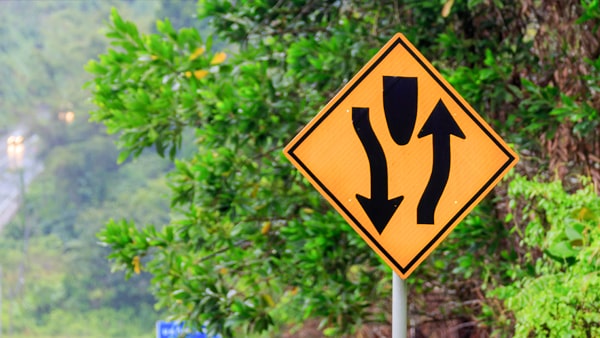
A yellow warning sign showing a median beginning between opposing traffic arrows means:

This sign means:
  1. A The divided highway ends
  2. B A one-way street begins
  3. C A one-way street ends
  4. D A divided highway begins

Correct answer: D – A divided highway begins

The Divided Highway sign warns that a median or other physical barrier will separate opposing traffic flows ahead. It is not a one-way-street sign. Keep to the right of the divider as you enter the divided section.

Source: OAR 734-020-0005 – Traffic Control Devices, Manual on Uniform Traffic Control Devices, 11th ed., § 2C.20 – Divided Highway Sign, Oregon Driver Manual — Signs and Traffic Signals, “Divided Highway Begins or Ends”

Question 5

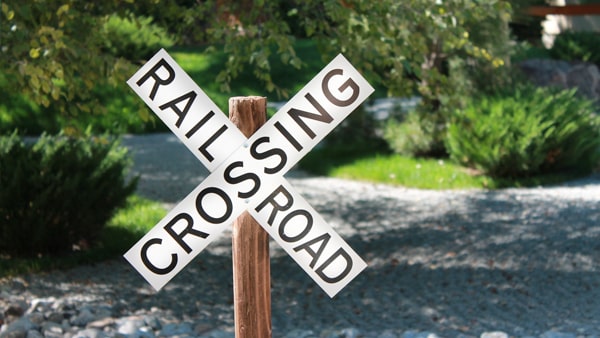
A white X-shaped sign marked “RAILROAD CROSSING” identifies:

This road sign means:
  1. A An intersection where you stop only for traffic
  2. B A three-way intersection
  3. C A crossroad ahead
  4. D A railroad crossing

Correct answer: D – A railroad crossing

In Oregon, a crossbuck assembly marks a railroad crossing and includes a yield or stop sign. Obey the sign installed with the crossbuck, and look and listen for trains. If a stop is required, proceed across the tracks only when the movement can be completed safely.

Source: Oregon Driver Manual — Railroad Crossings, Light Rail and Street Cars, “Railroad Crossings”, ORS 811.455 – Failure to stop for railroad signal; penalty

Question 6

A yellow diamond sign with a black cross symbol warns of:

This sign shows one type of:
  1. A A four-way intersection ahead
  2. B A series of curves
  3. C A mandatory right turn
  4. D A lane shift

Correct answer: A – A four-way intersection ahead

The crossroad warning sign indicates that a four-way intersection is ahead and that turning or entering traffic may be present. Its symbol depicts the general configuration of the intersecting roadways. It does not require a turn or indicate a lane shift.

Source: OAR 734-020-0005 – Traffic Control Devices, Manual on Uniform Traffic Control Devices, 11th ed., § 2C.41 – Intersection Warning Signs, Oregon Driver Manual — Signs and Traffic Signals, “Crossroad”