


Pennsylvania CDL General Knowledge Practice Test (PA) 2

4.9 out of 5 (111 votes)
80% Passing score
20 Questions
4 Mistakes allowed
As a Pennsylvanian aiming to ace your CDL General Knowledge test, you've found the right spot with our second CDL practice test. Designed to mirror the real DMV permit test, our general knowledge practice test offers a comprehensive and engaging way to sharpen your skills. Featuring 20 permit test questions and answers, each carefully curated to reflect the actual test's format and content, this tool is invaluable for anyone seeking a Class A or Class B driver's license, along with any endorsements. Our PA CDL general knowledge practice test covers a wide array of topics crucial for every aspiring commercial driver. From pre-trip vehicle inspection to mastering vehicle control and gear shifting, the questions delve into practical aspects that are essential for safe driving. You'll encounter scenarios about navigating hills and downgrades, communicating effectively with other road users, and crucial topics like speed control and drug and alcohol awareness. This PA CDL practice test ensures you're well-versed in all these areas, giving you a solid foundation for the real test. What sets this Pennsylvania permit practice test apart is its untimed nature. Unlike the pressure-filled environment of the actual CDL test in 2026, here you can take your time to thoroughly understand and answer each question. This relaxed approach is not just about getting the right answers; it's about truly absorbing the knowledge and applying it effectively. Moreover, the no-pressure environment of this PA general knowledge test practice is perfect for learning at your own pace. Without the anxiety of a ticking clock, you can focus better, understand deeper, and remember longer. This way, when you face the actual CDL test in PA, you'll feel more confident and prepared. Remember, the questions you practice here are not just random queries; they are a close reflection of what you'll face in the real written permit test. So, engage with each test question, learn from it, and build the confidence you need to succeed. This Pennsylvania CDL general knowledge practice test isn't just a stepping stone; it's a significant part of your path to becoming a licensed commercial driver in Pennsylvania in 2026!
FREE CDL Practice Test App
Pass your Pennsylvania CDL General Knowledge test with the NextDoorDriving app. Real questions and answers—100% free and ad-free.
Download on the App Store

Sample Pennsylvania CDL Test Questions - General Knowledge

Question 1

Which equipment must be clean and operating properly to help other road users see your vehicle?

  1. A Reflectors and marker lights
  2. B Clearance lights and taillights
  3. C Identification lights
  4. D All of these

Correct answer: D – All of these

Reflectors, marker lights, clearance lights, taillights, and identification lights all help show a commercial vehicle’s presence and dimensions. They must be clean and working properly, particularly for nighttime or reduced-visibility operation. Dirt can reduce the effectiveness of a light or reflector even when the device itself is not damaged.

Source: Pennsylvania Commercial Driver’s Manual (PUB 223) — § 2.11.4, “Vehicle Factors—Other Lights”
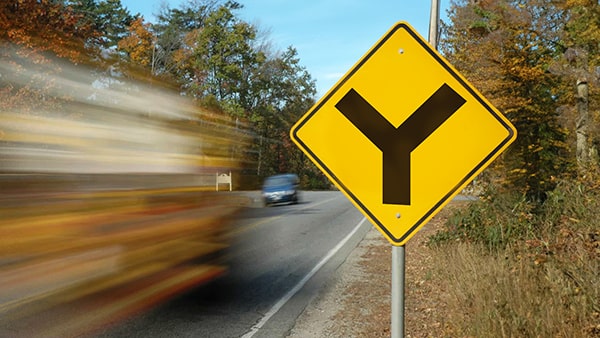
Question 2

A yellow diamond-shaped sign displaying a black Y symbol warns of what condition?

This sign warns drivers to _____________.
  1. A A T-intersection ahead
  2. B A Y-shaped intersection ahead
  3. C A construction zone ahead
  4. D A dip in the roadway

Correct answer: B – A Y-shaped intersection ahead

The sign warns that the roadway configuration ahead forms a Y-shaped intersection. In Pennsylvania, warning signs are placed in advance of conditions so drivers have time to search for traffic and adjust their speed or path if necessary. The sign does not by itself indicate that every approach has a stop or yield requirement.

Source: Manual on Uniform Traffic Control Devices, 11th ed. — Part 2C, “Warning Signs and Object Markers”

Question 3

Which description correctly defines controlled braking?

  1. A A method used only on vehicles without ABS
  2. B Applying the brakes as firmly as possible without locking the wheels
  3. C Locking the wheels, releasing the brakes, and then reapplying them
  4. D Holding the brakes until all wheels remain locked

Correct answer: B – Applying the brakes as firmly as possible without locking the wheels

During controlled braking, apply the brakes as hard as possible without locking the wheels. Keep steering movements small. If the wheels lock or a larger steering correction becomes necessary, release the brakes and reapply them as soon as possible. Intentionally locking and releasing the wheels is the separate technique known as stab braking.

Source: Pennsylvania Commercial Driver’s Manual (PUB 223) — § 5.4.3, “Emergency Stops”

Question 4

The same loading and unloading procedure can be used for every hazardous material.

  1. A True
  2. B False

Correct answer: B – False

Federal hazardous-material rules do not provide one identical procedure for every product. General precautions apply broadly, such as securing the vehicle and rejecting leaking packages, but additional requirements vary by hazard class and packaging. Explosives, corrosives, gases, radioactive materials, and other regulated products can have different loading, segregation, smoking, heating, or handling restrictions.

Source: Pennsylvania Commercial Driver’s Manual (PUB 223) — § 9.4, “Loading and Unloading”, 49 CFR Part 177 – Carriage by Public Highway

Question 5

If you are not seriously injured in a crash, what should be your first priority at the scene?

  1. A Leave before traffic begins to back up
  2. B Remove your personal belongings
  3. C Protect the area from another crash
  4. D Discuss fault with the other driver

Correct answer: C – Protect the area from another crash

The first priority is to protect the crash area from another collision. If possible, move the vehicle to the roadside, activate the hazard flashers, and place reflective triangles where approaching drivers can see them in time. After the area is protected, notify authorities and provide appropriate assistance to injured people.

Source: Pennsylvania Commercial Driver’s Manual (PUB 223) — § 2.20.1, “Protect the Area”

Question 6

Which statement best describes alcohol’s role in roadway crashes?

  1. A It is associated only with property-damage crashes
  2. B It contributes to many serious and fatal crashes
  3. C It is a concern only during nighttime driving
  4. D It does not affect driving below the legal BAC limit

Correct answer: B – It contributes to many serious and fatal crashes

Alcohol is a major roadway safety hazard and contributes to many deaths and serious injuries. It impairs coordination, reaction time, judgment, vision, and attention. Even a relatively small amount can reduce driving ability, and operating a large commercial vehicle while impaired increases the potential consequences of a crash.

Source: Pennsylvania Commercial Driver’s Manual (PUB 223) — § 2.22, “Alcohol, Other Drugs, and Driving”