Pennsylvania CDL Practice Test: General Knowledge (PA) 6

5 out of 5 (56 votes)
80% Passing score
50 Questions
10 Mistakes allowed
Gear up for the Pennsylvania CDL General Knowledge Practice Test, your essential tool for mastering the fundamentals of commercial driving. As the sixth in our series of comprehensive CDL practice tests, this one is crafted to bolster your knowledge and confidence on the road. Featuring 50 meticulously designed PA CDL test questions and answers, this test demands a minimum score of 40 to pass, reflecting the real exam's rigor. Our PA permit practice test is a mirror of the real-world challenges you'll face as a commercial driver. It delves into crucial topics like vehicle equipment, handling emergencies, accident procedures, and pre-trip inspections. You'll also encounter permit test questions on hazardous materials, vital knowledge for every aspiring driver, regardless of your HazMat endorsement plans. What sets this PA CDL practice test apart is its commitment to practical learning. Sample CDL permit test questions often simulate real-life driving scenarios, bridging the gap between theory and practice. This approach is invaluable for understanding how to apply your knowledge in actual driving situations, an essential skill for any professional driver. Another key feature of our CDL prep test is the immediate, detailed feedback provided for each question. Understanding why an answer is right or wrong is crucial for learning, and our explanations are designed to enhance your understanding of critical concepts. This feedback loop ensures that every attempt at the practice permit test is a learning experience, paving the way for success in your actual CDL test in 2026! All questions are rooted in the official Pennsylvania CDL driver's manual, the same source used for the actual CDL permit test. This alignment guarantees that you're studying the most relevant and accurate information, ensuring that you're well-prepared for both our Pennsylvania CDL permit practice test and the real deal. So, rev up your study engines and get ready to ace your CDL test!
FREE CDL Practice Test App
Pass your Pennsylvania CDL General Knowledge test with the NextDoorDriving app. Real questions and answers—100% free and ad-free.
Download on the App Store

Sample Pennsylvania CDL Test Questions - General Knowledge

Question 1

Before backing with a helper, which hand signal must both of you clearly understand?

  1. A Stop
  2. B Increase speed
  3. C Shift into a higher gear
  4. D Sound the horn

Correct answer: A – Stop

Before backing, the driver and helper should agree on a set of hand signals, especially a clear signal for “stop.” The helper should remain near the rear of the vehicle in a position where the driver can see them. If the helper disappears from view, the driver should stop backing until visual contact is restored.

Source: Pennsylvania Commercial Driver’s Manual — § 2.2.4, “Backing Safely.”

Question 2

What does a TWO-WAY TRAFFIC warning sign tell you?

This sign warns drivers to _____________.
  1. A You are about to cross a two-way road
  2. B Traffic will be moving in opposite directions on the road ahead
  3. C The road ahead is restricted to one-way traffic
  4. D You must turn because the road ends

Correct answer: B – Traffic will be moving in opposite directions on the road ahead

The TWO-WAY TRAFFIC sign warns that vehicles will be traveling in both directions on the roadway ahead. A driver should be prepared for oncoming traffic and remain to the right of the centerline. It does not indicate that the road ends or that a turn is required.

Source: 67 Pa. Code § 212.101(a) — Official Signs., Pennsylvania Handbook of Approved Signs (Publication 236M) — W6-3, “Two-Way Traffic.”

Question 3

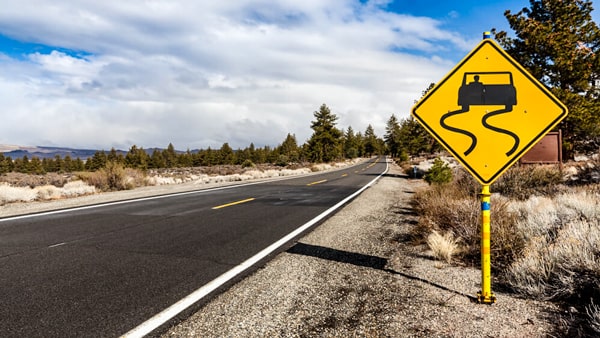
What does a SLIPPERY WHEN WET warning sign indicate?

This sign warns drivers to  _________________.
  1. A The pavement may provide less traction during wet weather
  2. B Driving is prohibited whenever it rains
  3. C Vehicles may become stuck after rainfall
  4. D The roadway is equally slippery in all weather

Correct answer: A – The pavement may provide less traction during wet weather

The SLIPPERY WHEN WET sign identifies pavement that may provide especially poor traction when wet. Drivers should reduce speed and make braking and steering inputs smoothly. A wet surface increases stopping distance and makes skidding more likely, especially when speed is too high for conditions.

Source: 67 Pa. Code § 212.101(a) — Official Signs., Pennsylvania Handbook of Approved Signs (Publication 236M) — W8-5, “Slippery When Wet.”, Pennsylvania Commercial Driver’s Manual — § 2.6.2, “Match Speed to the Road Surface.”

Question 4

If hazardous material is spilling from your vehicle, which response is appropriate?

  1. A Park the vehicle, moving it only as safety requires
  2. B Secure the surrounding area
  3. C Remain at the scene and send someone else for help
  4. D All of these answers are correct

Correct answer: D – All of these answers are correct

Pennsylvania’s hazardous-material guidance directs the driver to park, secure the area, remain there, and send someone else for help. Move the vehicle only as much as safety requires and only when doing so will not endanger anyone. Keep people away and provide responders with the location and available information about the material.

Source: Pennsylvania Commercial Driver’s Manual — § 9.7.3, “Fires.”

Question 5

In ideal conditions, what following interval should a 40-foot commercial vehicle maintain at 45 mph?

  1. A 2 seconds
  2. B 3 seconds
  3. C 4 seconds
  4. D 5 seconds

Correct answer: D – 5 seconds

A 40-foot vehicle needs four seconds of following distance under the basic one-second-per-10-feet rule. Because the speed is above 40 mph, the driver must add another second. The resulting minimum interval is five seconds under good conditions, with more space needed on slippery roads.

Source: Pennsylvania Commercial Driver’s Manual — § 2.7.1, “Space Ahead.”

Question 6

Which combination matches the emergency equipment required for most commercial power units?

  1. A A flashlight, tire gauge, and tire sealant
  2. B A first-aid kit, bandages, and pain reliever
  3. C A properly rated fire extinguisher and approved warning devices
  4. D A cell phone, wheel chocks, and portable work light

Correct answer: C – A properly rated fire extinguisher and approved warning devices

Federal rules require covered trucks, truck tractors, and buses to carry a properly rated, accessible, securely mounted fire extinguisher. They also require warning devices for stopped vehicles: either three bidirectional reflective triangles or at least six fusees. Flame-producing devices are prohibited on certain vehicles and hazardous-material loads. The other listed items do not satisfy these federal equipment requirements.

Source: 49 CFR § 393.95(a), (f), (g) — Emergency Equipment on All Power Units.