


Pennsylvania CDL Permit Test (PA) Online Simulator

5 out of 5 (58 votes)
80% Passing score
50 Questions
10 Mistakes allowed
Discover the cutting-edge Pennsylvania CDL Permit Test Online Simulator, a dynamic and comprehensive tool designed to elevate your test preparation to the next level in 2026. Our PennDOT simulator is uniquely crafted to assess and enhance your knowledge, ensuring you're fully prepared for the real CDL test. With over 700 meticulously curated CDL test questions and answers, the simulator guarantees a fresh challenge each time, presenting a new set of 50 questions from its vast knowledge base in every session. The permit test Simulator, mirroring the structure of the actual Pennsylvania CDL test, features a mix of multiple choice and true or false questions, along with the authentic answers you can expect in the real PA permit test. It's meticulously aligned with all CDL license classes, including A and B, providing an inclusive platform for all aspiring commercial drivers. Achieving a passing score requires correctly answering at least 40 out of the 50 driver's license questions. However, aiming for a higher score not only increases your chances of success but also solidifies your understanding of the driving rules and regulations. This approach to preparation is crucial, as it builds confidence and ensures a comprehensive grasp of the necessary knowledge. Our PA CDL test simulator stands out for its foundation in expertise and authenticity. The questions are crafted and rigorously vetted by professional driving instructors with decades of experience. These experts have guided thousands to successfully obtain their driver's licenses, infusing their deep understanding and practical insights into every question. The content of our Pennsylvania CDL general knowledge test simulator is directly sourced from the official CDL driver's manual, the same resource that forms the basis of the actual CDL written permit test. This alignment guarantees that you are studying the most relevant and accurate information, covering all the essentials without the clutter of unnecessary data. By engaging with our PennDOT CDL permit test simulator, you're not just practicing; you're adapting your study sessions to your needs, focusing on challenging topics, and tracking your progress in real time. Prepare for your CDL written test in 2026 with the confidence that you're learning from the best, in a way that works best for you!
FREE CDL Practice Test App
Pass your Pennsylvania CDL General Knowledge test with the NextDoorDriving app. Real questions and answers—100% free and ad-free.
Download on the App Store

Sample Pennsylvania CDL Test Questions - General Knowledge

Question 1

How should you plan to park a commercial vehicle whenever possible?

  1. A Park where the vehicle can be inspected without walking around it
  2. B Park so you can pull forward when leaving
  3. C Park where backing will be limited to exactly 10 feet
  4. D Park as close as possible to an entrance ramp

Correct answer: B – Park so you can pull forward when leaving

Because a driver cannot see everything behind a commercial vehicle, backing is always hazardous and should be avoided when possible. Park in a position that allows you to leave by moving forward. If backing cannot be avoided, check the path, use both mirrors, move slowly, and use a helper when available.

Source: Pennsylvania Commercial Driver’s Manual (Pub. 223) — § 2.2.4, “Backing Safely”
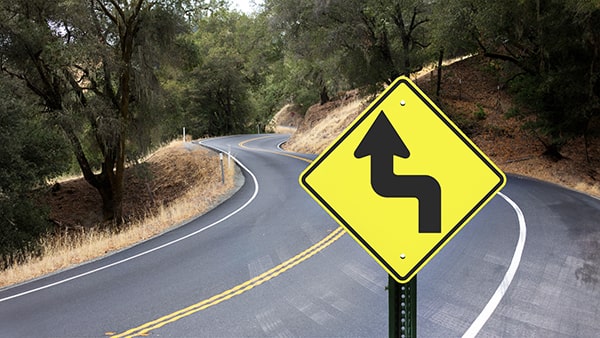
Question 2

In Pennsylvania, a yellow diamond sign showing one curve followed by an opposite curve means:

This sign warns drivers to  _________________.
  1. A Sharp left and right turns are ahead
  2. B A set of two curves is ahead
  3. C The pavement becomes unpaved
  4. D Only a left curve is ahead

Correct answer: B – A set of two curves is ahead

The Set of Curves sign indicates that the roadway curves first in one direction and then back in the opposite direction. It represents two curves rather than a series of three or more curves. Reduce speed as needed and prepare to follow both changes in roadway direction while remaining within your lane.

Source: Pennsylvania Driver’s Manual — Ch. 2, “Warning Signs—Set of Curves”

Question 3

Which statement about commercial-vehicle tire pressure is correct?

  1. A Air should routinely be released from warm tires
  2. B Tire pressure does not need to be checked during an inspection
  3. C Tire pressure increases as tire temperature rises
  4. D All of the above

Correct answer: C – Tire pressure increases as tire temperature rises

Air pressure inside a tire increases as its temperature rises. Do not release air merely because a properly inflated tire becomes hot; its pressure may be too low after it cools. Check tire mounting and pressure before driving, and inspect tires more frequently when operating in very hot weather.

Source: Pennsylvania Commercial Driver’s Manual (Pub. 223) — § 2.14.1, “Vehicle Checks”

Question 4

How must a driver respond to a flashing red traffic signal?

  1. A Stop and proceed only under the rules that apply at a STOP sign
  2. B Slow down but continue without stopping
  3. C Proceed as though facing a steady green light
  4. D Treat it as a YIELD sign

Correct answer: A – Stop and proceed only under the rules that apply at a STOP sign

Pennsylvania law requires a driver facing a flashing red signal to stop in the same manner as at a STOP sign. After stopping, check for pedestrians and traffic and proceed only when the intersection can be entered safely. A flashing yellow signal, not a flashing red signal, permits cautious travel without a mandatory stop.

Source: 75 Pa.C.S. § 3114(a) – Flashing signals, Pennsylvania Driver’s Manual — Ch. 2, “Flashing Signals”

Question 5

Which roadway hazards should you anticipate while traveling through a work zone?

  1. A Hazards only when workers are visible
  2. B Uneven pavement and sharp drop-offs
  3. C A mandatory stop at the beginning of every work zone
  4. D A need to accelerate quickly through the area

Correct answer: B – Uneven pavement and sharp drop-offs

Work zones may contain narrow lanes, sharp turns, uneven surfaces, and pavement drop-offs. Drive slowly and carefully, remain alert for workers and construction vehicles, and use warning lights when appropriate to alert following traffic. Pennsylvania also requires vehicle headlamps to be lighted while driving through a signed work zone.

Source: Pennsylvania Commercial Driver’s Manual (Pub. 223) — § 2.8.2, “Hazardous Roads”, 75 Pa.C.S. § 4309(a) – Lighted head lamps in work zones

Question 6

Which group best matches items that should be monitored or checked during a trip?

  1. A Gauges, exhaust stacks, cargo paperwork, and coupling paint
  2. B Gauges, pumps, hoses, radios, and windshield trim
  3. C Gauges, brakes, lights, cargo securement, and coupling devices
  4. D Gauges, shock absorbers, frame paint, and seat upholstery

Correct answer: C – Gauges, brakes, lights, cargo securement, and coupling devices

Watch the gauges for signs of trouble throughout the trip and use your senses to detect unusual conditions. When you stop, check critical items including brakes, lights and reflectors, trailer coupling devices, and cargo securement devices. Tires, wheels, rims, and trailer brake and electrical connections are also included in the recommended checks.

Source: Pennsylvania Commercial Driver’s Manual (Pub. 223) — § 2.1.2, “Types of Vehicle Inspection—During a Trip”