


Pennsylvania CDL Practice Test (PA) 2026

4.8 out of 5 (156 votes)
80% Passing score
20 Questions
4 Mistakes allowed
Dive into the world of commercial driving with our Pennsylvania CDL Practice Test, a vital tool for aspiring commercial drivers in the Keystone State in 2026. This first permit practice test sets the stage for your preparation, offering a comprehensive and up-to-date examination experience. With 20 PennDOT questions, mirroring the actual general knowledge test's style and substance, this test is an essential step in securing your Class A or B driver's license. Our PA CDL practice test stands out with its engaging visual learning aids. Expect to see vivid images of road signs and realistic traffic scenarios. These visual elements are not just decorative; they are crucial for visual learners, helping to imprint essential information in a memorable format. We understand the dynamic nature of driving regulations and practices. That's why our PA permit practice test is constantly refreshed to remain current with 2026 standards. The information you study today is what you'll find in the actual PennDOT permit test tomorrow. This alignment ensures that the time you invest in our practice test translates directly into success when you sit for the real Pennsylvania written permit test. Our Pennsylvania practice permit test covers a broad range of topics necessary for every commercial driver. From pre-trip vehicle inspection to drug and alcohol awareness, each sample DMV question is designed to test your knowledge and readiness for the road. Questions about basic vehicle control, gear shifting, and managing various driving conditions are included to prepare you for real-world driving scenarios. As you progress through the CDL practice test, you'll find helpful study aids for questions that might stump you. These aids are designed to provide clarity and reinforce learning, not just to give away the right answer. Preparing for the CDL permit test in Pennsylvania in 2026 is no small feat. Our PA CDL practice test is here to ensure that you approach the PennDOT test with confidence, well-prepared and knowledgeable about the essentials of commercial driving.
FREE CDL Practice Test App
Pass your Pennsylvania CDL General Knowledge test with the NextDoorDriving app. Real questions and answers—100% free and ad-free.
Download on the App Store

Sample Pennsylvania CDL Test Questions - General Knowledge

Question 1

Before taking a curve in a commercial vehicle, what should you do?

  1. A Reduce speed and select the proper lower gear before entering
  2. B Shift to a higher gear and accelerate before entering
  3. C Stop at the beginning of every curve

Correct answer: A – Reduce speed and select the proper lower gear before entering

Reduce your speed and select the proper gear before entering the curve. This allows you to apply slight power through the curve, helping the vehicle remain stable. Braking or shifting after entering can make control more difficult, while excessive curve speed may cause a skid or rollover, particularly in a vehicle with a high center of gravity.

Source: Pennsylvania Commercial Driver’s Manual (PUB 223) — § 2.3.1, “Manual Transmissions—Before Entering a Curve”, Pennsylvania Commercial Driver’s Manual (PUB 223) — § 2.6.3, “Speed and Curves”
Question 2

After an emergency stop on the shoulder of a divided highway, which action is required?

  1. A Activate the hazard flashers immediately and place required warning devices within 10 minutes
  2. B Ask a passing motorist to direct traffic
  3. C Remain in the cab until roadside assistance arrives
  4. D Switch off all vehicle lights

Correct answer: A – Activate the hazard flashers immediately and place required warning devices within 10 minutes

In Pennsylvania, the federal motor-carrier rule requires a stopped commercial vehicle’s hazard flashers to be activated immediately. Except for a necessary traffic stop, the driver must place the required warning devices as soon as possible and no later than 10 minutes after stopping. The devices must then be positioned according to the type and layout of the highway.

Source: 49 CFR § 392.22 – Emergency Signals; Stopped Commercial Motor Vehicles

Question 3

Before backing with a helper, which hand signal is most important to establish?

  1. A Pull forward
  2. B Turn right
  3. C Continue backing
  4. D Stop

Correct answer: D – Stop

Before backing, the driver and helper should agree on a clear set of hand signals, especially the signal for “stop.” The helper should stand near the rear where the driver can see them without entering the vehicle’s path. A clearly understood stop signal allows the maneuver to be halted immediately if clearance is lost or a hazard appears.

Source: Pennsylvania Commercial Driver’s Manual (PUB 223) — § 2.2, “Backing Safely—Use a Helper When You Can”

Question 4

Battery acid belongs to which hazardous-material class?

  1. A Class 6 poison
  2. B Class 3 flammable liquid
  3. C Minor fire hazard
  4. D Class 8 corrosive material

Correct answer: D – Class 8 corrosive material

Federal hazardous-material classifications place battery acid in Class 8, corrosive materials. Battery fluid in a conventional lead-acid battery is generally sulfuric acid and can injure skin, damage cargo, and corrode vehicle components. Charged storage batteries must be handled and loaded to prevent their liquid from spilling.

Source: PennDOT Hazardous Materials Endorsement Renewal Manual — “Table of Hazard Class Definitions”, 49 CFR § 172.101 – Purpose and Use of Hazardous Materials Table

Question 5

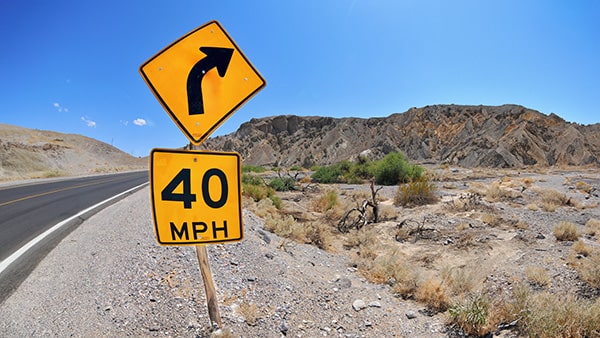
On a Pennsylvania roadway, a right-curve warning sign has a yellow 40 MPH plaque. What does 40 MPH indicate?

This sign warns drivers to _______________.
  1. A Vehicles under 40 mph must use the right lane
  2. B The minimum lawful speed is 40 mph
  3. C The recommended advisory speed for the curve is 40 mph
  4. D Drivers should exceed 40 mph through the curve

Correct answer: C – The recommended advisory speed for the curve is 40 mph

The plaque gives the recommended advisory speed for the condition identified by the warning sign. It is not the same as a regulatory speed-limit sign. A commercial driver may need to travel below the advisory speed because of the vehicle’s load, center of gravity, weather, traction, or other conditions affecting safe control.

Source: Manual on Uniform Traffic Control Devices, 11th ed. — § 2C.59, “Advisory Speed Plaque (W13-1P) and Confirmation Advisory Speed Plaque (W13-1aP)”, Pennsylvania Commercial Driver’s Manual (PUB 223) — § 2.6.3, “Speed and Curves”

Question 6

A commercial driver can safely assume that nearby motorists, pedestrians, and bicyclists have noticed the vehicle.

  1. A True
  2. B False

Correct answer: B – False

Do not assume another road user has noticed your vehicle. When necessary, communicate your presence with the horn or lights, and signal your intentions early. These measures improve the chance of being noticed, but the driver must still remain alert and prepared to respond if the other person does not react.

Source: Pennsylvania Commercial Driver’s Manual (PUB 223) — § 2.5.2, “Communicating Your Presence”