Pennsylvania DMV Test Evaluation

4.6 out of 5 (510 votes)
80% Passing score
10 Questions
2 Mistakes allowed
Pennsylvania's permit test leaves very little room for coasting. The official PennDOT permit test has 18 multiple-choice questions, and you need 15 correct answers to pass, so the margin is three mistakes. That is enough to make “I basically know this stuff” a slightly risky study plan, especially when the exam pulls from traffic signs, Pennsylvania driving laws, safe-driving practices, pavement markings, right-of-way rules, and those quiet little rule details that people tend to skim. This Pennsylvania permit practice test is built as a quick readiness check before you walk into a Driver License Center. It uses 10 randomly selected questions, with a passing score of 8 out of 10, so you get a tight but useful sample of where your knowledge actually stands. Not where you hope it stands. Where it stands. The questions are designed around the same broad territory as the official PA knowledge test, including road signs, traffic signals, lane use, safe following habits, and everyday driving decisions that show up in both rural and city driving. And, yes, it includes help without turning the whole thing into a lecture. If a question slows you down, the hint can point you in the right direction. If you miss one, the explanation gives you the reason behind the answer, which is the part that usually sticks better than simply memorizing a correct option and hoping the real test phrases it the same way. After the test, you can review what you missed and tighten up those weak spots before moving on to another DMV permit practice test. The permit test is also only one piece of the Pennsylvania licensing process, and it helps to know where it fits. First-time drivers must pass the vision screening and the knowledge test before PennDOT issues a learner’s permit. Drivers under 18 need consent from a parent, guardian, or qualifying adult, then must hold the permit for at least 6 months and complete 65 supervised driving hours before the road test, including 10 hours at night and 5 hours in bad weather. Adults 18 and older still need the learner’s permit first, though those teen practice-hour rules do not apply. Use this PA driver permit practice test as an early checkpoint. A strong score means you are on the right track; a messy one means you found the gaps while they are still cheap to fix.
FREE DMV Practice Test App
Study for your Pennsylvania permit test or driver’s license with the NextDoorDriving app. 700+ DMV questions and answers, 100% free!
Download on the App Store

Sample Pennsylvania Permit Test Questions

Question 1

Which mental ability does the driver’s manual specifically say is reduced by even the smallest amount of alcohol?

  1. A Ability to steer through a curve
  2. B Good judgment
  3. C Muscle strength
  4. D Ability to move the hands quickly

Correct answer: B – Good judgment

Even the smallest amount of alcohol can reduce concentration, perception, judgment, and memory. As more alcohol enters the bloodstream, reactions slow and the ability to control a vehicle declines. A driver may also become overly confident while driving ability is getting worse.

Source: Pennsylvania Driver’s Manual — Ch. 3, “Alcohol and Driving”
Question 2

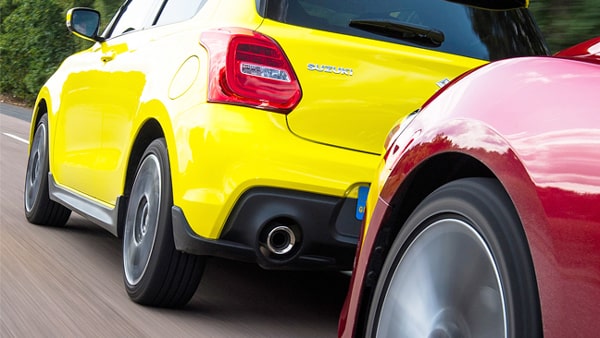
A vehicle suddenly moves into the space directly ahead of you. If no immediate collision is developing, what is the best response?

When you follow too closely and another driver cuts suddenly in front of you, what is the best thing to do?
  1. A Swerve immediately into the next lane
  2. B Apply the brakes as hard as possible
  3. C Drive onto the shoulder to get around it
  4. D Let the vehicle go and restore a safe following distance

Correct answer: D – Let the vehicle go and restore a safe following distance

Do not retaliate when another driver cuts in front of you. Let the driver proceed and restore adequate space between the vehicles. A safe following distance gives you time to respond without an unnecessary panic stop or sudden lane change.

Source: Pennsylvania Driver’s Manual — Ch. 3, “Dealing With Aggressive Drivers”, Pennsylvania Driver’s Manual — Ch. 3, “Managing Space”

Question 3

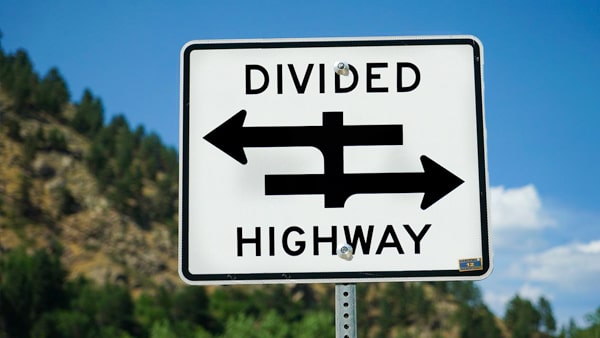
What does a DIVIDED HIGHWAY intersection sign tell you?

This sign means:
  1. A You must turn either left or right
  2. B The road ends at a T-intersection
  3. C Your road intersects a highway separated by a median or barrier
  4. D Your road passes over a divided highway

Correct answer: C – Your road intersects a highway separated by a median or barrier

The Pennsylvania manual explains that this sign marks an intersection with a divided highway. Opposing traffic on that highway travels on separate one-way roadways divided by a median or guide rail. When entering it, turn right onto the first roadway or cross the median before turning left onto the second roadway.

Source: Pennsylvania Driver’s Manual — Ch. 2, “Divided Highway”

Question 4

Which statement about slippery road conditions is correct?

  1. A Shaded road sections may freeze sooner and dry last
  2. B Frost can create slippery areas on bridges in cold weather
  3. C A thin layer of water over ice is more slippery than ice alone
  4. D All of the above

Correct answer: D – All of the above

All three statements describe hazards identified in the Pennsylvania manual. Shaded pavement can freeze more quickly and dry last, while bridges may develop frost during cold weather. A thin layer of water over ice creates especially slippery conditions, requiring lower speed and greater following distance.

Source: Pennsylvania Driver’s Manual — Ch. 3, “Road Conditions”

Question 5

In Pennsylvania, you are traveling 30 mph and intend to turn right. When must your signal begin?

  1. A At least 50 feet before the turn
  2. B Only after entering the intersection
  3. C At least 100 feet before the turn
  4. D Only when another vehicle is behind you

Correct answer: C – At least 100 feet before the turn

At a speed below 35 mph, a turn signal must be given continuously for at least the final 100 feet before the turn. At speeds above 35 mph, the required distance is at least 300 feet. Signaling communicates your intention but does not remove the duty to make the turn with reasonable safety.

Source: 75 Pa.C.S. § 3334(a), (b) – Turning movements and required signals

Question 6

Which marked area beside an accessible parking space must be kept clear?

  1. A The striped or crosshatched access aisle
  2. B An otherwise legal space 60 feet from the nearest railroad rail
  3. C A curbside space where parking is permitted and no restriction applies
  4. D All three areas

Correct answer: A – The striped or crosshatched access aisle

Pennsylvania law defines an access aisle as an area marked by white or blue hash marks, crosshatching, or similar no-parking indicators beside an accessible space. It may not be obstructed in a way that prevents a person or mobility device from entering or leaving a legally parked vehicle. A violation carries a fine of $100 to $300.

Source: 75 Pa.C.S. § 3354(d.1), (f), (h) – Additional parking regulations