


Pennsylvania Permit Practice Test

4.7 out of 5 (305 votes)
80% Passing score
20 Questions
4 Mistakes allowed
Pennsylvania’s permit test is short, which is exactly why it deserves more attention than people tend to give it. The official PennDOT knowledge test has 18 multiple-choice questions, and you need 15 correct answers to pass. That leaves room for only 3 mistakes. Not a huge cushion, especially when a missed road sign, a right-of-way rule, and one oddly plain-looking safety question can eat up that margin fast. This PA permit practice test gives you 20 multiple-choice questions drawn from the same general territory as the real exam: traffic signs, Pennsylvania driving laws, safe-driving practices, pavement markings, signals, lane rules, and the kind of licensing details that are easy to skim past in the Driver’s Manual. It is not trying to bury you in trivia. It is meant to make the official material feel familiar before you are sitting at a PennDOT Driver License Center, taking the actual knowledge test that has to be passed before a learner’s permit can be issued. Road signs deserve their own mental folder, even though Pennsylvania does not treat them as a separate test for a standard non-commercial permit. They are folded into the regular 18-question knowledge exam, along with laws and safe-driving judgment. Shapes matter. Colors matter. Regulatory signs, warning signs, guide signs, traffic signals, lane markings — all of it can show up, and all of it counts toward that same 15-out-of-18 passing score. The licensing process has its paperwork layer too, because of course it does. A first-time applicant must complete the DL-180 learner’s permit application, have the medical section handled by a health care provider, bring required identity and Social Security documentation, pay the fee, and pass the vision screening. Applicants under 18 also need the DL-180TD consent form from a parent, guardian, person in loco parentis, or qualifying spouse. Adults 18 and older have their own extra step: two proofs of Pennsylvania residency. For teen drivers, the permit is the opening move, not the finish line. Pennsylvania requires drivers under 18 to hold the learner’s permit for at least 6 months and complete 65 hours of supervised driving before the road test, including 10 hours at night and 5 hours in bad weather. Adults still need the permit and road test, but those under-18 practice-hour rules do not apply to them. Use this PA driving test practice to tighten up the parts you think you already know and expose the ones you have been quietly guessing on. If you fail the real knowledge test, PennDOT allows a retake the following business day, but walking in prepared is a cleaner, calmer plan.
FREE DMV Practice Test App
Study for your Pennsylvania permit test or driver’s license with the NextDoorDriving app. 700+ DMV questions and answers, 100% free!
Download on the App Store

Sample Pennsylvania Permit Test Questions

Question 1

When parking downhill beside a curb in Pennsylvania, how should you position the front wheels?

  1. A Turn them to the right, toward the curb
  2. B Turn them left, away from the curb
  3. C Keep them straight and parallel to the curb
  4. D Wheel direction does not matter if the transmission is in Park

Correct answer: A – Turn them to the right, toward the curb

When parking downhill, turn the steering wheel completely to the right so the front wheels point toward the curb or roadside. State law also requires a vehicle left unattended on a grade to have its wheels turned toward the curb or side of the highway and its brake effectively set.

Source: 75 Pa.C.S. § 3701(a) – Unattended motor vehicle, Pennsylvania Driver’s Manual — Ch. 3, “Parking”
Question 2

Why should you search the roadway 12 to 15 seconds ahead?

  1. A To eliminate the need to check mirrors
  2. B To maintain a fixed stare on the centerline
  3. C To identify problems early and avoid last-minute maneuvers

Correct answer: C – To identify problems early and avoid last-minute maneuvers

Looking 12 to 15 seconds ahead helps you recognize slowing traffic, lane changes, warning signs, and other hazards before they become immediate problems. At city speeds, this is approximately one block; at highway speeds, it is about one-quarter mile. Continue scanning the entire roadway instead of staring at one point.

Source: Pennsylvania Driver’s Manual — Ch. 3, “Looking Ahead”

Question 3

At a Pennsylvania railroad crossing, an electric or mechanical signal warns that a train is approaching. What must you do?

  1. A Stop 15 to 50 feet from the nearest rail and proceed only when it is safe
  2. B Slow down and cross if the train is not yet visible
  3. C Stop only after the crossing gate begins to lower
  4. D Sound the horn and continue across the tracks

Correct answer: A – Stop 15 to 50 feet from the nearest rail and proceed only when it is safe

A driver must stop between 15 and 50 feet from the nearest rail when a visible electric or mechanical signal warns of an approaching train. The driver may not proceed until crossing can be done safely and may not drive around a closed or moving gate. Violating the stopping requirement is punishable by a fine of $50 to $200.

Source: 75 Pa.C.S. § 3341(a)(1), (b), (c) – Obedience to signal indicating approach of train

Question 4

On a Pennsylvania limited-access highway, you are traveling slower than traffic in the left lane and are not passing or moving left for another permitted reason. What should you do?

  1. A Move into an available right-hand lane when the lane change can be made safely
  2. B Remain in the left lane whenever you are driving the speed limit
  3. C Wait until at least five vehicles have formed behind you
  4. D Turn on the hazard flashers and continue in the left lane

Correct answer: A – Move into an available right-hand lane when the lane change can be made safely

Vehicles on a multilane limited-access highway must generally use the available right-hand lanes. Exceptions include passing, traveling faster than the traffic flow, moving left to allow merging traffic, or preparing for a permitted left movement. A driver traveling below the normal traffic speed must also use the available right-hand lane unless a statutory exception applies.

Source: 75 Pa.C.S. § 3313(d)(1) – Restrictions on use of limited access highways, 75 Pa.C.S. § 3301(b)(1) – Driving on right side of roadway

Question 5

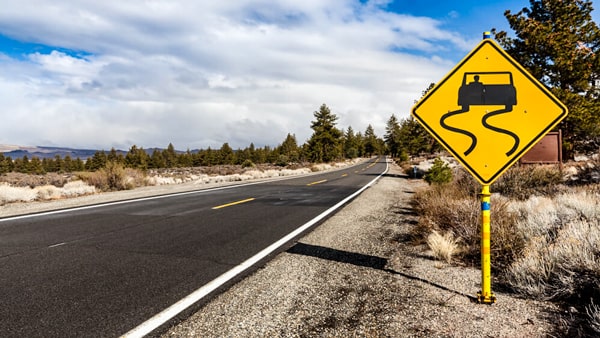
Which driving technique is safest when the roadway is slick?

When roads are slippery, you should:
  1. A Look a shorter distance ahead
  2. B Brake firmly to test tire traction
  3. C Reduce speed and make steering and braking movements gradually
  4. D Maintain dry-road speed but increase engine power

Correct answer: C – Reduce speed and make steering and braking movements gradually

Wet, snowy, or icy surfaces reduce the traction available for steering and braking. Slow down, increase following distance, and avoid slamming on the brakes or turning suddenly. Smooth control movements help the tires maintain contact and grip while conditions are slippery.

Source: Pennsylvania Driver’s Manual — Ch. 3, “Road Conditions,” “Wet Pavements,” and “Snow and Ice”

Question 6

A vehicle’s blind spot is an area that:

  1. A Is directly visible through the rear window
  2. B Appears clearly in the rearview mirror
  3. C Appears clearly in a properly adjusted side mirror
  4. D Cannot be seen without moving your head to check it

Correct answer: D – Cannot be seen without moving your head to check it

A blind spot is an area around a vehicle the driver cannot see without moving their head. Before changing lanes, check the rearview and side mirrors and briefly look over the appropriate shoulder. Do not rely on mirrors or sensors alone.

Source: Pennsylvania Driver’s Manual — Ch. 3, “Keep Your Vehicle Where It Can Be Seen” and “Looking Behind”