Pennsylvania Permit Test Practice 3

4.9 out of 5 (163 votes)
80% Passing score
20 Questions
4 Mistakes allowed
Pennsylvania’s permit test is one of those first official steps that feels small until you realize it controls everything that comes after it. You cannot apply for a non-commercial learner’s permit before your 16th birthday, and once you do apply, the state expects the usual paperwork, the vision screening, the fee, and the knowledge test. So the PA permit practice test is not just something to click through because it is free—although, yes, free helps. It is a way to get comfortable with the rules before they are being asked in that flat, official testing-room style. This Pennsylvania permit practice test includes 20 questions, with 16 correct answers needed to pass. The format is simple enough, but the material deserves real attention. You will see questions tied to Pennsylvania road rules, safe driving habits, traffic laws, and things new drivers sometimes skim past too quickly, like the state’s ban on handheld mobile device use while driving. That matters on I-76, on a two-lane road outside Lancaster, in Pittsburgh traffic, or wherever else someone suddenly decides their text message is more important than staying in their lane. The test also gives you a little backup while you work through it. Hints are there when a question starts to feel slippery, and explanations appear when you miss one, which is where a lot of the learning actually happens. A wrong answer with a clear explanation is more useful than a lucky guess, even if the lucky guess feels better for about four seconds. Then there is the licensing process, which is its own little stack of requirements. A Pennsylvania learner’s permit is valid for 1 year. If you are under 18, you must hold that permit for at least 6 months before the road test and complete 65 hours of supervised driving practice, including 10 hours at night and 5 hours in bad weather. While driving with a permit, you need a licensed supervising driver beside you—usually someone at least 21, though certain licensed parents, guardians, spouses, or people in loco parentis who are at least 18 may qualify. After the road test, teen drivers move into the junior driver’s license stage, with limits on late-night driving and young passengers. An unrestricted license usually comes at 18, unless a teen qualifies earlier by completing approved driver education, keeping a clean record for 12 months, and submitting the required DL-59 paperwork. In other words, the permit test is not the whole story. It is just the gate at the front, and this PA learners permit practice test helps you walk up to it knowing what you are doing.
FREE DMV Practice Test App
Study for your Pennsylvania permit test or driver’s license with the NextDoorDriving app. 700+ DMV questions and answers, 100% free!
Download on the App Store

Sample Pennsylvania Permit Test Questions

Question 1

At a Pennsylvania intersection with a steady red light, when may you turn right?

  1. A After stopping and yielding, unless a sign prohibits the turn
  2. B Whenever a red right-turn arrow is displayed
  3. C Only when turning from the left lane
  4. D After slowing without coming to a complete stop

Correct answer: A – After stopping and yielding, unless a sign prohibits the turn

Before turning right on red, stop at the marked stop line, before the crosswalk, or before entering the intersection when neither is present. The turn is allowed unless a sign prohibits it. You must yield to pedestrians in an adjacent crosswalk and to traffic lawfully using the intersection.

Source: 75 Pa.C.S. § 3112(a)(3)(i), (ii) – Traffic-control signals
Question 2

Before opening the traffic-side door of a parked vehicle, what must you verify?

  1. A Opening it is reasonably safe and will not interfere with traffic
  2. B Approaching drivers have enough room to stop for the open door
  3. C You have given a left-turn hand signal
  4. D You have sounded the horn

Correct answer: A – Opening it is reasonably safe and will not interfere with traffic

A vehicle door may not be opened until doing so is reasonably safe and will not interfere with moving traffic. Check behind and alongside the vehicle before opening a traffic-side door. The door also may not be left open to traffic longer than necessary for passengers to enter or leave.

Source: 75 Pa.C.S. § 3705 – Opening and closing vehicle doors

Question 3

Another motorist cuts into your lane ahead of you. If there is no immediate emergency, you should:

If another driver "cuts" in front of you, it would be better if you:
  1. A Let the motorist proceed and increase the space ahead
  2. B Brake suddenly to express your displeasure
  3. C Accelerate and try to pass immediately
  4. D Follow closely and sound your horn

Correct answer: A – Let the motorist proceed and increase the space ahead

The defensive response is to let the incident go rather than retaliate. Reestablishing a safe following distance gives you more time to react if traffic slows. Sudden braking, aggressive acceleration, or close following can reduce your available space and escalate the situation.

Source: Pennsylvania Driver’s Manual — Ch. 3, “Dealing With Aggressive Drivers”, Pennsylvania Driver’s Manual — Ch. 3, “Managing Space”

Question 4

When passing a large truck traveling in the center lane of a three-lane highway, you should:

  1. A Pass on the left without lingering beside it, then move ahead when safely clear
  2. B Remain beside the truck in the left lane
  3. C Pass on the right and stay near the trailer
  4. D Drive slowly in the truck’s side blind spot

Correct answer: A – Pass on the left without lingering beside it, then move ahead when safely clear

A truck has large blind spots along both sides, and you should not remain beside it longer than necessary. Use the left passing lane when it is safe and complete the pass without lingering. Return to the lane only after you can see the truck’s front or headlights in your rearview mirror.

Source: Pennsylvania Driver’s Manual — Ch. 3, “Passing a Truck”

Question 5

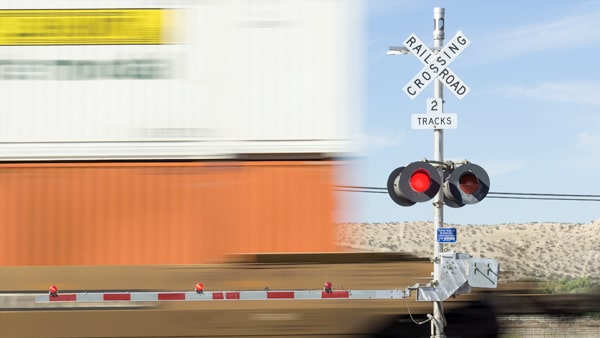
After a train clears a railroad crossing, what should you do before proceeding?

After a train has passed, you should:
  1. A Wait for a standard traffic light to turn green
  2. B Enter the crossing immediately
  3. C Sound the horn and drive across
  4. D Check again for another train, then cross only when clear

Correct answer: D – Check again for another train, then cross only when clear

Do not begin crossing immediately after one train passes. At a multiple-track crossing, wait until you have a clear view along all tracks and check for another approaching train. The manual also directs drivers to check again at a single-track crossing before proceeding.

Source: Pennsylvania Driver’s Manual — Ch. 3, “Railroad Crossings”

Question 6

Under Pennsylvania law, which occupants age 18 or older must wear seat belts in a passenger car?

  1. A Only a driver who is younger than 21
  2. B The driver and each front-seat occupant
  3. C Only passengers seated in the rear
  4. D Only occupants traveling at highway speeds

Correct answer: B – The driver and each front-seat occupant

Adult drivers and front-seat occupants must wear properly adjusted and fastened seat belts, subject to listed statutory exceptions. Occupants age eight or older but under 18 must be secured regardless of seating position. Violating § 4581(a)(2) is a summary offense carrying a $10 fine; an adult-seat-belt conviction requires another simultaneous Vehicle Code conviction.

Source: 75 Pa.C.S. § 4581(a)(2), (b) – Restraint systems