Pennsylvania Learners Permit Practice Test 7

4.9 out of 5 (96 votes)
80% Passing score
20 Questions
4 Mistakes allowed
The PA PennDOT learners test is short, but it is not especially forgiving. The real Pennsylvania knowledge test has 18 multiple-choice questions, and you need 15 correct answers to pass. So there is a little breathing room, sure, but not enough to wander in half-prepared and hope the road signs carry the whole performance. This Pennsylvania permit practice test gives you a practical way to rehearse the material before you sit for the real thing. It covers the areas PennDOT expects new drivers to know: traffic signs, Pennsylvania driving laws, safe-driving practices, insurance requirements, and the legal details that tend to sound minor until they show up in a question. Carrying proof of insurance, for example, is not just paperwork cluttering up a glove box. It is tied to Pennsylvania’s financial responsibility rules, which means it belongs in your study pile whether it feels exciting or not. Mostly not, but still. Use this PA DMV learners permit practice test as a study tool, not as a lucky charm. A strong score tells you your prep is probably moving in the right direction. A rough score is not a disaster; it is more like the test quietly pointing at the chapters you skimmed too fast. Right-of-way, warning signs, pavement markings, night driving, bad-weather safety — those topics are all fair game, and they are exactly where “I think I know this” can turn into a very confident wrong answer. The licensing process has its own fine print as well. In Pennsylvania, you can apply for a learner’s permit at 16. If you are under 18, you must hold the permit for 6 months and complete 65 hours of supervised practice, including 10 hours at night and 5 hours in bad weather, before moving toward the road test. After that comes the junior license stage, with an 11 p.m. to 5 a.m. nighttime restriction and limits on non-family passengers under 18. In other words, the permit test is only the first gate, but it is still a gate. This PA learners license practice test keeps your prep current for 2026 and varied enough that you are not just memorizing a cozy little loop of repeat answers. Pair it with the Pennsylvania drivers handbook, road sign charts, and a few rounds of flashcards, and the real test should feel a lot less like a surprise inspection.
FREE DMV Practice Test App
Study for your Pennsylvania permit test or driver’s license with the NextDoorDriving app. 700+ DMV questions and answers, 100% free!
Download on the App Store

Sample Pennsylvania Permit Test Questions

Question 1

On a two-way, two-lane road, what does a single broken yellow centerline mean?
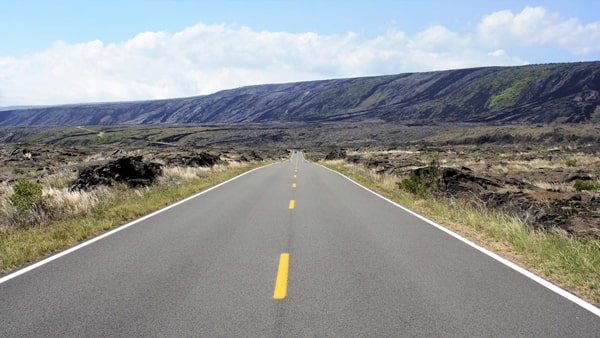
A broken yellow center line on the roadway means:
  1. A. Passing is prohibited in both directions
  2. B. Drivers on either side may pass when conditions are safe
  3. C. Drivers must reduce speed before crossing the line
  4. D. Turning across the centerline is prohibited

Correct answer: B. – Drivers on either side may pass when conditions are safe

A single broken yellow line marks the center of a two-way, two-lane road. Passing is permitted for traffic on either side when safe conditions exist. Because a passing driver must temporarily use a lane assigned to oncoming traffic, the driver must verify that the roadway ahead is clear before crossing the line.

Source: Pennsylvania Driver's Manual — Ch. 2, “Pavement Markings”
Question 2

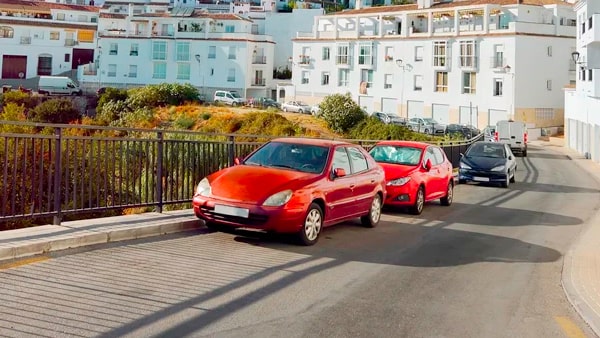
When parking uphill next to a curb, where should your front wheels point?

When parking your vehicle facing uphill with a curb, you should point your front wheels:
  1. A. Toward the curb
  2. B. Away from the curb
  3. C. In either direction
  4. D. Straight ahead

Correct answer: B. – Away from the curb

When parking uphill with a curb, turn the steering wheel left so the front wheels point away from the curb. Secure the vehicle by setting the parking brake and placing an automatic transmission in Park. The law also requires a vehicle left on a grade to have its wheels turned toward the curb or side of the highway to impede movement.

Source: 75 Pa.C.S. § 3701(a) – Unattended motor vehicle, Pennsylvania Driver's Manual — Ch. 3, “Parking”

Question 3

Which actions should you take if a tire blows out while you are driving?

  1. A. Hold the steering wheel firmly and steer smoothly
  2. B. Ease off the accelerator and brake gently only if braking becomes necessary
  3. C. Let the vehicle slow and move completely off the road at a safe location
  4. D. All of the above

Correct answer: D. – All of the above

Grip the steering wheel tightly, steer smoothly, and slowly remove your foot from the accelerator. Avoid braking immediately because braking after a blowout can cause a skid and loss of control. If braking becomes necessary, apply the brakes gently. Allow the vehicle to slow and pull completely off the road before stopping to change the tire or seek assistance.

Source: Pennsylvania Driver's Manual — Ch. 3, “If You Have a Tire Blowout”

Question 4

Which of these is not a safe driving practice?

  1. A. Keeping at least a four-second following distance on dry pavement
  2. B. Staring continuously at the center of the road ahead
  3. C. Using low-beam headlights in unfavorable weather
  4. D. Maintaining a space cushion around the vehicle

Correct answer: B. – Staring continuously at the center of the road ahead

Pennsylvania’s manual recommends scanning the entire roadway rather than staring at its center. Your search should include the road ahead, both sides, mirrors, and blind spots when appropriate. It also recommends a four-second following distance on dry pavement and a space cushion around the vehicle. Low beams improve visibility in rain, snow, fog, and similar conditions without creating the glare caused by high beams.

Source: Pennsylvania Driver's Manual — Ch. 3, “Managing Space”, Pennsylvania Driver's Manual — Ch. 3, “Driving At Night”

Question 5

Under Pennsylvania law, when may a motor vehicle cross a sidewalk area?

You may drive across a sidewalk to:
  1. A. To avoid a traffic-calming device
  2. B. When using a permanent or duly authorized temporary driveway
  3. C. To complete a U-turn
  4. D. To pass stopped traffic

Correct answer: B. – When using a permanent or duly authorized temporary driveway

Motor vehicles generally may not be driven on a sidewalk or sidewalk area. The statutory exception permits a vehicle to use a permanent or duly authorized temporary driveway that crosses the sidewalk. When entering or leaving an alley, building, private road, or driveway, the driver must yield to pedestrians approaching on the sidewalk that extends across the entrance.

Source: 75 Pa.C.S. § 3703(a) – Driving upon sidewalk, 75 Pa.C.S. § 3547 – Right-of-way of pedestrians on sidewalks

Question 6

What must you do when approaching an intersection displaying a flashing red signal?

If you are approaching an intersection with a red flashing light, what should you do?
  1. A. Proceed without reducing speed
  2. B. Slow down and yield without stopping
  3. C. Wait for the signal to display steady green
  4. D. Come to a complete stop and proceed when it is safe

Correct answer: D. – Come to a complete stop and proceed when it is safe

A flashing red signal requires a complete stop in the same manner as a stop sign. After stopping, yield to vehicles in or approaching the intersection closely enough to create a hazard. Enter only when the intersection can be crossed safely. A flashing red signal does not require you to wait for a steady green indication.

Source: 75 Pa.C.S. § 3114(a)(1) – Flashing signals, 75 Pa.C.S. § 3323(b) – Stop signs and yield signs