Pennsylvania Permit Test Simulator

4.5 out of 5 (646 votes)
83% Passing score
18 Questions
3 Mistakes allowed
Pennsylvania’s permit test is brief, but brief does not mean casual. You get 18 multiple-choice questions, and PennDOT expects at least 15 correct answers before it issues a learner’s permit. That leaves room for only three mistakes, which is not a lot when the questions are pulling from traffic signs, Pennsylvania driving laws, and safe-driving habits that all start to sound a little too familiar after a while. The better way to study is to treat the test like a very small exam with very little padding. A solid Pennsylvania permit practice test should not feel like generic driving trivia. It should press on the same things the real knowledge test does: road signs, sign shapes and colors, right-of-way rules, lane markings, traffic signals, pavement markings, speed decisions, and those plain little safety rules that seem obvious until PennDOT phrases them in its own dry, official way. And, just to clear up a common bit of confusion, Pennsylvania does not use a separate road-sign-only passing score for the standard non-commercial learner’s permit test. Road signs are folded into the regular 18-question knowledge test. So yes, study the signs, but do not study them in a vacuum while ignoring the law-and-safety questions sitting right beside them. Before test day, the paperwork deserves real attention. It is boring, absolutely, but it is also where people lose time. First-time applicants need the completed DL-180, proof of identity and date of birth, Social Security documentation or an acceptable alternative, the required fee, and any original name-change documents if their current name does not match their identity document. Applicants under 18 also need the DL-180TD consent form. Adults 18 and older need two proofs of Pennsylvania residency. So the smart move is steady practice, not frantic overstudying. Work through questions, read the explanations when you miss one, and pay extra attention to the details that feel almost too small to matter. On this test, they do matter. Fifteen correct answers gets you through; guessing your way around Pennsylvania-specific rules is where the wheels start to wobble a bit.
FREE DMV Practice Test App
Study for your Pennsylvania permit test or driver’s license with the NextDoorDriving app. 700+ DMV questions and answers, 100% free!
Download on the App Store

Sample Pennsylvania Permit Test Questions

Question 1

What does a BIKE LANE pavement marking mean in Pennsylvania?

  1. A Motor vehicles may use the lane during rush hour
  2. B The lane is reserved for bicyclists rather than ordinary motor-vehicle travel
  3. C The lane is reserved for motorcycles
  4. D The lane may be used for unrestricted parking

Correct answer: B – The lane is reserved for bicyclists rather than ordinary motor-vehicle travel

The Pennsylvania manual identifies a marked BIKE LANE as a lane reserved for bicyclists. It is not an ordinary travel lane for motor vehicles. Drivers should observe the markings and watch carefully for bicyclists wherever their paths may cross.

Source: Pennsylvania Driver’s Manual — Ch. 2, “Pavement Markings”
Question 2

A school bus is stopped ahead on your side of the road with red lights flashing and its stop arm extended. You must:

  1. A Stop at least 10 feet away and remain stopped as required
  2. B Change lanes and pass at a reduced speed
  3. C Stop only until the last child leaves the bus
  4. D Proceed unless the bus driver signals you to stop

Correct answer: A – Stop at least 10 feet away and remain stopped as required

Stop at least 10 feet before reaching the school bus. Remain stopped until the flashing red lights are no longer operating, and do not resume movement until children who left the bus have reached a place of safety. A signal from the bus driver does not replace these statutory conditions.

Source: 75 Pa.C.S. § 3345(a) – Meeting or overtaking school bus, Pennsylvania Driver’s Manual — Ch. 3, “School Buses”

Question 3

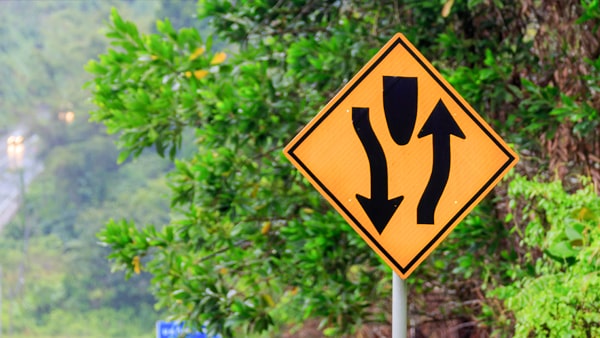
A yellow warning sign showing a median beginning ahead means:

This sign means:
  1. A The divided highway ends
  2. B A one-way street begins
  3. C A one-way street ends
  4. D The divided highway begins

Correct answer: D – The divided highway begins

The DIVIDED HIGHWAY BEGINS sign warns that opposing traffic will soon be separated by a median or divider. Each side of the divided highway carries traffic in one direction. Keep to the right of the divider as you enter the divided section.

Source: Pennsylvania Driver’s Manual — Ch. 2, “Warning Signs: Divided Highway Begins”

Question 4

In an alcohol-related investigation, a chemical test of breath or blood is used to determine:

  1. A The driver’s reaction time
  2. B The alcoholic content of the driver’s blood
  3. C The driver’s visual acuity
  4. D The driver’s general vehicle-handling skill

Correct answer: B – The alcoholic content of the driver’s blood

Pennsylvania’s chemical-testing statute authorizes breath or blood testing to determine the alcoholic content of a person’s blood. The resulting concentration may be used as evidence in a DUI proceeding. Chemical blood testing may also be used to identify the presence or amount of a controlled substance, but it does not directly measure reaction time, eyesight, or driving skill.

Source: 75 Pa.C.S. § 1547(a), (c) – Chemical testing to determine amount of alcohol or controlled substance, Pennsylvania Driver’s Manual — Ch. 4, “Pennsylvania’s Implied Consent Law (Chemical Testing for Alcohol or Drugs)”

Question 5

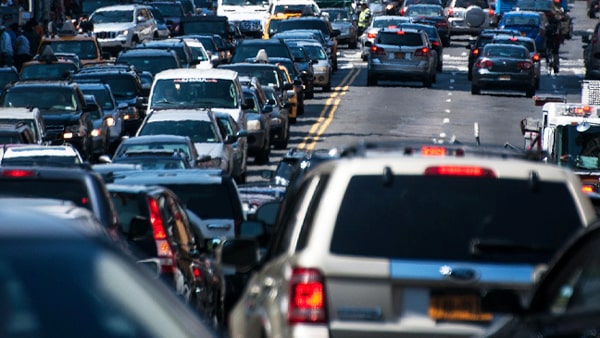
Which travel choice can reduce the number of individual vehicles contributing to traffic congestion?

Choose the situation that would have the best impact on reducing traffic congestion:
  1. A Taking public transportation
  2. B Following other vehicles more closely
  3. C Reducing your space cushion
  4. D Driving during the busiest travel period

Correct answer: A – Taking public transportation

The Pennsylvania Driver’s Manual lists public transportation as one way to drive less. A transit trip can replace a separate trip in a personal vehicle, reducing individual vehicle travel. Following closely or reducing your space cushion does not provide that benefit and creates an unsafe following distance.

Source: Pennsylvania Driver’s Manual — Ch. 3, “Eco-Driving”

Question 6

Under Pennsylvania law, which position is generally prohibited as double parking?

  1. A Within 12 inches of a curb where parking is permitted
  2. B In the direction authorized for traffic
  3. C On the roadway side of a vehicle stopped or parked at the curb
  4. D Inside a lawful marked parking space

Correct answer: C – On the roadway side of a vehicle stopped or parked at the curb

State law generally prohibits stopping, standing, or parking on the roadway side of a vehicle at the curb. Limited exceptions include disabled vehicles and loading or unloading authorized by local ordinance. A violation of Section 3353 is a summary offense punishable by a fine of up to $50.

Source: 75 Pa.C.S. § 3353(a)(1)(i), (e) – Prohibitions in specified places, 75 Pa.C.S. § 3351(b) – Stopping, standing and parking outside business and residence districts