


Pennsylvania Road Signs Permit Test 2

4.9 out of 5 (73 votes)
80% Passing score
20 Questions
4 Mistakes allowed
Pennsylvania’s learner’s permit knowledge test gives you 18 multiple-choice questions, and PennDOT expects 15 correct answers before it will issue a learner’s permit. That leaves room for only 3 misses, which is enough breathing space, technically, but not so much that road signs can be treated like background decoration. They are part of the test, part of the Driver’s Manual, and, inconveniently, part of every actual drive you will take after the test is over. This PA practice permit test is built around road signs, signals, pavement markings, lane markings, and the everyday rules hiding inside them. Some questions may seem familiar at first — red signs for restrictions, yellow signs for warnings, green signs for directions and guidance — but the useful part is learning how those meanings hold up when the answer choices are close together. A regulatory sign is not just “one of those official-looking signs.” A warning sign is not just “probably something ahead.” PennDOT’s test rewards people who know the difference, and it does not give much credit for vague confidence. There is not a separate road-sign-only passing score on the standard non-commercial Pennsylvania knowledge test. Road sign questions count inside the full 18-question exam, along with Pennsylvania driving laws and safe-driving practices. Still, practicing signs on their own is smart, because this is where a lot of test-takers discover they know the shape of a sign better than they know what it actually requires them to do. That gap matters. A sign question can be simple, and then — there it is — a tiny wording difference that changes the answer. Before taking the official test, make sure the paperwork side is handled too. PennDOT requires the completed DL-180 application, proof of date of birth and identification, an original Social Security card or accepted alternative, the proper fee, and original legal name-change documents if your current name does not match your identity document. Applicants under 18 also need the DL-180TD parent or guardian consent form. Applicants 18 and older need two proofs of Pennsylvania residency. Use this Pennsylvania road signs test as focused preparation, not filler practice. It gives you a realistic way to review the signs and markings that PennDOT expects you to understand, while also building the kind of recognition you need when the same signs show up outside the testing center, surrounded by traffic and everyone else’s questionable decisions.
FREE DMV Practice Test App
Study for your Pennsylvania permit test or driver’s license with the NextDoorDriving app. 700+ DMV questions and answers, 100% free!
Download on the App Store

Sample Pennsylvania Permit Test Questions

Question 1

In Pennsylvania, a green arrow displayed with a red circular signal means that you:

  1. A Must remain stopped even when traveling in the arrow’s direction
  2. B Must wait for the circular signal to become green
  3. C May make the movement shown by the arrow after yielding as required
  4. D Must follow the arrow because the roadway ahead is closed

Correct answer: C – May make the movement shown by the arrow after yielding as required

A green arrow permits entry into the intersection for the movement indicated by the arrow. You must yield to pedestrians lawfully in an adjacent crosswalk and to other traffic lawfully using the intersection. The red circular indication continues to control movements that are not authorized by the green arrow or another signal indication.

Source: 75 Pa.C.S. § 3112(a)(1)(ii) – Traffic-control signals, Pennsylvania Driver’s Manual — Ch. 2, “Red, Yellow, and Green Traffic Lights and Arrows”

Question 2

What does a steady downward green arrow displayed over a travel lane mean?

This green arrow on a lane use control signal means that:
  1. A Traffic may use the lane
  2. B Traffic may not enter the lane
  3. C Traffic in the lane has priority over everyone else
  4. D All nearby traffic must merge into the lane

Correct answer: A – Traffic may use the lane

A steady downward green arrow over a lane indicates that traffic may travel in that lane. By contrast, a red “X” means drivers may not enter or travel in the lane. These overhead signals are commonly used where lane availability or direction can change according to traffic conditions.

Source: 75 Pa.C.S. § 3115 – Lane-direction-control signals, Pennsylvania Driver’s Manual — Ch. 2, “Lane Use Control Signals”

Question 3

Under Pennsylvania guidance, when may a driver cross a single solid white line?

  1. A At any time without checking surrounding traffic
  2. B When making a permitted turn and the movement can be made safely
  3. C Whenever passing a slower vehicle
  4. D Only when making a U-turn

Correct answer: B – When making a permitted turn and the movement can be made safely

Solid white lines divide lanes traveling in the same direction or mark the roadway edge. The driver’s manual states that solid traffic lines generally should not be crossed except when making a turn. Any turn or lane movement must still be permitted, properly signaled, and made only after the driver verifies that it can be completed safely.

Source: 75 Pa.C.S. § 3334(a) – Turning movements and required signals, Pennsylvania Driver’s Manual — Ch. 2, “Pavement Markings”

Question 4

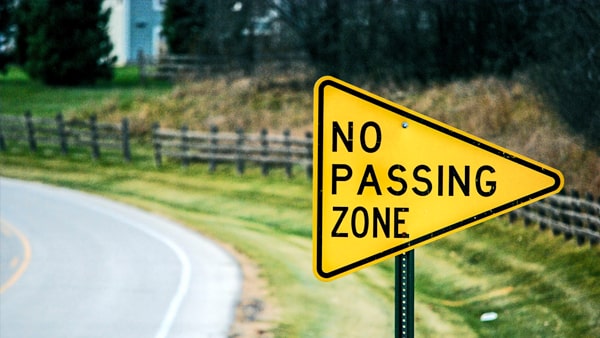
What does a yellow, pennant-shaped sign posted on the left side of the roadway mark?

The sign with this shape and color is a _____________ sign.
  1. A The beginning of a no-passing zone
  2. B The beginning of a wrong-way roadway
  3. C A railroad crossing
  4. D A required stop

Correct answer: A – The beginning of a no-passing zone

The yellow pennant sign marks the beginning of a no-passing zone and faces drivers from the left side of the roadway. Drivers must obey visible signs and pavement markings that define such a zone. Except for a lawful pass of a pedalcycle under the applicable statutory conditions, drivers may not travel left of the no-passing marking within the zone.

Source: 75 Pa.C.S. § 3307 – No-passing zones, Pennsylvania Driver’s Manual — Ch. 2, “No Passing Zone”

Question 5

Why is a turn controlled by a steady green arrow described as a protected turn?

  1. A Pedestrians and vehicles already in the intersection must yield to you
  2. B Oncoming traffic is stopped by a red signal
  3. C You may turn without observing the intersection
  4. D All of the above

Correct answer: B – Oncoming traffic is stopped by a red signal

The Pennsylvania Driver’s Manual describes a steady green-arrow turn as protected because oncoming traffic is stopped by a red signal. The arrow permits movement only in its indicated direction. You must still yield to pedestrians lawfully within an adjacent crosswalk and to any other traffic lawfully using or clearing the intersection.

Source: 75 Pa.C.S. § 3112(a)(1)(ii) – Traffic-control signals, Pennsylvania Driver’s Manual — Ch. 2, “Red, Yellow, and Green Traffic Lights and Arrows”

Question 6

What colors are normally used for highway guide signs showing destinations, exits, or distances?

  1. A Yellow with black lettering
  2. B Black with white lettering
  3. C Red with white lettering
  4. D Green with white lettering

Correct answer: D – Green with white lettering

Highway and expressway guide signs are normally green with white letters. They identify destinations, routes, upcoming exits, and other navigation information. Advance guide signs may also show the distance to an exit so drivers have time to move into the appropriate lane.

Source: Pennsylvania Driver’s Manual — Ch. 2, “Highway/Expressway Guide Signs”