Pennsylvania DMV Sign Test 3

5 out of 5 (75 votes)
80% Passing score
20 Questions
4 Mistakes allowed
Pennsylvania road signs are only one part of the learner’s permit knowledge test, but they are not a throwaway part. PennDOT includes traffic signs alongside Pennsylvania driving laws and safe-driving practices on the official exam, so this Pennsylvania road signs test gives you a focused way to practice the stuff that tends to show up in real driving and, yes, on test day too. The actual PA permit test has 18 multiple-choice questions, and you need 15 correct answers to pass. That means you can miss up to 3. Not a lot, really, especially when a sign question seems obvious at first glance and then the answer choices start sounding a little too similar. This PA permit practice test keeps the focus on road sign recognition: shapes, colors, warning signs, regulatory signs, guide signs, traffic signals, pavement markings, lane markings—the visual language PennDOT expects you to read without needing a long internal debate every time. And the shapes matter more than people usually admit. An octagon is doing a very different job from a diamond-shaped warning sign. Rectangular signs often carry instructions or information, while color can tell you whether a sign is warning you, regulating you, guiding you, or trying to get your attention before you make a very avoidable mistake. That is the quiet little trick with road signs: they are designed to be understood fast, not admired slowly. There is no separate road-sign-only passing score for a standard Pennsylvania non-commercial learner’s permit. Sign questions count inside the same 18-question knowledge test, with the same 15-correct requirement. So this practice permit test is best used as targeted prep, especially if you already know the general rules but want more confidence with the sign portion. You can take this road sign recognition test without a timer, without the stiff Driver License Center feeling, and without making one wrong answer feel like the end of the whole process. Retake it, slow down, read the explanations, notice the patterns. Before PennDOT issues a learner’s permit, you still need to pass the vision screening and knowledge test, but getting comfortable with signs now makes the official exam feel a lot less like guesswork and a lot more like something you already know how to handle.
FREE DMV Practice Test App
Study for your Pennsylvania permit test or driver’s license with the NextDoorDriving app. 700+ DMV questions and answers, 100% free!
Download on the App Store

Sample Pennsylvania Permit Test Questions

Question 1

Before entering an intersection on a green light, why should you scan both directions?

  1. A Cross traffic may still be present or a driver may fail to yield
  2. B You should look only straight ahead after entering
  3. C Cross traffic always receives a green arrow at the same time
  4. D Every pedestrian on the cross street must cross first

Correct answer: A – Cross traffic may still be present or a driver may fail to yield

A circular green signal permits you to proceed, but you must yield to vehicles and pedestrians lawfully within the intersection or an adjacent crosswalk. Pennsylvania guidance also emphasizes that another road user may fail to yield as required. Scan the intersection before entering and be prepared to avoid a conflict even though your signal is green.

Source: 75 Pa.C.S. § 3112(a)(1)(i) – Traffic-control signals, Pennsylvania Driver’s Manual — Ch. 3, “Negotiating Intersections”
Question 2

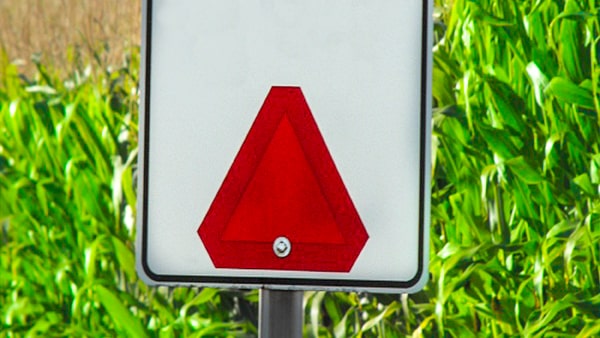
In Pennsylvania, what does a triangular emblem with a fluorescent orange center and red reflective border identify?

An orange and red sign of this shape always means:
  1. A A vehicle that must yield to all traffic
  2. B A vehicle having priority over other traffic
  3. C A slow-moving vehicle
  4. D An emergency vehicle stopped ahead

Correct answer: C – A slow-moving vehicle

This emblem identifies certain vehicles designed to operate at 25 mph or less, as well as animal-drawn vehicles traveling on a highway. The required emblem has a fluorescent yellow-orange triangle surrounded by a dark red reflective border. Its appearance warns approaching motorists that the vehicle may be traveling much more slowly than normal traffic.

Source: 75 Pa.C.S. § 4529(a), (b) – Slow moving vehicle emblem, 67 Pa. Code § 165.4 – Description

Question 3

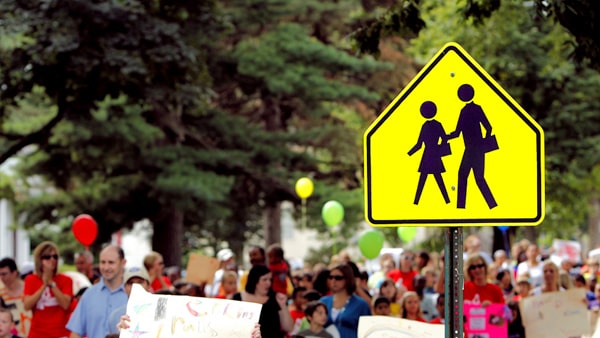
What does a five-sided yellow or fluorescent yellow-green sign showing schoolchildren mean?

This road sign means:
  1. A A stop sign is ahead
  2. B You are approaching a school zone
  3. C A shopping district is ahead
  4. D Pedestrians must remain on the sidewalk

Correct answer: B – You are approaching a school zone

The pentagon-shaped warning sign indicates that you are approaching a school zone. If it includes a downward-pointing arrow, it marks the location of a school crosswalk. Reduce your speed, watch carefully for children crossing the roadway, and stop when necessary.

Source: Pennsylvania Driver’s Manual — Ch. 2, “School”

Question 4

Which traffic signal requires a complete stop before you may proceed?

  1. A A flashing red light
  2. B A steady yellow light
  3. C A steady yellow arrow
  4. D A flashing yellow light

Correct answer: A – A flashing red light

A flashing red signal requires you to stop in the same manner as at a stop sign. Stop at the proper stop line, crosswalk, or viewing point, then yield to pedestrians and traffic that present a hazard. Enter the intersection only when it is safe; a flashing yellow signal requires caution but not an automatic stop.

Source: 75 Pa.C.S. § 3114(a) – Flashing signals, 75 Pa.C.S. § 3323(b) – Stop signs and yield signs

Question 5

On a Pennsylvania two-way road marked with one solid and one broken yellow line, when may you pass?

You may cross a double line to pass another vehicle if the line on your side is:
  1. A When the solid yellow line is next to your lane
  2. B Whenever the vehicle ahead is below the speed limit
  3. C When the broken line is next to your lane and conditions are safe
  4. D Only when the vehicle ahead signals you to pass

Correct answer: C – When the broken line is next to your lane and conditions are safe

You may pass when the broken yellow line is on your side and safe conditions exist. The left side must be visible and clear far enough ahead to complete the maneuver without interfering with approaching or overtaken traffic. You may not pass when the solid yellow line is next to your lane.

Source: 75 Pa.C.S. § 3305 – Limitations on overtaking on the left, Pennsylvania Driver’s Manual — Ch. 2, “Pavement Markings”

Question 6

What must you do when you approach a red, eight-sided STOP sign?

This sign means:
  1. A Slow down and stop only when another vehicle is approaching
  2. B Stop completely, yield as required, and proceed when safe
  3. C Continue cautiously if the intersection appears empty
  4. D Stop only for traffic approaching from the intersecting road

Correct answer: B – Stop completely, yield as required, and proceed when safe

Stop at the marked stop line or, if none exists, before entering the near crosswalk. If neither is present, stop where you can see approaching traffic before entering the intersection. Yield to pedestrians and to vehicles in or near the intersection that present a hazard, then proceed when it is safe.

Source: 75 Pa.C.S. § 3323(b) – Stop signs and yield signs, Pennsylvania Driver’s Manual — Ch. 2, “Regulatory Signs — Stop”