Pennsylvania Road Signs Test 4

4.9 out of 5 (68 votes)
80% Passing score
20 Questions
4 Mistakes allowed
This PA road signs test is meant to do one thing well: help you get faster and more certain with the signs, signals, and markings that show up in Pennsylvania permit prep. Not “sort of familiar.” Not “I saw that one in the manual somewhere.” Familiar enough that a stop sign, warning sign, lane marking, traffic signal, or guide sign does not make you pause and mentally flip through three almost-right answers. That pause is where people lose easy points. The practice test keeps the focus on the road sign material PennDOT expects you to know, including sign shapes, colors, regulatory signs, warning signs, guide signs, pavement markings, and lane markings. Some of it feels obvious when you are reading it casually. Fine. But the real value is in working through the questions more than once, because recognition gets much better when you have seen the same ideas asked in slightly different ways. That is the unglamorous part of studying, and, unfortunately, it works. On the actual Pennsylvania learner’s permit knowledge test, road signs are not a separate road-sign-only exam. They are part of the full PennDOT knowledge test, along with Pennsylvania driving laws and safe-driving practices. The official test has 18 multiple-choice questions, and you need 15 correct answers to pass. So yes, you can miss up to 3, but that is the entire cushion. A few careless guesses on sign meanings or traffic rules can use it up quickly. The permit test is taken as part of the learner’s permit application process at a PennDOT Driver License Center. Before Pennsylvania issues a valid learner’s permit, you need to pass the vision screening and the knowledge test. If you fail the knowledge test, you may retake it the following business day, which is better than waiting weeks, but still not exactly how anyone wants to spend another trip to PennDOT. After that, the process depends on your age and situation. First-time drivers need a learner’s permit before driving. Applicants under 18 also need parent or guardian consent, then must hold the permit for at least 6 months and complete 65 hours of supervised driving before the road test, including 10 hours at night and 5 hours in bad weather. Adults still start with the permit and road test path, but they are not subject to those teen practice-hour requirements. Certain out-of-state drivers may also need to apply for a Pennsylvania learner’s permit if their previous license has been expired for more than 6 months. So use this Pennsylvania practice permit test as the first layer of preparation. Get the signs settled first, then build outward into the full knowledge test and the rest of the licensing steps.
FREE DMV Practice Test App
Study for your Pennsylvania permit test or driver’s license with the NextDoorDriving app. 700+ DMV questions and answers, 100% free!
Download on the App Store

Sample Pennsylvania Permit Test Questions

Question 1

Which color lines separate traffic lanes moving in the same direction?

  1. A Yellow
  2. B White
  3. C Red
  4. D Black

Correct answer: B – White

White lines separate lanes carrying traffic in the same direction. Broken white lines may generally be crossed for a lane change when it is safe. Solid white lines discourage or restrict crossing and are also used to mark the right edge of the roadway.

Source: Pennsylvania Driver’s Manual — Ch. 2, “Pavement Markings”
Question 2

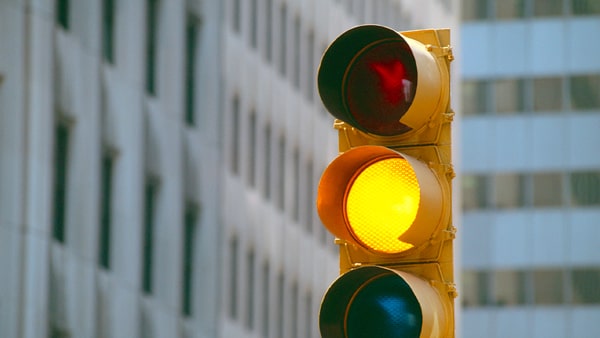
A steady green signal changes to yellow as you approach. What should you do?

As you near an intersection, the traffic light changes from green to yellow. Your best action would be to:
  1. A Accelerate to enter before the light turns red
  2. B Brake sharply regardless of your distance from the intersection
  3. C Enter the intersection and prepare to stop in its center
  4. D Slow down and prepare to stop before entering, if you can stop safely

Correct answer: D – Slow down and prepare to stop before entering, if you can stop safely

A steady yellow signal warns that the green indication is ending and a red indication will follow immediately. Slow down and prepare to stop before entering the intersection. If you are already within the intersection or cannot stop safely before entering, continue through cautiously rather than making an unsafe sudden stop.

Source: 75 Pa.C.S. § 3112(a)(2)(i) – Traffic-control signals, Pennsylvania Driver’s Manual — Ch. 2, “Red, Yellow, and Green Traffic Lights and Arrows”

Question 3

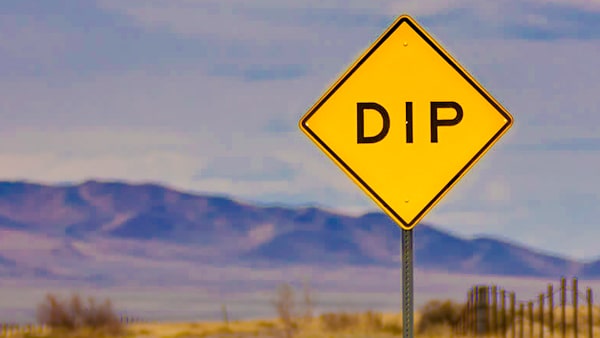
A yellow diamond-shaped sign marked “DIP” warns of:

This sign means:
  1. A A depression in the roadway ahead
  2. B A soft shoulder beside the roadway
  3. C A pedestrian crossing
  4. D A required complete stop

Correct answer: A – A depression in the roadway ahead

The DIP warning sign identifies a depression in the roadway ahead. Warning signs are placed in advance of roadway conditions that may require drivers to adjust. Reduce speed as conditions require and maintain control while traveling through the dip.

Source: 67 Pa. Code § 212.2 – Adoption of Federal standards, PennDOT Publication 236, Handbook of Approved Signs — W8-2, “DIP”, Pennsylvania Driver’s Manual — Ch. 2, “Warning Signs”

Question 4

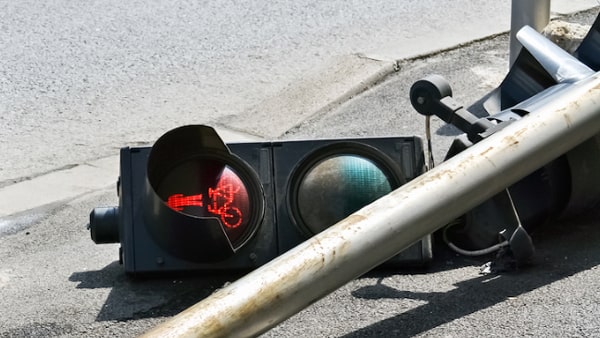
What must you do at an intersection where the traffic signal is completely dark?

When a traffic signal light is not working, you should:
  1. A Stop only when another vehicle is present
  2. B Slow down and stop only if cross traffic approaches
  3. C Stop as at a stop sign and proceed when right-of-way rules permit
  4. D Drive through as though the signal were green

Correct answer: C – Stop as at a stop sign and proceed when right-of-way rules permit

Under Pennsylvania law, traffic facing a completely unlighted or malfunctioning red signal must stop in the same manner as at a stop sign. After stopping, proceed only when the applicable right-of-way rules permit. The driver’s manual describes a nonfunctioning signal as a four-way stop.

Source: 75 Pa.C.S. § 3112(c)(2) – Traffic-control signals, Pennsylvania Driver’s Manual — Ch. 2, “Non-Functioning Traffic Lights”

Question 5

Your signal turns green, but vehicles still occupy the intersection. What should you do?

  1. A Wait until they clear and there is enough space for your vehicle
  2. B Enter if you can steer around the other vehicles
  3. C Move into the intersection and wait there
  4. D Sound your horn and enter slowly

Correct answer: A – Wait until they clear and there is enough space for your vehicle

Pennsylvania law requires traffic facing green to yield to vehicles and pedestrians lawfully within the intersection. A driver also may not enter unless sufficient space exists on the other side to accommodate the vehicle without causing an obstruction. Wait until the intersection clears and you can continue through it.

Source: 75 Pa.C.S. § 3112(a)(1)(i) – Traffic-control signals, 75 Pa.C.S. § 3710 – Stopping at intersection or crossing to prevent obstruction

Question 6

Which warning sign indicates that a roadway’s median or divider will end ahead?

  1. A LANE ENDS
  2. B DIVIDED HIGHWAY ENDS
  3. C TWO-WAY TRAFFIC AHEAD
  4. D TURN LEFT OR RIGHT

Correct answer: B – DIVIDED HIGHWAY ENDS

The DIVIDED HIGHWAY ENDS sign warns that the separated roadways and median will end ahead. Traffic will continue on an undivided roadway carrying vehicles in both directions. Stay to the right of the centerline and watch for oncoming traffic.

Source: Pennsylvania Driver’s Manual — Ch. 2, “Warning Signs: Divided Highway Ends”