Rhode Island Permit Test Practice

4.8 out of 5 (100 votes)
80% Passing score
20 Questions
4 Mistakes allowed
A good RI permit test practice should feel close enough to the real thing that it exposes what you actually know, not just what you sort of remember from skimming the manual. Rhode Island’s knowledge exam is based on the state Driver’s Manual, and the coverage is broader than a few stop signs and speed-limit questions. You can be tested on traffic laws, right-of-way, pavement markings, signals, impaired driving, safe following habits, and how to share the road with pedestrians, bicyclists, motorcycles, emergency vehicles, and large trucks. So, yes, the road signs matter. But they are not the whole story. This Rhode Island DMV practice test is designed around that bigger picture. The questions are multiple choice and focused on the same kinds of topics applicants need to know before heading to the DMV: RI driving laws, road signs, common traffic situations, licensing rules, and the small judgment calls that separate a lucky guess from real understanding. The official passenger-car question count and score are not clearly published on every DMV page, but the practical format commonly used for Rhode Island prep is 50 questions, with 40 correct answers needed to pass. That is an 80% score, which is a useful benchmark when you are deciding whether you are ready or merely feeling ready, which is not quite the same thing. There are a few process details worth keeping straight, because Rhode Island is particular about them. The computerized knowledge exam is given by reservation at the DMV headquarters in Cranston, and a vision screening is handled at the time of the exam. Computerized tests are available in English, Spanish, and Portuguese, while other foreign-language exams need to be requested ahead of time. Not complicated, exactly, but it is the kind of detail that can make test day smoother if you know it before you are standing there with paperwork in your hand. Teen applicants have extra requirements. If you are under 18, Rhode Island generally requires the 33-hour driver education course before a Limited Instruction Permit, and online driver education does not count for that requirement. Adults 18 and older skip the teen course, but still need the knowledge test, vision screening, documents, fees, and instruction permit. Use this practice permit test as a working study tool, not a decoration. Take it, miss a few, go back to the manual, and tighten up the weak spots before the DMV gets a turn.

FREE DMV Practice Test App
Study for your Rhode Island permit test or driver’s license with the NextDoorDriving app. 700+ DMV questions and answers, 100% free!
Download on the App Store

Sample Rhode Island Permit Test Questions

Question 1

If your accelerator sticks and you plan to switch off the ignition, when should you do so?

  1. A After steering completely off the roadway
  2. B Immediately, before shifting to neutral
  3. C While negotiating a sharp turn
  4. D As soon as the engine begins racing

Correct answer: A – After steering completely off the roadway

For a stuck accelerator, first try to free the pedal, shift to neutral while braking, and steer toward an open area off the roadway. The driver’s manual places turning off the ignition after the vehicle has followed that escape path off the road. Switching it off earlier can remove engine power while you still need to steer to safety.

Source: Rhode Island Driver’s Manual — V.E, “Stuck Accelerator”, Rhode Island Driver’s Manual — V.F, “Engine Failure”

Question 2

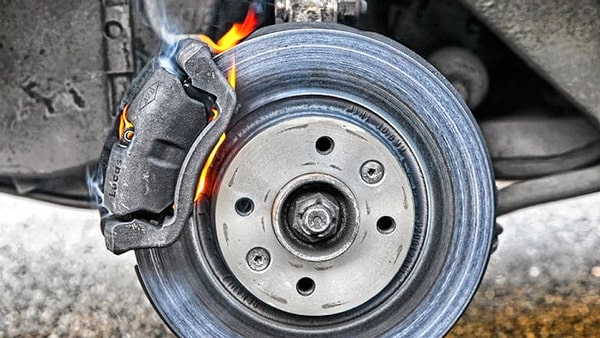
Which actions are recommended if the brake pedal suddenly goes to the floor?

If you experience brake failure while driving, you should:
  1. A Pump the brake pedal several times
  2. B Shift to a lower gear to use engine braking
  3. C Apply the parking brake carefully and steer toward an open area
  4. D All of the above

Correct answer: D – All of the above

During total brake failure, pump the brake pedal three or four times to determine whether pressure can be restored. Downshift to a lower gear to use the engine’s braking power. Engage the parking brake, releasing it briefly if the vehicle begins to skid, and search for an open area where the vehicle can be brought under control.

Source: Rhode Island Driver’s Manual — V.C, “Total Brake Failure”

Question 3

After a dry period, when can a roadway become especially slippery during rain?

The road surface is most slippery:
  1. A Only during a severe storm
  2. B After the rain has completely stopped
  3. C Just after the rain begins
  4. D Only when standing water becomes deep

Correct answer: C – Just after the rain begins

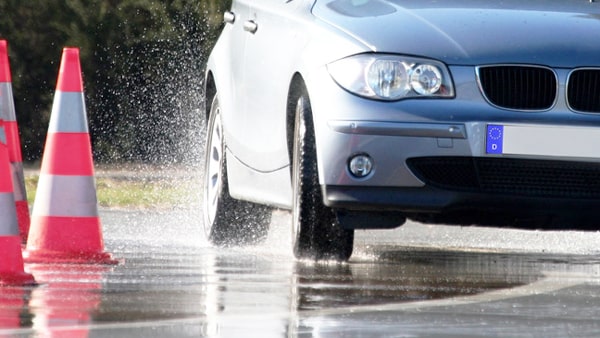
Right after rain begins, water mixes with oil left on the road by vehicles, making the surface particularly slippery. Continued rain can wash much of that oil away. Reduce speed when rain begins because reduced traction makes turning and stopping more difficult.

Source: Rhode Island Commercial Driver’s License Manual — § 2.6.2, “Matching Speed to the Road Surface”

Question 4

What does a flashing yellow traffic signal require?

  1. A Merge with traffic immediately
  2. B Proceed through or past the signal with caution
  3. C Stop for every pedestrian near the roadway
  4. D Make a complete stop before proceeding

Correct answer: B – Proceed through or past the signal with caution

A flashing yellow signal is a caution signal. Drivers may proceed through the intersection or past the signal, but they must do so cautiously. The driver’s manual recommends slowing, covering the brake, and checking conditions before continuing.

Source: R.I. Gen. Laws § 31-13-9(2) – Flashing signals, Rhode Island Driver’s Manual — Traffic Signals, “Flashing Yellow Light”

Question 5

When your route crosses railroad tracks, which action must you avoid?

  1. A Looking and listening for an approaching train
  2. B Waiting while warning signals are active
  3. C Trying to cross or turn over the tracks ahead of an approaching train
  4. D Obeying a lowered crossing gate

Correct answer: C – Trying to cross or turn over the tracks ahead of an approaching train

Never attempt to beat an approaching train across a railroad crossing. Active warning signals, a lowered gate, a flagger, or a visibly approaching train require a driver to stop and wait until proceeding is safe. Trains need considerable distance to stop and cannot leave the rails to avoid a vehicle blocking the crossing.

Source: R.I. Gen. Laws § 31-20-1 – When railroad crossing stops required of all vehicles, Rhode Island Driver’s Manual — V.L, “Vehicle Stalls on Railroad Tracks”

Question 6

Before passing in the oncoming lane of a two-lane road, what should you evaluate?

When passing in the oncoming traffic lane of a two-lane road, you should consider:
  1. A Whether you can complete the pass without exceeding the speed limit
  2. B Whether enough clear roadway is available to pass and return safely
  3. C The location of oncoming traffic, curves, hills, intersections, and other hazards
  4. D All of the above

Correct answer: D – All of the above

A passing driver must verify that the left side is visible and free of oncoming traffic for enough distance to complete the maneuver safely. The driver must return to the right before coming within 100 feet of an approaching vehicle. Adequate space, roadway hazards, vehicle performance, and compliance with the speed limit all affect whether the pass can be completed safely.

Source: R.I. Gen. Laws § 31-15-6 – Clearance for overtaking, R.I. Gen. Laws § 31-15-7 – Places where overtaking prohibited, Rhode Island Driver’s Manual — III.J, “Passing Another Vehicle”