Rhode Island DMV Permit Test Practice 2

4.9 out of 5 (67 votes)
80% Passing score
20 Questions
4 Mistakes allowed
Rhode Island’s permit test rewards people who study the actual rules, not people who skim a few road-sign flashcards and hope the rest sorts itself out. This RI practice permit test is built around that idea. It gives you 20 questions covering the kinds of details that matter on the computerized knowledge exam and, more importantly, on the road: seat belt use for every occupant, safe signaling, yielding, traffic signs, following distance, and Rhode Island’s rule against handheld device use while driving. The useful part is not just getting a score at the end, although that helps. It is seeing where your understanding gets thin. Maybe you know the obvious signs but hesitate on right-of-way. Maybe you remember the seat belt rule for the driver but forget that Rhode Island requires all occupants to buckle up. That sort of gap is small, technically, but small gaps have a way of becoming missed questions when the wording is dry and official and not especially forgiving. For applicants under 18, the process has its own rhythm. Rhode Island uses the Graduated Licensing system, and teens must complete the required 33-hour driver education course before applying for a Limited Instruction Permit. The DMV wants the original Driver’s Education Certificate, too — not a photocopy, not a “we can probably print another one later” situation. Students who complete driver education through CCRI may be able to take the test through the college. Teens who finish an approved course somewhere else generally need to bring their completion certificate to DMV headquarters in Cranston and take the computerized knowledge exam there. Adults follow a different route, and this is where people sometimes mix up the requirements. Rhode Island residents age 18 or older who have never had a Rhode Island driver’s license, or whose license has been expired for more than five years, must pass the knowledge exam to get an instruction permit. They do not need the 33-hour teen driver education course. After receiving a learner’s permit, an adult permit holder may be eligible for the road test after 30 days, and Rhode Island allows adults with permits to drive without supervision during that period. New residents, out-of-state drivers, and out-of-country applicants may face different document or testing requirements depending on their license status. So this DMV practice permit test is not a shortcut, and it is not pretending to be one. It is a cleaner way to review the rules, catch weak spots, and go into the Rhode Island DMV permit test knowing what you are actually ready for.
FREE DMV Practice Test App
Study for your Rhode Island permit test or driver’s license with the NextDoorDriving app. 700+ DMV questions and answers, 100% free!
Download on the App Store

Sample Rhode Island Permit Test Questions

Question 1

How should a driver approach and make a right turn at an intersection?

  1. A From the left lane into the right lane
  2. B As close as practicable to the right-hand curb or roadway edge
  3. C From any lane into any open lane
  4. D From the center of the roadway

Correct answer: B – As close as practicable to the right-hand curb or roadway edge

Rhode Island law requires both the approach for a right turn and the turn itself to be made as close as practicable to the right-hand curb or edge. This establishes the proper path through the intersection. The driver must also yield to pedestrians when a traffic control device grants them the right-of-way.

Source: R.I. Gen. Laws § 31-16-2(1) – Manner of turning at intersection

Question 2

A warning sign indicates that the shoulder is lower than the travel lane. What hazard should concern you most?

What should you be most concerned about when you see this sign?
  1. A Headlights becoming misaligned
  2. B The engine overheating on the shoulder
  3. C Water entering the exhaust system
  4. D Difficulty controlling the vehicle if a wheel drops from the pavement

Correct answer: D – Difficulty controlling the vehicle if a wheel drops from the pavement

A drop between the roadway and shoulder requires greater steering control if a vehicle leaves the pavement. Hold the steering wheel firmly, release the accelerator, and brake gently rather than making an abrupt correction. Slow substantially and check traffic before steering back onto the roadway at a suitable location.

Source: Rhode Island Driver’s Manual — V.G, “Off Road Recovery”

Question 3

An emergency vehicle approaches with flashing emergency lights and an audible siren. What must you do?

When you hear the sirens or see the red emergency lights of a closely approaching emergency vehicle, you must:
  1. A Accelerate until you are ahead of it
  2. B Continue slowly in your present lane
  3. C Move near the right-hand edge, clear of the intersection, and stop
  4. D Stop immediately within the intersection

Correct answer: C – Move near the right-hand edge, clear of the intersection, and stop

Rhode Island requires other drivers to yield, move parallel and as close as possible to the right-hand curb or roadway edge, and stop clear of an intersection. Remain stopped until the emergency vehicle passes unless a police officer directs otherwise. If already in an intersection, clear it before pulling to the right and stopping.

Source: R.I. Gen. Laws § 31-17-6 – Yielding to emergency vehicle

Question 4

Why should you maintain a space cushion around your vehicle?

What is the benefit of a "space cushion" around your vehicle?
  1. A It prevents other drivers from entering your lane
  2. B It is needed only on high-speed highways
  3. C It provides time and room to respond when something goes wrong
  4. D It allows you to ignore hazards farther ahead

Correct answer: C – It provides time and room to respond when something goes wrong

Space around your vehicle provides time to think and take action when traffic conditions change. Keeping adequate room can allow you to brake, steer, or choose another open path instead of reacting suddenly. A useful space cushion includes sufficient following distance and available space beside the vehicle whenever possible.

Source: Rhode Island Commercial Driver’s License Manual — § 2.7, “Managing Space”, Rhode Island Driver’s Manual — Defensive Driving, “MR. SMITH”

Question 5

If your vehicle’s turn-signal lamps stop working, how should you indicate a turn?

If your turn signals fail, you should use _____ to indicate you are turning.
  1. A Sound the horn
  2. B Flash the headlights
  3. C Use the required hand-and-arm signal
  4. D Turn on the hazard flashers

Correct answer: C – Use the required hand-and-arm signal

Rhode Island law permits a required turn signal to be given by hand and arm or by signal lamps or another mechanical signal device. If the turn-signal lamps are unavailable, use the proper signal from the left side of the vehicle. Extend the arm horizontally for a left turn or upward for a right turn.

Source: R.I. Gen. Laws § 31-16-8 – Method of giving signals, R.I. Gen. Laws § 31-16-10 – Manner of giving arm signals

Question 6

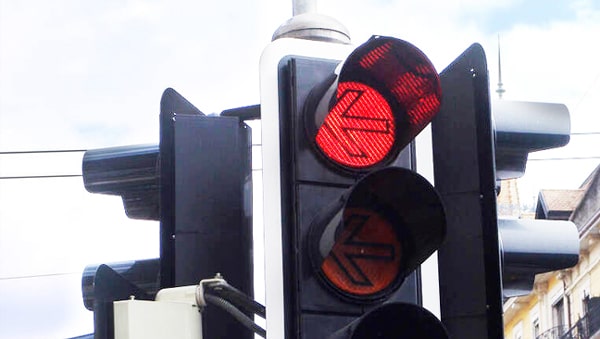
How does a steady red arrow differ from a steady circular red signal?

What is the difference between traffic lights with red arrows and those with solid red lights?
  1. A You may not make the movement shown by a red arrow until a signal permits it
  2. B A red arrow applies only to left turns
  3. C A red arrow allows a turn after slowing without stopping
  4. D A red arrow is only an advisory warning

Correct answer: A – You may not make the movement shown by a red arrow until a signal permits it

Under Rhode Island law, traffic facing a steady red arrow must stop and remain stopped for the movement indicated until another signal permits it. A steady circular red signal also requires a stop, but a right turn may be permitted after stopping unless a device prohibits the turn or a steady red arrow controls it. Any permitted turn remains subject to stop-sign right-of-way rules.

Source: R.I. Gen. Laws § 31-13-6(3)(i)(A), (3)(ii) – Meaning of traffic control signals