Rhode Island Drivers Ed Practice Test 8

5 out of 5 (43 votes)
80% Passing score
20 Questions
4 Mistakes allowed
Rhode Island intersection questions deserve more attention than most people give them. Four-way stops, right-of-way calls, turning traffic, hesitant drivers — all of it sounds basic, and then the RI permit test practice question adds one tiny detail that changes who goes first. That is exactly why this Rhode Island DMV practice test stays focused on intersections and the judgment behind them, instead of wandering through every driving topic at once. You get 20 multiple-choice questions built around the situations that tend to trip up new drivers: who yields, who proceeds, what a sign is really telling you, and how to read a traffic scene without guessing your way through it. The value is in the repetition, honestly. Take the practice permit test once and you may catch the obvious stuff. Take it again, and the wording starts to feel more familiar — not easier in a fake way, just less slippery. That helps when you sit for the real Rhode Island drivers ed written test and need to answer cleanly, without overthinking yourself into the wrong choice. There is also the larger licensing picture, which is less exciting but very much part of the deal. Rhode Island teen permit applicants should know that online driver education is not accepted as an approved curriculum in the state; the DMV says that rule has been in effect since July 1, 2022. So this RI drivers ed practice test works best as part of a broader study plan: the official RI driver’s handbook, approved driver education, road sign review, flashcards if they help you, and enough practice to make the rules feel usable rather than vaguely familiar. Once the permit test is behind you, Rhode Island still expects you to be organized. Road tests can be scheduled, changed, canceled, and paid for online, but you will need a valid learner’s permit and the completed LI-1 license application form when you show up. Using someone else’s vehicle adds another wrinkle: if the registered owner is not present, you need a notarized letter or Vehicle Use Authorization form. Before test day, read the Rhode Island Road Test Checklist and the Road Test Information and Procedures Brochure. Seriously, read them. A road test can be terminated for violations, dangerous actions, collisions, leaving the designated roadway, equipment failure, erratic driving, lack of cooperation, or driving that shows dangerous inexperience — and that termination counts as a failed test. This practice test is one step, but it is a useful one: learn the intersection rules now, so they are not wobbling around in your head later.
FREE DMV Practice Test App
Study for your Rhode Island permit test or driver’s license with the NextDoorDriving app. 700+ DMV questions and answers, 100% free!
Download on the App Store

Sample Rhode Island Permit Test Questions

Question 1

What is a safety zone?

  1. A An unused shoulder beside a highway divider
  2. B A marked or protected roadway area set apart for pedestrians
  3. C The median of every divided highway
  4. D A space cushion maintained around a moving vehicle

Correct answer: B – A marked or protected roadway area set apart for pedestrians

A safety zone is an area within a roadway officially set apart for the exclusive use of pedestrians. It must be protected, marked, or indicated by signs so that it is plainly visible while in use. Vehicles may not be driven through or within a designated safety zone.

Source: R.I. Gen. Laws § 31-1-26 – Safety zone, R.I. Gen. Laws § 31-22-5 – Safety zones
Question 2

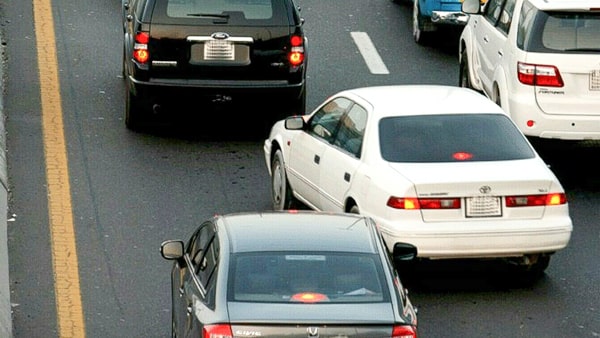
Before moving into another lane, which condition must you verify?

Before changing lanes, you must:
  1. A The intended lane and path are clear
  2. B Your signal has given you the right-of-way
  3. C You are traveling faster than every nearby vehicle
  4. D All of the above

Correct answer: A – The intended lane and path are clear

A driver may not move right or left on a roadway until the movement can be made with reasonable safety. Before changing lanes, check the mirrors and look over the appropriate shoulder to cover areas hidden by the mirrors. Signal when other traffic may be affected, but personally verify that no vehicle has entered the intended path.

Source: R.I. Gen. Laws § 31-16-5 – Turn signal required, Rhode Island Driver’s Manual — Ch. III, “Starting from the Curb or Making a Safe Lane Change”

Question 3

One reason to check your rearview and side mirrors periodically is to:

You should check traffic behind you:
  1. A Monitor traffic only while driving on a freeway
  2. B Identify a vehicle that is following too closely
  3. C Look behind only when you begin braking
  4. D Read roadway signs located ahead

Correct answer: B – Identify a vehicle that is following too closely

The driver’s manual recommends looking behind periodically in the rearview and side mirrors. These checks can reveal an approaching vehicle or a driver who is following too closely. If you are being tailgated, the manual advises changing lanes or allowing the driver to pass rather than speeding up or suddenly applying the brakes.

Source: Rhode Island Driver’s Manual — Ch. III, “Safe Driving on the Highway”

Question 4

Which situation normally requires a motorist to cross a sidewalk?

You may drive across a sidewalk to:
  1. A Driving around a speed bump
  2. B Entering or leaving a driveway or alley
  3. C Completing a U-turn
  4. D Passing stopped traffic

Correct answer: B – Entering or leaving a driveway or alley

Rhode Island requires a driver crossing a sidewalk to yield to all traffic proceeding along it. A driver emerging from an alley, driveway, or building in a business or residence district must stop immediately before entering the sidewalk area and yield to pedestrians as necessary to avoid a collision. The driver must also yield to approaching roadway traffic before entering the road.

Source: R.I. Gen. Laws § 31-18-18 – Right-of-way on sidewalks, R.I. Gen. Laws § 31-20-10 – Vehicles emerging from alleys, driveways, and buildings

Question 5

A driver may cross single or double solid yellow centerlines:

  1. A To pass a slower vehicle traveling in the same direction
  2. B Only during daylight hours
  3. C Whenever the opposing lane appears clear
  4. D To make a legal turn when permitted

Correct answer: D – To make a legal turn when permitted

Solid yellow lines separate traffic moving in opposite directions and prohibit passing. The driver’s manual recognizes exceptions for legal turns and certain roadway emergencies, such as an obstruction or breakdown. A driver may not cross the lines merely because the opposing lane appears clear or because it is daytime.

Source: Rhode Island Driver’s Manual — Ch. IV, “Roadway Markings”

Question 6

Unless a statutory exception applies, an adult driver must wear a safety belt:

  1. A Only while traveling on an interstate highway
  2. B Whenever operating a vehicle required by federal law to have safety belts
  3. C Only when traveling at the posted speed limit
  4. D Only when transporting passengers

Correct answer: B – Whenever operating a vehicle required by federal law to have safety belts

Rhode Island requires an operator to be properly restrained while driving a motor vehicle that federal law requires to have safety belts. The operator must also ensure that adult passengers are properly restrained. Exceptions include certain pre-July 1, 1966 vehicles, qualifying medical verification, vehicles not federally required to have belts, and on-duty letter carriers. The scheduled fine for an unbelted operator or adult passenger is $40.

Source: R.I. Gen. Laws § 31-22-22(f), (g), (i) – Safety belt use — Child restraint, R.I. Gen. Laws § 31-41.1-4 – Schedule of violations