South Carolina Practice Permit Test 5

4.9 out of 5 (90 votes)
80% Passing score
20 Questions
4 Mistakes allowed
South Carolina’s beginner’s permit test does not treat DUI laws as a minor footnote, and neither does this SC DMV permit practice test. New drivers are expected to understand more than the basic “don’t drink and drive” warning, because the actual rules get more specific than that. Blood alcohol content, impaired judgment, slowed reaction time, license consequences, implied consent, and the legal trouble that follows a DUI can all show up in the material you are supposed to know before you get behind the wheel. This South Carolina permit practice test focuses heavily on DUI laws and alcohol-related driving rules, while still keeping you grounded in the broader knowledge test topics. You will see questions that help you think through how alcohol affects vision, coordination, concentration, and decision-making—not in a dramatic lecture-hall way, thankfully, but in the practical way the DMV tends to care about. The point is to recognize why even small amounts of alcohol can make driving unsafe, how BAC limits are used, and why South Carolina takes impaired driving seriously for both new and experienced drivers. The official South Carolina beginner’s permit knowledge test has 30 multiple-choice questions, and you need 24 correct answers to pass. That is an 80% passing score, with up to 6 questions missed. The test is based on the South Carolina Driver’s License Manual and may include traffic laws, road signs, pavement markings, signals, sharing the road, safe driving, driver responsibility, and alcohol and drug rules. The SCDMV does not release the actual test questions, so this SC permit test practice uses similar wording and subject matter instead of pretending to be a leaked copy. Better, honestly, because memorizing fake certainty is a great way to get humbled. One thing to note: for adult first-time applicants, a permit is still part of the licensing process. If you are 18 or older, you must provide the required identity, Social Security, residency, and name-change documents, pass the vision test, pass the knowledge test, and pay the $2.00 knowledge-test fee plus the $2.50 beginner’s permit fee. After holding the beginner’s permit for at least 30 days, you can take the road test and then pay the $25 fee for an eight-year Class D driver’s license. Use this DUI-focused South Carolina DMV permit practice test to review the rules, catch the details you missed, and build the kind of knowledge that helps on test day—and, more importantly, after it.

FREE DMV Practice Test App
Study for your South Carolina permit test or driver’s license with the NextDoorDriving app. 700+ DMV questions and answers, 100% free!
Download on the App Store

Sample South Carolina Permit Test Questions

Question 1

In South Carolina, what must you do when flashing red railroad-crossing lights warn of an approaching train or other on-track equipment?

  1. A Stop 15 to 50 feet from the nearest rail and proceed only when safe
  2. B Stop only after you can see the train
  3. C Slow down but continue across the tracks
  4. D Drive around the gate if the tracks appear clear

Correct answer: A – Stop 15 to 50 feet from the nearest rail and proceed only when safe

A driver must stop within 50 feet, but no closer than 15 feet, from the nearest rail when a visible signal warns of an approaching train or other on-track equipment. The driver may proceed only when it is safe. Never drive through, around, or under a crossing gate while it is closed or moving.

Source: S.C. Code § 56-5-2710(a)(1), (b) – Obedience to signal indicating approach of train or other on-track equipment

Question 2

What color pavement markings identify traffic moving in opposite directions?

  1. A White
  2. B Red
  3. C Black
  4. D Yellow

Correct answer: D – Yellow

Yellow lane markings are used on roadways carrying traffic in opposite directions. The markings may be solid or broken depending on whether passing is permitted. White lane markings generally separate lanes carrying traffic in the same direction.

Source: South Carolina Driver’s Manual — Section 6, “Yellow Lane Markings”

Question 3

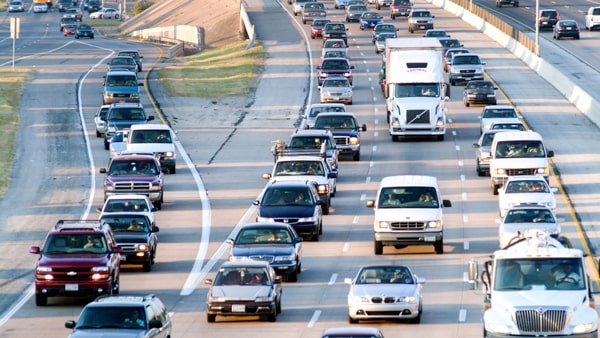
Before merging from an entrance lane onto a multi-lane highway, how should you check for traffic?

When you enter a freeway, you should check traffic by using:
  1. A Use only the inside rearview mirror
  2. B Use only the outside mirrors
  3. C Check your mirrors and look over your shoulder for the blind spot
  4. D Look only through the driver-side window

Correct answer: C – Check your mirrors and look over your shoulder for the blind spot

Merging requires the same traffic checks used for a lane change. Check the mirrors, turn your head to inspect the blind spot, and identify a safe opening before moving over. Use the acceleration lane to approach the speed of highway traffic and merge into the selected gap.

Source: South Carolina Driver’s Manual — Section 7, “Changing Lanes”, South Carolina Driver’s Manual — Section 7, “Entering a Multi-lane Highway”

Question 4

Which visual-search technique helps you identify driving hazards early?

  1. A Stare continuously at the vehicle directly ahead
  2. B Watch only the inside mirror
  3. C Look well ahead while continuing to check the sides and rear
  4. D Use high beams in all traffic conditions

Correct answer: C – Look well ahead while continuing to check the sides and rear

The South Carolina driver’s manual recommends looking ahead, to the sides, and behind the vehicle. Looking well down your planned path helps you identify roadway conditions and other users early enough to adjust. Ideally, drivers should search about 20 to 30 seconds ahead while avoiding a fixed stare.

Source: South Carolina Driver’s Manual — Section 8, “Visual Search”

Question 5

When approaching a sharp curve, when should you reduce your speed?

When you approach a sharp curve in the road, you should:
  1. A Only after entering the curve
  2. B Before entering the curve
  3. C After accelerating into the curve
  4. D Only when another vehicle is visible

Correct answer: B – Before entering the curve

Reduce to a safe speed before entering a curve. Additional slowing is needed when traction is poor, another vehicle is ahead, or the end of the curve is not visible. Hard braking after entering the curve can cause the tires to lose traction.

Source: South Carolina Driver’s Manual — Section 8, “Adjusting To Roadway Conditions”

Question 6

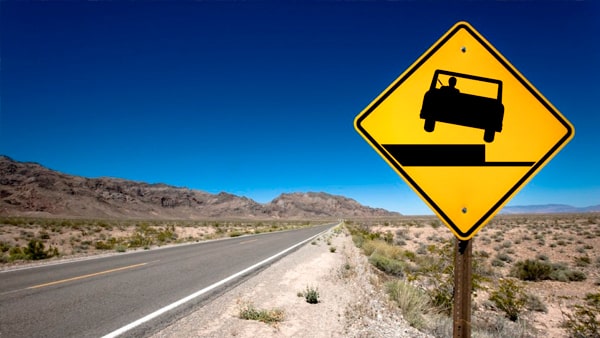
A warning sign indicates an uneven pavement-edge drop-off. What is the main danger?

What should you be most concerned about when you see this sign?
  1. A Your headlights may become misaligned
  2. B A tire will always be punctured on the shoulder
  3. C The shoulder will necessarily be flooded
  4. D You may lose control if your wheels leave the pavement and you steer back sharply

Correct answer: D – You may lose control if your wheels leave the pavement and you steer back sharply

An uneven drop-off can cause a serious collision if the driver reacts improperly. If the vehicle leaves the pavement, slow gradually when safe and steer gently back onto the road. A sudden, sharp steering movement can produce erratic vehicle behavior when the tires encounter the lower or unpaved shoulder.

Source: South Carolina Driver’s Manual — Section 9, “Uneven Surface Drop-Offs”