


South Carolina Dmv Practice Test 7

5 out of 5 (82 votes)
80% Passing score
20 Questions
4 Mistakes allowed
The South Carolina beginner’s permit test should not be a guessing game, and this SC DMV practice test is meant to keep it from going that way. The real exam has 30 multiple-choice questions, and you need 24 correct answers to pass, which works out to 80%. This practice test gives you 20 focused questions, so it is not trying to pretend it is the full exam. What it does do — and this matters more than people like to admit — is give you a clean look at whether you actually understand the material or just sort of recognize it when it sounds familiar. The questions here cover the kinds of topics South Carolina expects new drivers to know: road signs, signals, pavement markings, safe driving habits, basic maneuvers, sharing the road, insurance responsibilities, and those legal details that are easy to skim past because they feel obvious until they are not. The official SC DMV permit test is based on the South Carolina Driver’s License Manual, so pairing this DMV practice test with the handbook is the sensible move. A drivers ed course can help too, especially for teen drivers who will need it later before moving into a Conditional or Special Restricted license. A few practical details are worth keeping in your head. The SCDMV charges $2.00 for the knowledge test and $2.50 for the beginner’s permit after you pass. Knowledge testing is handled in person at an SCDMV branch, and you need to get there before 4 p.m. for the test. Teens can apply for a Class D beginner’s permit at age 15, but if they have no previous driving experience, they generally have to hold that permit for at least 180 days before they can move forward. Adults starting from scratch still begin with a permit, though the waiting period before a road test is usually at least 30 days. So, yes, the paperwork-and-timing part is not thrilling, but it is part of getting licensed. Use this free SC permit practice test more than once if you need to. The point is not to memorize a neat little string of answers and hope the real test is friendly. The point is to catch weak spots early, get more comfortable with South Carolina road rules, and walk into the DMV with fewer surprises than the person who only glanced at the manual the night before.
FREE DMV Practice Test App
Study for your South Carolina permit test or driver’s license with the NextDoorDriving app. 700+ DMV questions and answers, 100% free!
Download on the App Store

Sample South Carolina Permit Test Questions

Question 1

Which pavement marking helps drivers choose the correct lane for a turn?

  1. A A flashing red signal
  2. B A flashing yellow signal
  3. C A white edge line beside the roadway
  4. D A directional arrow painted within the lane

Correct answer: D – A directional arrow painted within the lane

Pavement markings include lines, arrows, words, and symbols that provide directions or warnings. Directional arrows painted within lanes show which lanes are intended for particular movements, including turns. Enter the appropriate lane before reaching the intersection and obey any accompanying signs or traffic signals.

Source: South Carolina Driver’s Manual — § 6, “Pavement Markings”, S.C. Code § 56-5-1900(c) – Driving on roadways laned for traffic
Question 2

For an occupant covered by South Carolina’s safety-belt law, when must the belt be worn?

  1. A Only when traveling faster than 40 mph
  2. B Only during short, low-speed trips
  3. C Only while driving in cities
  4. D Whenever the vehicle is operated on public streets or highways

Correct answer: D – Whenever the vehicle is operated on public streets or highways

Covered drivers and occupants must wear fastened safety belts whenever their motor vehicle is operated on public streets or highways. The requirement is not limited to high-speed travel or rural roads. Safety belts should be positioned correctly, with the lap belt low across the hips and the shoulder belt across the chest and shoulder.

Source: S.C. Code § 56-5-6520 – Mandatory use of seat belt, South Carolina Driver’s Manual — § 4, “Safety Belts”

Question 3

How should you position your vehicle when approaching a right turn?

  1. A Near the centerline
  2. B Close to the left edge of the roadway
  3. C As close as practicable to the right curb or roadway edge
  4. D Past the center of the intersection before turning

Correct answer: C – As close as practicable to the right curb or roadway edge

Both the approach for a right turn and the turn itself must be made as close as practicable to the right-hand curb or edge of the roadway. This positioning helps prevent a wide turn into another lane. Follow any official traffic-control device that directs a different turning path.

Source: S.C. Code § 56-5-2120(a), (c) – Required position and method of turning

Question 4

You have a green light, but traffic leaves no room for your vehicle beyond the intersection. What should you do?

  1. A Enter if cross traffic can steer around you
  2. B Wait until there is enough space to clear the intersection
  3. C Enter because the green light gives you the right-of-way
  4. D Follow the vehicle ahead into the intersection

Correct answer: B – Wait until there is enough space to clear the intersection

A driver may not enter an intersection, marked crosswalk, or railroad grade crossing unless sufficient space is available on the other side. This rule applies even when a traffic signal indicates that the driver may proceed. Wait behind the intersection until your vehicle can pass completely through without blocking vehicles, pedestrians, or trains.

Source: S.C. Code § 56-5-2735(A) – Obstructing intersection or grade crossing; passing near grade crossing; traffic lines when stopped at railroad crossing; vehicles in tow

Question 5

An appropriate signal is required when a driver is:

  1. A Making a turn
  2. B Moving right or left, including changing lanes
  3. C Stopping or suddenly reducing speed when there is an opportunity to warn a following driver
  4. D Doing any of the above

Correct answer: D – Doing any of the above

South Carolina requires an appropriate signal before turning or moving right or left on a roadway. A driver also must signal before stopping or suddenly reducing speed when there is an opportunity to warn a vehicle immediately behind. Signaling does not eliminate the separate duty to verify that the intended movement can be made safely.

Source: S.C. Code § 56-5-2150(A), (C) – Turning movements and required signals

Question 6

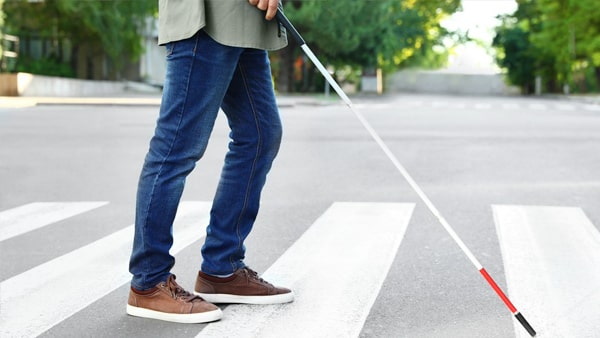
What does a raised white cane commonly indicate about a pedestrian?

You need to use extra caution when driving near a pedestrian using a white cane because:
  1. A The pedestrian is unable to hear traffic
  2. B The pedestrian is directing traffic
  3. C The pedestrian is visually impaired
  4. D The pedestrian is requesting a ride

Correct answer: C – The pedestrian is visually impaired

A white cane is commonly used by a person who is totally or partially blind. The driver’s manual identifies pedestrians crossing with white canes or guide dogs as visually impaired and requires drivers to come to a complete stop. The statutory protection also applies when such a pedestrian is attempting to cross the roadway.

Source: S.C. Code § 56-5-3190 – Only blind or incapacitated person may raise certain canes, S.C. Code § 56-5-3200 – Vehicle shall stop for pedestrian guided by dog or raising cane, South Carolina Driver’s Manual — § 10, “Pedestrians”