


South Carolina Permit Test Practice 9

4.9 out of 5 (66 votes)
80% Passing score
20 Questions
4 Mistakes allowed
School bus questions deserve a little more attention than most people give them, and this SC permit practice test keeps the focus exactly there. It is built around 20 questions on South Carolina school bus laws: when to stop, when traffic in both directions must stop, what flashing red lights and an extended stop arm mean, and when a divided roadway changes what drivers on the opposite side are required to do. That last part is where people tend to get sloppy, honestly. Not because the rule is impossible, but because the wording can make a normal road situation feel more complicated than it looked in the driver’s manual. This SC practice permit test uses the same basic passing standard South Carolina expects on the official knowledge exam. The real SCDMV knowledge test has 30 questions, and you need 24 correct answers to pass, which is 80%. Here, you will need at least 16 out of 20 correct answers, so the scoring feels familiar while keeping the review narrow and manageable. It is a school-bus-heavy practice test, yes, but that is the point. These are not throwaway questions. They cover the kind of decisions drivers have to make near neighborhoods, two-lane roads, school zones, and bus stops where there is not much room for “I think that was right.” The licensing details are worth keeping in the same mental folder. In South Carolina, a beginner’s permit is available at age 15, and teen drivers usually must hold it for 180 days before moving toward a Conditional Driver’s License or Special Restricted Driver’s License. Teens also need 40 hours of supervised driving practice, including 10 hours at night. Adult permit holders have a 30-day holding period before the road test. The official knowledge test fee is $2.00, and the beginner’s permit fee is $2.50, which is not exactly dramatic money, but still—showing up prepared is better than turning a cheap test into a repeat errand. When you finish this SC drivers permit practice test, the performance summary shows what you missed and gives the correct answers, which is where the useful studying really happens. Use it to tighten up the school bus rules before the written permit test, because on South Carolina roads, this is one of those topics where knowing the rule clearly matters.
FREE DMV Practice Test App
Study for your South Carolina permit test or driver’s license with the NextDoorDriving app. 700+ DMV questions and answers, 100% free!
Download on the App Store

Sample South Carolina Permit Test Questions

Question 1

Under South Carolina law, two vehicles reach an uncontrolled intersection from different roads at approximately the same time. Who must yield?

  1. A The driver traveling faster
  2. B The driver on the left
  3. C The driver on the right
  4. D Neither driver

Correct answer: B – The driver on the left

The driver of the vehicle on the left must yield to the vehicle on the right when both approach or enter at approximately the same time. This rule applies to an uncontrolled intersection. It may be modified at a through highway or where another traffic rule or control device applies.

Source: S.C. Code § 56-5-2310 – Vehicles approaching or entering intersection
Question 2

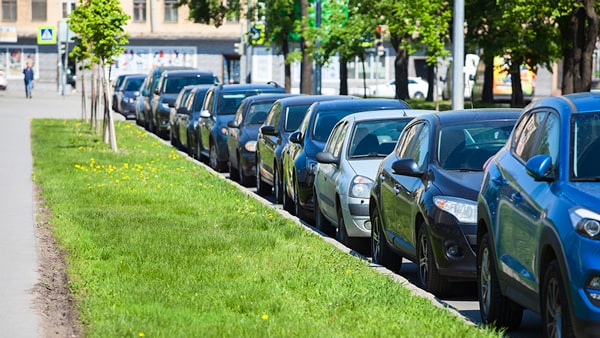
When parking along the right-hand curb, how close must your vehicle’s right wheels be?

When you park on a level road next to a curb:
  1. A Parallel to and within 18 inches of the curb
  2. B Within 30 inches of the curb
  3. C Touching the curb
  4. D Any distance away if the parking brake is set

Correct answer: A – Parallel to and within 18 inches of the curb

South Carolina requires a vehicle parked next to a right-hand curb to have its right wheels parallel to and within 18 inches of the curb. Keeping the vehicle close and parallel prevents it from unnecessarily occupying the traveled part of the roadway. Different rules may apply where approved angle or left-side parking is permitted.

Source: S.C. Code § 56-5-2560 – Parking at right-hand curb not more than 18 inches from curb

Question 3

Which driving habit helps prevent a skid on a slippery roadway?

  1. A Braking sharply to reduce speed quickly
  2. B Avoiding sudden stops
  3. C Following the vehicle ahead closely
  4. D Steering toward low areas where water collects

Correct answer: B – Avoiding sudden stops

Slippery surfaces reduce tire grip, increase stopping distance, and make turning more difficult. Sudden stops are one cause of skids, particularly when traction is already limited. Reduce speed early and use smooth braking and steering rather than abrupt movements.

Source: South Carolina Driver’s Manual — Section 8, “Adjusting To Roadway Conditions”, South Carolina Driver’s Manual — Section 9, “Dealing with Skids”

Question 4

What is a proven benefit of wearing a safety belt?

  1. A It is useful only during high-speed driving
  2. B It makes being ejected from the vehicle safer
  3. C It increases the likelihood of being trapped after every crash
  4. D It greatly reduces the chance of injury or death in a collision

Correct answer: D – It greatly reduces the chance of injury or death in a collision

The South Carolina driver’s manual states that safety belts greatly reduce the chances of injury or death in a collision. They help prevent occupants from being thrown from the vehicle and can help the driver maintain control. The lap belt should fit snugly across the hips, and the shoulder belt should not be placed behind the back or under the arm.

Source: South Carolina Driver’s Manual — Section 4, “Using Safety Belts”

Question 5

Under South Carolina driving guidance, when may a motorist drive across or into a designated bicycle lane?

  1. A Whenever bicycle traffic is light
  2. B When entering or leaving an alley or driveway
  3. C For 200 feet before every right turn
  4. D When passing a slow vehicle

Correct answer: B – When entering or leaving an alley or driveway

Motorists generally must not stop, park, or drive in a designated bicycle lane. The driver’s manual permits entry when entering or leaving an alley or driveway and in limited situations involving official duties, police direction, or an emergency. A motorist must yield to a bicyclist in the lane before entering or crossing it.

Source: S.C. Code § 56-5-3425 – Bicycle lanes, South Carolina Driver’s Manual — Section 10, “Bicyclists”

Question 6

When no hazard or law requires a lower speed, may you drive so slowly that you impede normal traffic?

  1. A Yes, because it forces everyone else to slow down
  2. B No, unnecessarily impeding normal and reasonable traffic is prohibited
  3. C Yes, because any speed below the limit is automatically safe
  4. D Yes, as long as you remain out of the left lane

Correct answer: B – No, unnecessarily impeding normal and reasonable traffic is prohibited

South Carolina law prohibits driving so slowly that you impede the normal and reasonable movement of traffic. An important exception applies when reduced speed is necessary for safe operation or required by law. Drivers should adjust for hazards without creating an unnecessary obstruction when conditions permit normal travel.

Source: S.C. Code § 56-5-1560(a) – Minimum speed limits