


South Carolina Permit Test Simulator

4.6 out of 5 (173 votes)
80% Passing score
30 Questions
6 Mistakes allowed
The South Carolina beginner’s permit test is not some giant exam, which is almost what makes it easy to misjudge. It is 30 multiple-choice questions. You need 24 correct answers to pass. That sounds simple enough, and then the material starts spreading out: road signs, traffic signals, pavement markings, right-of-way rules, alcohol and drug laws, insurance basics, safe-driving judgment, and the little licensing details people tend to skim because they look administrative instead of testable. This SC permit practice test is built around that real format. You get 30 questions at a time, pulled randomly, so the experience does not turn into a stale memorization loop after one or two tries. The passing score is set at 24 out of 30, just like the South Carolina DMV knowledge test, but honestly, stopping at “barely passed” is not where you want to be. Six wrong answers is the whole margin. That can disappear fast if you mix up a sign shape, misread a DUI question, or forget which permit rule applies to teens versus adults. The test covers the same kinds of material South Carolina expects first-time Class D applicants to know. Road signs and rules of the road are a big part of it, of course, but the less flashy topics matter too. DUI laws, driver responsibility, sharing the road, vehicle requirements, and beginner’s permit restrictions can all show up in ways that are more specific than casual studying prepares you for. Teen drivers should be especially careful with the graduated licensing rules: permit eligibility at 15, the 180-day holding period, supervised driving requirements, nighttime limits, and passenger restrictions later on. Adult first-time drivers have their own track, including the 30-day permit holding period before the road test, so age changes the process more than people usually assume. Use this free South Carolina DMV practice test as a rehearsal, not a quick confidence booster you click through once and forget. Take it on your phone, take it on a laptop, miss a few questions, get irritated for a second, then actually look at what you missed. Pair it with the South Carolina Driver’s License Manual, keep going until 24 feels comfortably beatable, and you will walk into the SCDMV with a much clearer sense of what the real permit test is going to ask.
FREE DMV Practice Test App
Study for your South Carolina permit test or driver’s license with the NextDoorDriving app. 700+ DMV questions and answers, 100% free!
Download on the App Store

Sample South Carolina Permit Test Questions

Question 1

Ideally, how far ahead should you scan along your planned path?

  1. A 4 to 6 seconds
  2. B 10 to 15 seconds
  3. C 15 to 20 seconds
  4. D 20 to 30 seconds

Correct answer: D – 20 to 30 seconds

The official manual recommends looking about 20 to 30 seconds ahead when conditions permit. Searching well down your planned path helps you detect traffic changes, roadway conditions, and other potential problems early. Keep your eyes moving rather than staring at one object, and also check the sides and rear.

Source: South Carolina Driver’s License Manual — § 8, “Visual Search”
Question 2

On a South Carolina two-lane road, an emergency vehicle is immediately approaching with its siren and flashing lights. What must you do?

  1. A Continue until the emergency vehicle begins to pass
  2. B Pull as close as possible to the right edge, clear of the intersection, and stop
  3. C Reduce speed but remain in your travel lane
  4. D Accelerate and turn at the next intersection

Correct answer: B – Pull as close as possible to the right edge, clear of the intersection, and stop

On a two-lane roadway, a driver must yield to an immediately approaching authorized emergency vehicle using the required signals. Move parallel to and as close as possible to the right edge or curb, remain clear of an intersection, and stop. Stay there until the emergency vehicle has passed unless a police officer directs otherwise.

Source: S.C. Code § 56-5-2360(a) — Operation of vehicles on approach of authorized emergency vehicles

Question 3

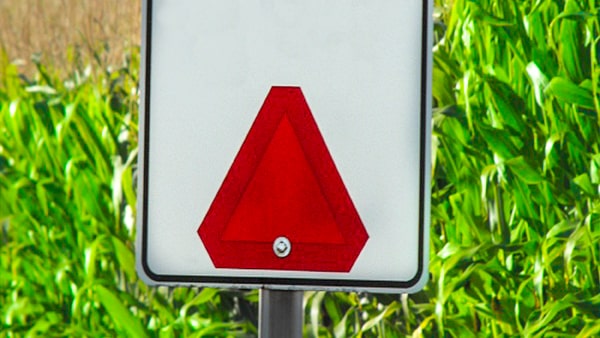
An orange-and-red reflective triangle mounted on the rear of a vehicle identifies:

An orange and red sign of this shape always means:
  1. A A vehicle that must yield at every intersection
  2. B A vehicle with priority over other traffic
  3. C A slow-moving vehicle
  4. D An emergency-response vehicle

Correct answer: C – A slow-moving vehicle

The fluorescent or reflective orange-and-red triangle marks a slow-moving vehicle, such as certain farm, construction, or animal-drawn vehicles. The manual explains that the emblem indicates travel below 25 mph. Approach carefully and pass only after confirming that the maneuver can be completed safely.

Source: South Carolina Driver’s License Manual — § 10, “Slow-Moving Vehicles”

Question 4

When is using high-beam headlights appropriate at night?

  1. A Only when driving on an unlit city street
  2. B During fog, rain, or snow
  3. C When no oncoming vehicle is close and you are not closely following another vehicle
  4. D At all times on a highway

Correct answer: C – When no oncoming vehicle is close and you are not closely following another vehicle

Use high beams when they will not glare into another driver’s eyes. South Carolina requires lower beams when approaching an oncoming vehicle within 500 feet and when following another vehicle within 200 feet, except while passing. Low beams are also recommended in fog, rain, or snow because high beams can reflect glare back toward the driver.

Source: S.C. Code § 56-5-4780 — Use of multiple-beam road-lighting equipment, South Carolina Driver’s License Manual — § 11, “Night Driving”

Question 5

In South Carolina, which statement about signaling before a turn is correct?

  1. A A signal is unnecessary when a green arrow protects the turn
  2. B A designated turn lane replaces the need to signal
  3. C Signal at least 100 feet before turning, even when no other vehicle is visible
  4. D Signal only when traveling slower than surrounding traffic

Correct answer: C – Signal at least 100 feet before turning, even when no other vehicle is visible

The official manual directs drivers to activate a turn signal 100 feet or more before turning left or right. A signal is also required before changing lanes or merging. Using a turn lane or facing a green arrow does not replace the need to communicate the planned movement.

Source: South Carolina Driver’s License Manual — § 8, “Signaling Your Movements”

Question 6

When parking an automatic-transmission vehicle on a hill, you should always:

  1. A Place one rear tire against the curb
  2. B Set the parking brake, shift to Park, and turn off the engine
  3. C Leave the front wheels parallel to the roadway
  4. D Turn the wheels toward the curb in every situation

Correct answer: B – Set the parking brake, shift to Park, and turn off the engine

When parking on a hill, set the parking brake, place an automatic transmission in Park, and turn off the engine. The correct wheel direction depends on whether the vehicle faces uphill or downhill and whether a curb is present. The wheels should not always be turned toward the curb.

Source: South Carolina Driver’s License Manual — § 7, “Parking on Hills”