South Dakota CDL General Knowledge Practice Test (SD) 2

4.7 out of 5 (52 votes)
80% Passing score
20 Questions
4 Mistakes allowed
As someone preparing for your CDL General Knowledge test, you've found the right spot for your second CDL practice test. Our 20-question general knowledge test is designed to emulate the real DMV experience, covering essential topics from pre-trip vehicle inspection to drug and alcohol awareness. You'll need to correctly answer at least 16 questions to pass, but don't worry; our DMV practice test includes multiple choice questions with real permit test answers and study aids for those tricky spots. Whether you're aiming for a Class A or Class B license, with any endorsements, this general knowledge test practice is a crucial step. It's identical across all license classes, ensuring everyone gets the same thorough preparation. We believe in authentic practice over shortcuts. While some sites offer 'DMV test cheat sheets', we pride ourselves on providing reliable, legally sound practice materials. Our South Dakota CDL practice tests are crafted to reflect the DMV's style, helping you understand the material deeply, not just memorize answers. This is especially beneficial for visual learners, as we include images of road signs and traffic scenarios. Remember, while these SD DMV general knowledge practice tests are invaluable, they complement, not replace, traditional drivers ed programs, such as Entry Level Driver Training (ELDT). If your state requires a certified driver's education course, it's important to complete it. However, our South Dakota CDL practice tests are perfect for reinforcing what you've learned and covering any gaps, ensuring you're well-prepared for the actual DMV permit test in 2026. So, get ready to gear up your knowledge and confidence with our comprehensive South Dakota general knowledge CDL practice test, tailored for aspiring commercial drivers in 2026!
FREE CDL Practice Test App
Pass your South Dakota CDL General Knowledge test with the NextDoorDriving app. Real questions and answers—100% free and ad-free.
Download on the App Store

Sample South Dakota CDL Test Questions - General Knowledge

Question 1

What is the primary safety benefit of an antilock braking system?

  1. A It permits higher speeds and shorter following distances
  2. B It prevents every type of skid
  3. C It guarantees a shorter stopping distance
  4. D It helps prevent wheel lockup and maintain control during braking

Correct answer: D – It helps prevent wheel lockup and maintain control during braking

ABS helps keep wheels from locking during hard braking, allowing the driver to maintain better control. It may help the driver steer around an obstacle and avoid skids caused by overbraking. ABS may or may not shorten stopping distance and does not compensate for excessive speed or poor braking technique.

Source: South Dakota Commercial Driver License Manual — § 2.18.4, “How ABS Helps You”
Question 2

A yellow diamond-shaped sign displaying a black cross symbol warns of:

This sign indicates _________________.
  1. A A pedestrian crossing ahead
  2. B A railroad crossing ahead
  3. C A rest area ahead
  4. D A crossroad intersection ahead

Correct answer: D – A crossroad intersection ahead

The W2-1 Cross Road sign provides advance warning of an intersection. Drivers should recognize that traffic may turn or enter from the intersecting road. It is an intersection warning sign, not a railroad, pedestrian, or service-area sign.

Source: Manual on Uniform Traffic Control Devices for Streets and Highways, 11th ed. — Ch. 2C, “Warning Signs and Object Markers,” W2-1 Cross Road

Question 3

What is the minimum UL fire-extinguisher rating required on the power unit of a vehicle carrying enough hazardous material to require placards?

  1. A 10 B:C
  2. B 9 B:C
  3. C 8 B:C
  4. D 7 B:C

Correct answer: A – 10 B:C

Federal equipment rules require a power unit transporting hazardous materials in a placardable quantity to carry an extinguisher rated at least 10 B:C. The extinguisher must be properly marked, charged, readily accessible, and securely mounted. A lower rating does not meet the minimum requirement for a placarded vehicle.

Source: South Dakota Commercial Driver License Manual — § 9.6.8, “10 B:C Fire Extinguisher”, 49 CFR § 393.95(a)(1)(i) – Emergency equipment on all power units

Question 4

When should a commercial driver use the horn?

  1. A Before every lane change
  2. B When it is needed to help prevent a collision
  3. C To express irritation with another driver
  4. D Whenever an animal is visible beside the road

Correct answer: B – When it is needed to help prevent a collision

The horn can alert others to your presence and help prevent a crash. Use it when necessary for safety, rather than as a routine signal or an expression of frustration. Unnecessary horn use can startle other road users and create additional danger.

Source: South Dakota Commercial Driver License Manual — § 2.5.2, “Communicating Your Presence”

Question 5

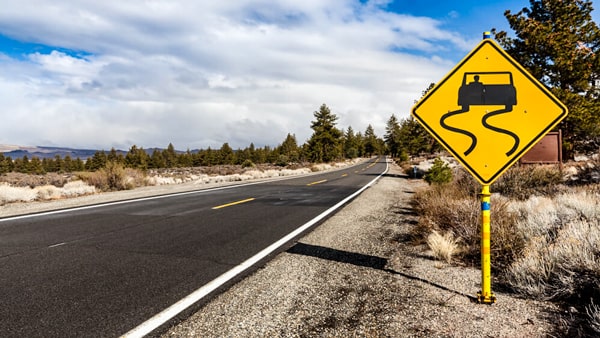
A yellow diamond sign showing a car with wavy skid marks warns that:

This sign warns drivers to  _________________.
  1. A The roadway may be slippery when wet
  2. B Driving is prohibited during rain
  3. C Vehicles may become stuck in standing water
  4. D The roadway is slippery in every weather condition

Correct answer: A – The roadway may be slippery when wet

In South Dakota, the car-and-skid-marks symbol warns that the pavement may be unexpectedly slippery when wet. It does not prohibit driving in rain or state that the road is always slippery. Reduce speed to match available traction; CDL guidance recommends approximately a one-third reduction on a wet roadway.

Source: Manual on Uniform Traffic Control Devices for Streets and Highways, 11th ed. — Ch. 2C, “Warning Signs and Object Markers,” W8-5 Slippery When Wet, South Dakota Commercial Driver License Manual — § 2.6.2, “Matching Speed to the Road Surface”

Question 6

An orange diamond-shaped ROAD WORK AHEAD sign tells a driver to:

This sign warns drivers to  _____________.
  1. A Stop until a worker waves the vehicle forward
  2. B Stop and turn around
  3. C Expect a construction or maintenance area ahead
  4. D Leave the roadway at the next available turn

Correct answer: C – Expect a construction or maintenance area ahead

The ROAD WORK AHEAD sign gives advance notice that a driver is approaching a road-work activity area. Drivers should be prepared for temporary traffic-control signs, changed roadway conditions, or directions from authorized personnel. The sign itself does not require an immediate stop or detour.

Source: Manual on Uniform Traffic Control Devices for Streets and Highways, 11th ed. — Part 6, “Temporary Traffic Control,” W20-1 Road Work Ahead