


South Dakota DMV Practice Test 2

4.9 out of 5 (240 votes)
80% Passing score
20 Questions
4 Mistakes allowed
South Dakota’s permit test rewards people who study the rules in a practical way, not people who skim the manual once and hope the obvious answers carry them through. This South Dakota DMV practice test gives you a tighter, more useful way to work through the material, with 20 questions that stay close to the kinds of topics the real knowledge exam pulls from: road signs, traffic signals, pavement markings, right-of-way, speed control, school buses, seat belt rules, impaired driving, and the plain old safe-driving judgment that shows up more often than people expect. The real South Dakota knowledge test is based on the state Driver License Manual, and the standard format is 25 questions. You need 20 correct answers to pass, which means an 80% score and no more than 5 missed questions. That is a small margin, honestly. Not terrifying, not complicated, but small enough that guessing your way through signs, alcohol laws, or who goes first at an intersection is a bad little strategy dressed up as confidence. This South Dakota DMV permit practice test is built for that in-between stage where the rules mostly make sense, but the details still need to settle in. First-time teen drivers can use it before applying for an Instruction Permit, which South Dakota allows at age 14 with parent or guardian consent. Adults applying for a permit can use it too, and so can drivers who need a refresher because an expired license, a move from another state, or just time away from the manual has made the details a little dusty. And yes, that happens. The review at the end is where the practice test earns its keep. You can see what you missed, check the correct answers, and retake the test until the material feels less like a pile of rules and more like something you can actually use. Road signs are folded into the main South Dakota DMV knowledge test, not treated as a separate standard road-sign-only exam, so sign questions belong right there beside safe driving, traffic law, and driver responsibility. Use this South Dakota DMV permit test online alongside the manual. The manual gives you the official rules; the practice test helps you find out whether you can recognize those rules when they are asked in test form, which is the part that matters before you walk into a Driver Licensing location.
FREE DMV Practice Test App
Study for your South Dakota permit test or driver’s license with the NextDoorDriving app. 700+ DMV questions and answers, 100% free!
Download on the App Store

Sample South Dakota Permit Test Questions

Question 1

Which driver must yield at a roundabout?
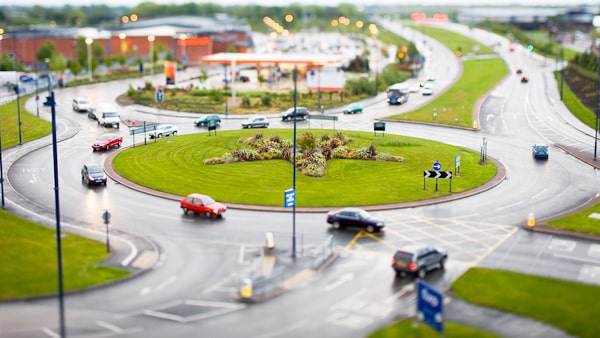
You have the right-of-way when you are:
  1. A A driver already circulating in the roundabout
  2. B A driver leaving the roundabout
  3. C A driver approaching an exit from inside the roundabout
  4. D A driver entering the roundabout

Correct answer: D – A driver entering the roundabout

In South Dakota roundabouts, an entering driver must slow down and yield to traffic approaching from the left that is already circulating. Enter only when a safe gap is available. Once inside, keep your speed low, follow the appropriate lane, and signal right as you approach your exit.

Source: South Dakota Driver License Manual — General Driving, “Steps for driving a roundabout”
Question 2

Subject to statutory exceptions, who must wear a safety belt in a passenger vehicle moving forward on a public highway?

  1. A Only passengers younger than eighteen
  2. B The driver and each front-seat passenger
  3. C Only the driver when traveling above 25 mph
  4. D Only occupants of vehicles manufactured after 2010

Correct answer: B – The driver and each front-seat passenger

South Dakota law requires every driver and front-seat passenger of a covered passenger vehicle to wear a properly adjusted and fastened safety belt whenever the vehicle is moving forward. The law contains limited statutory exceptions. A violation is a petty offense, and the requirement applies even during short or low-speed trips.

Source: SDCL § 32-38-1 – Use required--Public highways--Front seat passenger, SDCL § 32-38-5 – Enforcement--Violation as petty offense

Question 3

When parking an automatic-transmission vehicle on a hill, set the parking brake and:

  1. A Shift the transmission into Park
  2. B Leave the transmission in Neutral
  3. C Keep the engine running
  4. D Leave the front wheels pointed straight ahead in every situation

Correct answer: A – Shift the transmission into Park

After positioning the wheels correctly for the slope, set the parking brake and place an automatic transmission in Park. A manual transmission should be left in reverse when facing downhill or the lowest forward gear when facing uphill. These steps help secure the vehicle if it begins to roll.

Source: South Dakota Driver License Manual — Parking, “Parking on a hill”

Question 4

Driving after drinking alcohol is:

  1. A A minor concern when traffic is light
  2. B A serious traffic-safety hazard
  3. C Safe for an experienced driver after only a few drinks
  4. D Dangerous only to the driver who consumed alcohol

Correct answer: B – A serious traffic-safety hazard

Alcohol-impaired driving is a serious hazard to the driver, passengers, and other road users. Alcohol can reduce judgment, blur vision, interfere with distance and speed estimates, and slow reaction time. The official manual states that no one can drink alcohol and drive safely, regardless of driving experience.

Source: South Dakota Driver License Manual — “Alcohol, Other Drugs, and Driving”, South Dakota Driver License Manual — “Effects of Alcohol and Other Impairing Drugs”

Question 5

Following another vehicle too closely is:

  1. A Permitted whenever both vehicles are below the speed limit
  2. B Aggressive behavior that leaves too little time and space to react
  3. C A useful way to prevent another driver from merging
  4. D Recommended in congested traffic

Correct answer: B – Aggressive behavior that leaves too little time and space to react

Following too closely limits your view and reduces the time available to avoid a crash. The South Dakota manual lists following too closely among behaviors associated with aggressive driving and recommends at least a four-second following interval under normal conditions. State law prohibits following more closely than is reasonable and prudent for the traffic, speed, and road conditions.

Source: SDCL § 32-26-40 – Following too closely--Violation as misdemeanor, South Dakota Driver License Manual — “Aggressive Driving”, South Dakota Driver License Manual — Cushion of Space, “Providing an Adequate Following Distance”

Question 6

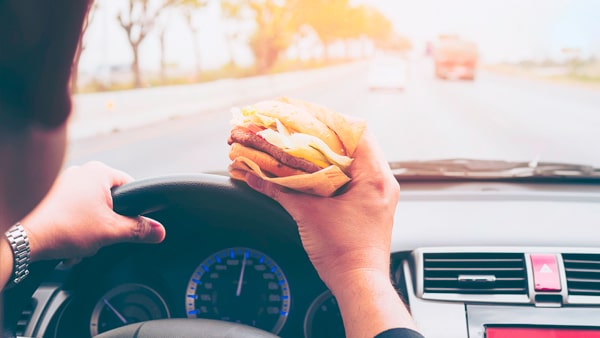
Why should drivers avoid eating or drinking while operating a vehicle?

Drivers who eat and drink while driving:
  1. A It improves concentration too much
  2. B It causes the vehicle to travel below the speed limit
  3. C It eliminates the need to check mirrors
  4. D It can divert attention and interfere with vehicle control

Correct answer: D – It can divert attention and interfere with vehicle control

Eating or drinking can take a driver's attention away from the roadway and may require removing a hand from the steering wheel. Distractions can delay recognition of hazards and interfere with safe vehicle control. The official manual advises drivers to avoid eating and remain focused on the driving task.

Source: South Dakota Driver License Manual — “Driver Distractions”