South Dakota Practice Drivers Test 5

4.9 out of 5 (137 votes)
80% Passing score
20 Questions
4 Mistakes allowed
South Dakota’s adult licensing process is fairly direct, but it still has a few steps that matter, and the knowledge test is one of the big ones. If you are 18 or older and applying for your first license, you will need to complete the application, provide the required identity, Social Security, lawful-presence, and South Dakota address documents, pay the fee, have your photo taken, pass the vision test, and pass the written knowledge test. After that, if you are not already licensed, you will need an Instruction Permit before you can move on to the road test. It is not a complicated path, exactly, but it is a path, and skipping over the test prep part is where people tend to make things harder on themselves. This South Dakota DMV practice test is built for that written-test stage. It gives you 20 questions based on real DMV materials, with a strong focus on DUI regulations, blood alcohol content limits, and the everyday rules of the road that South Dakota expects drivers to know before they start making decisions in actual traffic. The DUI and BAC material deserves real attention, too. Those questions can look straightforward at first glance, and then the details start doing the work — legal limits, consequences, impaired-driving rules, the kind of information you do not want to half-remember on test day. The test is free and untimed, which is a simple thing, but a useful one. You can move through the questions at your own pace instead of racing a clock for no good reason. Hints are available when you need a little push, and when you miss an answer, the explanation gives you the reasoning behind it. That is the part worth slowing down for, because a South Dakota drivers license test is not only checking whether you can recognize the correct answer once. It is checking whether the rule actually stuck. Adult applicants are not held to South Dakota’s teen GDL requirements, so there is no 275-day or 180-day teen permit holding period, no 50-hour supervised driving affidavit, no required 10 hours after dark, no required 10 hours in inclement weather, and no Restricted Minor’s Permit passenger or driving-window rules. But adults still have to pass the knowledge test, and before upgrading from an Instruction Permit to an Operator’s License, they must pass the driving test with a score of 80% or higher. An adult Instruction Permit is valid for 5 years, or until lawful-presence documents expire, whichever comes first. Use this South Dakota practice drivers test as often as you need. It is a practical way to prepare for the real SD DMV test, especially if you want the DUI laws, BAC limits, and licensing steps to feel familiar before you are sitting for the official exam.

FREE DMV Practice Test App
Study for your South Dakota permit test or driver’s license with the NextDoorDriving app. 700+ DMV questions and answers, 100% free!
Download on the App Store

Sample South Dakota Permit Test Questions

Question 1

How far before a right or left turn must a South Dakota driver begin signaling?

  1. A At least 50 feet
  2. B Only after entering the intersection
  3. C Continuously during at least the final 100 feet
  4. D Only when another vehicle is following

Correct answer: C – Continuously during at least the final 100 feet

The required turn signal must be given continuously during at least the final 100 feet traveled before turning. Signaling gives other road users time to understand your intended movement, but it does not grant right-of-way. You must still be properly positioned and make the turn only when it can be completed safely.

Source: SDCL § 32-26-18.1 – Turning from wrong lane prohibited--Turn signal required--Violation as misdemeanor, South Dakota Driver License Manual — Safe Driving Tips, “Communicating”

Question 2

A school bus is stopped on the opposite side of a highway that has at least two travel lanes in each direction. Are you required to stop?

If a school bus stops to unload children on a divided highway with a dividing barrier, vehicles traveling in the opposite direction are:
  1. A Yes, until the bus begins moving again
  2. B Yes, but only for five seconds
  3. C Yes, then you may pass at 15 mph
  4. D No, opposite-direction traffic is not required to stop on this type of highway

Correct answer: D – No, opposite-direction traffic is not required to stop on this type of highway

The school-bus stopping rule has a specific exception for an operator approaching from the opposite direction on a highway providing at least two lanes of travel in each direction. Under that condition, the opposite-direction driver does not have to stop for the bus’s flashing red signals. Drivers traveling in the bus’s direction must still obey the applicable stopping rule.

Source: SDCL § 32-32-6

Question 3

An oncoming driver begins turning left across your path. What is the appropriate defensive response?

  1. A Maintain speed because the other driver must yield
  2. B Slow down or stop as needed to avoid a collision
  3. C Sound the horn while continuing at the same speed
  4. D Accelerate through the conflict area

Correct answer: B – Slow down or stop as needed to avoid a collision

A driver turning left must yield to oncoming traffic that is in the intersection or close enough to create an immediate hazard. If that driver enters your path anyway, reduce speed or stop as necessary to avoid the crash. The driver manual advises motorists not to worsen another driver’s mistake and to adjust speed when doing so allows traffic to move safely.

Source: SDCL § 32-26-19 – Left-turning vehicles--Right-of-way of oncoming vehicle--Signals--Violation as misdemeanor, South Dakota Driver License Manual — Safe Driving Tips, “Space for Dangerous Situations”

Question 4

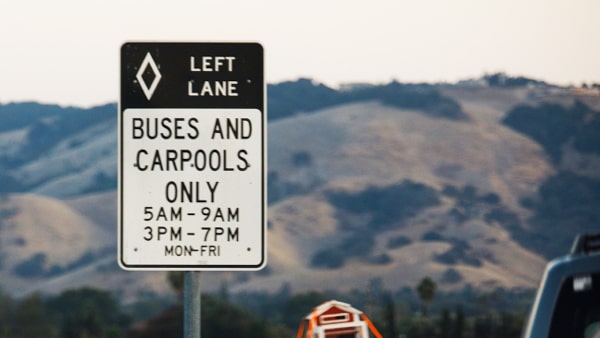
A regulatory sign reserves a lane for vehicles carrying a stated minimum number of occupants. When may you use that lane?

You can drive in a carpool lane if:
  1. A When your vehicle meets the occupancy requirement shown on the sign
  2. B Whenever you are driving a large passenger van
  3. C Whenever you want to pass slower traffic
  4. D Whenever other lanes are congested

Correct answer: A – When your vehicle meets the occupancy requirement shown on the sign

Lane-control signs and pavement markings tell drivers which lanes may be used for particular movements or purposes. If a sign establishes a minimum occupancy requirement, your vehicle must meet the posted condition before using that lane. Congestion, haste, or a desire to pass does not override a regulatory lane-use sign.

Source: South Dakota Driver License Manual — Rules of the Road, “Regulatory Signs” and “Pavement Markings”

Question 5

You hold a South Dakota instruction permit or restricted minor’s permit, and your phone rings while you are driving. What should you do?

If you are a minor and your cell phone rings while you are driving, you should:
  1. A Answer with a hands-free device
  2. B Let the call go to voicemail
  3. C Answer if a parent is calling
  4. D Send a quick text saying you are driving

Correct answer: B – Let the call go to voicemail

Instruction-permit and restricted-minor’s-permit holders may not use any type of wireless communication device while operating on a public highway. This restriction is not limited to handheld calls; answering hands-free or sending a brief text would still involve using the device. Let the call go unanswered and use the phone only after you have stopped in a safe location.

Source: SDCL § 32-12-11 – Application for license or permit--Persons at least fourteen and less than eighteen--Instruction permit--Restrictions, SDCL § 32-12-12 – Restricted minor’s permit--Restrictions on operation

Question 6

When may you pass a vehicle on its right?

  1. A When it is preparing to turn right
  2. B When it is preparing to turn left and the pass can be made safely
  3. C Whenever it slows near the curb
  4. D Whenever the shoulder is wide enough

Correct answer: B – When it is preparing to turn left and the pass can be made safely

A vehicle preparing to turn left may be passed on the right when there is sufficient space and the maneuver can be completed safely. Passing on the right does not give a driver permission to leave the main-traveled portion of the roadway. Check for pedestrians, bicyclists, driveways, and other traffic before beginning the pass.

Source: SDCL § 32-26-30