


South Dakota Permit Practice Test 6

5 out of 5 (121 votes)
80% Passing score
20 Questions
4 Mistakes allowed
This South Dakota DMV practice test focuses on turn signals, safe turns, lane changes, and the everyday driving choices that tell other people on the road what you are doing before you actually do it. That sounds simple enough, sure, but signaling is one of those topics where the details matter more than people want to admit. Signal too late, forget before a lane change, drift through a turn without warning anyone — suddenly the “basic” stuff is the part causing trouble. The practice test gives you 20 multiple-choice questions based on material from the South Dakota driver’s manual, with hints and explanations after you answer. To pass this South Dakota practice drivers test, you need at least 16 correct answers, which matches the 80% standard used on the real knowledge exam. The official SD permit test has 25 questions, and you need 20 correct to pass, so yes, the math is a little different here, but the pressure is similar: you do not get a huge pile of mistakes to spend freely. What makes this practice permit test useful is the way it keeps you in the same neighborhood as the real test. You are not memorizing oddball trivia or guessing at vague road-rule folklore. You are working through the kinds of questions South Dakota expects new drivers to understand — when to signal, how to handle turns, what lane movement requires, and why “I thought they knew where I was going” is not exactly a legal driving strategy. Charming confidence, bad plan. Once you finish, you can review what you missed and see where your answers held up. That part is easy to skip, and also the part that actually helps, which is rude but true. The explanations point out weak spots before the DMV does, and the DMV is not known for delivering feedback with much warmth. A few licensing details are worth keeping in the same mental folder. South Dakota allows an Instruction Permit at 14, but applicants under 18 need parent or guardian consent. Teen drivers must complete 50 supervised driving hours, including 10 after dark and 10 in inclement weather. The permit must be held 275 days without approved driver education, or 180 days with it. Bring the right documents, too: identity or lawful presence, Social Security number, and two South Dakota address documents dated within the last year. No photocopies, because apparently paper can still betray you.
FREE DMV Practice Test App
Study for your South Dakota permit test or driver’s license with the NextDoorDriving app. 700+ DMV questions and answers, 100% free!
Download on the App Store

Sample South Dakota Permit Test Questions

Question 1

After parking along the right side of a two-way roadway, which position is lawful?
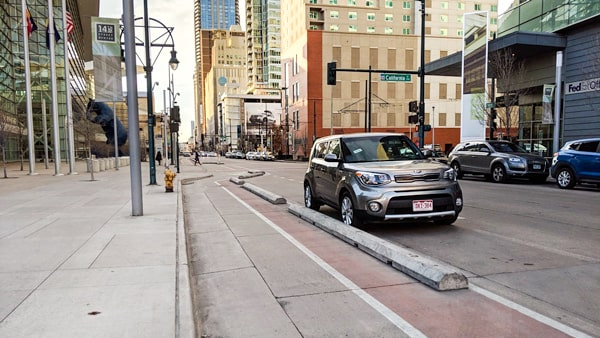
When you park on a level road next to a curb:
  1. A The right-hand wheels are parallel to and no more than 12 inches from the curb or edge
  2. B The right-hand wheels are no more than 18 inches from the curb
  3. C The left-hand wheels are within 12 inches of the curb
  4. D The vehicle is angled toward the center of the roadway

Correct answer: A – The right-hand wheels are parallel to and no more than 12 inches from the curb or edge

On a two-way roadway, the vehicle’s right-hand wheels must be parallel to and within 12 inches of the right-hand curb or roadway edge. This requirement applies unless an authorized exception, such as a permitted angle-parking arrangement, governs the location.

Source: SDCL § 32-30-2.1 – Position of parking on two-way road--Violation as misdemeanor.
Question 2

What does a driver signal by extending the left arm downward from the vehicle?

  1. A A left turn
  2. B A right turn
  3. C Slowing down or stopping
  4. D Beginning to move

Correct answer: C – Slowing down or stopping

South Dakota uses a downward extension of the left hand and arm to indicate a stop or decrease in speed. A horizontal arm indicates a left turn, while an upward arm indicates a right turn. These signals must be made from the vehicle’s left side.

Source: SDCL § 32-26-24 – Manner of making arm signal--Violation as misdemeanor.

Question 3

At an uncontrolled South Dakota intersection, two vehicles arrive at approximately the same time. Which driver must yield?

  1. A The driver traveling faster
  2. B The driver on the left
  3. C The driver on the right
  4. D The driver whose vehicle is smaller

Correct answer: B – The driver on the left

When two vehicles approach or enter an intersection at approximately the same time, the driver on the left must yield to the vehicle on the right. This rule is subject to statutory exceptions involving vehicles entering from private property, emergency vehicles, and highway equipment. A driver traveling at an unlawful speed forfeits any right-of-way otherwise provided by this rule.

Source: SDCL § 32-26-13 – Right-of-way at intersections--Unlawful speed as forfeiting right-of-way--Violation as misdemeanor.

Question 4

How should you approach a railroad crossing that has a crossbuck but no lights or gates?

  1. A Stop every time, even when no train is approaching
  2. B Slow down, look and listen, and be prepared to stop
  3. C Continue without checking because trains must stop
  4. D Accelerate to spend less time on the tracks

Correct answer: B – Slow down, look and listen, and be prepared to stop

Not every highway-railroad crossing has flashing lights or a gate. A railroad warning sign directs drivers to slow down, look, listen, and be prepared to stop if a train or railroad vehicle is approaching. Check all tracks and do not cross until the crossing is clear.

Source: South Dakota Driver License Manual — “Railroad Crossing Warning Signs”

Question 5

If your vehicle begins to skid on a slippery roadway, what should you do?

  1. A Brake as hard as possible
  2. B Accelerate sharply to regain traction
  3. C Look toward the obstacle you are trying to avoid
  4. D Release pressure from the brake or accelerator and look where you want to go

Correct answer: D – Release pressure from the brake or accelerator and look where you want to go

A skid can occur when the vehicle is moving too fast for conditions, stops too suddenly, or loses tire grip. Release pressure from the brake or accelerator rather than making another abrupt input. Keep your eyes directed toward the path where you want the vehicle to travel.

Source: South Dakota Driver License Manual — “Dealing with Skids”

Question 6

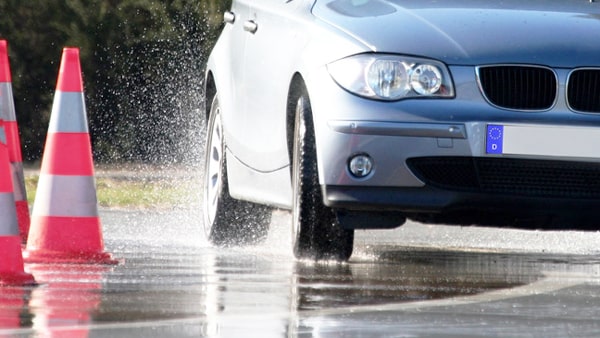
When should you begin reducing speed because of rain?

The road surface is most slippery:
  1. A Only after the rain becomes heavy
  2. B After the roadway begins to dry
  3. C At the first sign of rain
  4. D Only when standing water is visible

Correct answer: C – At the first sign of rain

Reduce speed at the first sign of rain or other precipitation. Wet or slippery pavement provides less tire grip, increases stopping distance, and makes turning without skidding more difficult. Hydroplaning is also less likely when drivers slow down on wet roads or where water has pooled.

Source: South Dakota Driver License Manual — “Speed Management—Adjusting to Roadway Conditions”