South Dakota Road Signs Test Simulator

5 out of 5 (82 votes)
80% Passing score
25 Questions
5 Mistakes allowed
A South Dakota DMV practice test should do more than toss a few road signs on the screen and hope the repetition works. This one stays focused on road signs, traffic control devices, signals, and the little visual cues that drivers are expected to read without overthinking. That matters because the official South Dakota knowledge test is not a separate road-sign quiz. Road signs are folded into the main permit test, along with rules of the road, safe driving, right-of-way, pavement markings, school buses, speed management, and the rest of the material covered in the South Dakota Driver License Manual. The real South Dakota permit test has 25 questions, and you need 20 correct answers to pass. That is 80%, with only 5 misses allowed. This SD DMV practice test uses 20 questions and sets the passing mark at 16, so the standard stays close to the official one while giving you a more concentrated way to work on signs. It is narrower than the real exam, yes, but that is the point. Road signs are quick-recognition questions, and quick-recognition questions have a way of exposing what you only sort of know. Each session pulls from a larger question set, which keeps the practice from turning into simple answer memorization. You may see warning signs, regulatory signs, traffic signals, pavement markings, and those ordinary-looking signs that people tend to skim because, well, they look ordinary. Then the test asks you to slow down just enough to prove you actually know what they mean. This South Dakota DMV test online is useful for first-time teen applicants, adults getting an instruction permit, drivers renewing after an expired license, or anyone who wants a sharper handle on the sign portion before dealing with the full knowledge test. Teen drivers can apply for an instruction permit at 14 with the right documents and parent or guardian consent; adults still need the vision and knowledge tests before moving toward the road test. Different path, same basic expectation: know the manual, know the signs, and do not treat the easy-looking material like filler. That is usually where a few points wander off.
FREE DMV Practice Test App
Study for your South Dakota permit test or driver’s license with the NextDoorDriving app. 700+ DMV questions and answers, 100% free!
Download on the App Store

Sample South Dakota Permit Test Questions

Question 1

A diamond-shaped traffic sign normally warns of:

  1. A A roadway hazard or special condition ahead
  2. B An interstate route number
  3. C A school crossing only
  4. D A regulatory speed limit

Correct answer: A – A roadway hazard or special condition ahead

Most warning signs are diamond shaped and use a yellow background with black symbols or lettering. They alert drivers to possible dangers or special roadway conditions ahead. Work-zone warnings may also be diamond shaped, but they generally use an orange background.

Source: South Dakota Driver License Manual — Traffic Signs, “Warning Signs” and “Work Zone Signs”
Question 2

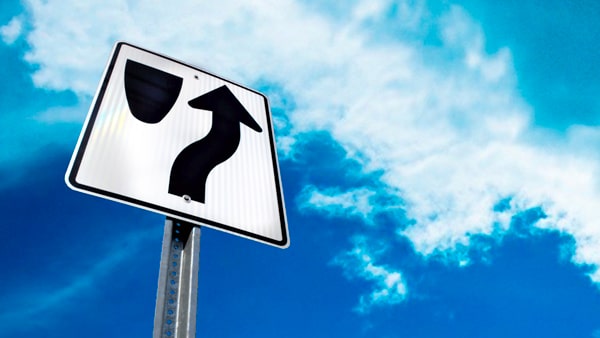
The pictured white regulatory sign with an arrow passing to the right of an obstruction directs drivers to:

This white sign means:
  1. A Keep to the right of the divider or obstacle
  2. B Yield before making a right turn
  3. C Move right only if traveling below the speed limit
  4. D Turn right at the next intersection

Correct answer: A – Keep to the right of the divider or obstacle

The sign directs traffic to pass on the right side of a median, island, or other obstruction. White signs with black symbols are commonly regulatory signs governing traffic direction or lane use. Drivers in South Dakota must obey official traffic-control devices unless a law enforcement officer gives different instructions.

Source: SDCL § 32-28-10 – Other traffic control devices--Directions by police officer--Violation as misdemeanor., South Dakota Driver License Manual — Traffic Signs, “Regulatory Signs”

Question 3

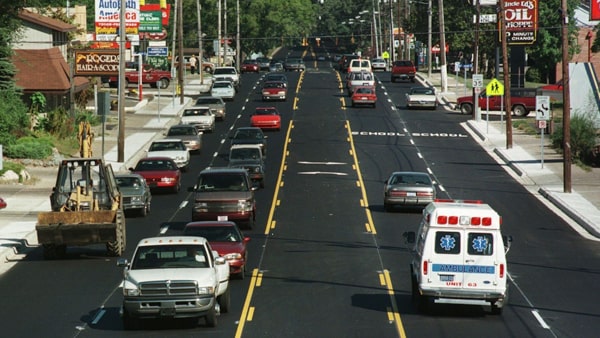
A shared center lane marked with left-turn arrows for both directions is reserved for:

The center lane in the illustration is used for:
  1. A Continuous through travel
  2. B Left turns and permitted U-turns
  3. C Passing slower vehicles
  4. D Emergency vehicles

Correct answer: B – Left turns and permitted U-turns

In South Dakota, a shared center lane is reserved for vehicles making left turns or permitted U-turns. Drivers traveling in either direction may use it, as shown by the alternating turn arrows. It is not a regular travel or passing lane, and you should enter it only when safe.

Source: South Dakota Driver License Manual — Other Lane Controls, “Shared Center Lane”

Question 4

A steady yellow arrow appears while you are waiting in a dedicated left-turn lane. What should you do?

  1. A Accelerate to enter the intersection before the signal changes
  2. B Turn immediately because oncoming traffic must stop
  3. C Prepare to stop because the protected-turn period is ending
  4. D Treat the arrow as a flashing yellow signal

Correct answer: C – Prepare to stop because the protected-turn period is ending

A steady yellow arrow indicates that the protected turning interval is ending. If you have not entered the intersection, prepare to stop and be ready to yield to oncoming traffic before turning. It is different from a flashing yellow arrow, which allows a cautious turn after yielding to oncoming traffic and pedestrians.

Source: South Dakota Driver License Manual — Rules of the Road, “Traffic Signals”

Question 5

Your signal turns green, but vehicles are still crossing or occupying the intersection. What should you do?

  1. A Enter and wait in the intersection
  2. B Drive around the vehicles if another lane appears open
  3. C Remain stopped until the intersection is clear
  4. D Proceed because the green signal gives you absolute right-of-way

Correct answer: C – Remain stopped until the intersection is clear

Traffic facing a green signal may proceed, but drivers must yield to vehicles and pedestrians lawfully within the intersection or adjacent crosswalk. Enter only after crossing traffic has cleared and your path is open. Waiting also prevents your vehicle from becoming trapped in or blocking the intersection.

Source: SDCL § 32-28-2 – Meaning of green or “go” signal--Vehicular traffic--Pedestrians, South Dakota Driver License Manual — Rules of the Road, “Traffic Signals”

Question 6

A double yellow centerline has one broken line and one solid line. When may you pass?

You may cross a double line to pass another vehicle if the line on your side is:
  1. A When the solid line is on your side
  2. B Whenever traffic ahead is moving slowly
  3. C When the broken line is on your side and the pass is safe
  4. D Only after crossing onto the shoulder

Correct answer: C – When the broken line is on your side and the pass is safe

A broken yellow line on your side indicates that passing is permitted, but only when the maneuver can be completed safely. South Dakota requires the left side to be clearly visible and free of oncoming traffic for sufficient distance. A broken line does not override signs, limited visibility, or other passing restrictions.

Source: SDCL § 32-26-34 – Passing by crossing highway center line when vision is obscured--Violation as misdemeanor, South Dakota Driver License Manual — Traffic Control Devices, “Pavement Markings”