Tennessee CDL Permit Test (TN) Online Simulator

5 out of 5 (47 votes)
80% Passing score
50 Questions
10 Mistakes allowed
Get ready to elevate your CDL test preparation with our exclusive Tennessee CDL Permit Test Simulator! This isn't your average DMV practice test. We've designed a unique tool that's set to challenge and prepare you better for your CDL permit test in 2026. With a vast database of over 700 DMV test answers, each session with our simulator introduces a fresh set of 50 questions, ensuring that no two tests are the same. This approach keeps you on your toes and mirrors the unpredictable nature of the actual CDL permit test. This Tennessee CDL practice test isn't just about quantity; it's about quality, too. Featuring a mix of multiple-choice and true/false questions, it mimics the real 2026 DMV test's format, giving you a realistic practice experience. With questions covering all CDL license classes, A and B, the DMV test simulator is a comprehensive tool designed for all aspiring commercial drivers in Tennessee. Ditch those dubious DMV cheat sheets and opt for a more reliable, legal, and effective study tool. Our Tennessee CDL test simulator provides visual aids, like road sign images and traffic scenario illustrations, catering to visual learners and enhancing the learning experience for everyone. After each question, you'll receive immediate feedback with detailed explanations, helping you understand the rationale behind each answer and solidifying your knowledge. Aim beyond the minimum passing score of 40 out of 50 questions. Our TN DMV permit test simulator encourages you to strive for excellence, preparing you not just to pass, but to excel in your actual test. Get started with our Tennessee CDL Permit Test Simulator today and take a significant step towards achieving your commercial driving license in 2026!
FREE CDL Practice Test App
Pass your Tennessee CDL General Knowledge test with the NextDoorDriving app. Real questions and answers—100% free and ad-free.
Download on the App Store

Sample Tennessee CDL Test Questions - General Knowledge

Question 1

Which list contains recognized causes of commercial vehicle fires?

  1. A. Spilled fuel and improper use of flares
  2. B. Smoking, improper fueling, and loose fuel connections
  3. C. Flammable, poorly sealed, improperly loaded, or poorly ventilated cargo
  4. D. All of the above

Correct answer: D. – All of the above

The Tennessee CDL manual identifies all of these as possible vehicle-fire causes. Spilled fuel and improperly used flares can start fires after a crash. Smoking, improper fueling, loose fuel connections, flammable cargo, defective cargo packaging, and poor ventilation can also create serious fire hazards.

Source: Tennessee Commercial Driver’s License Manual — § 2.21.1, “Causes of Fire”

Question 2

Which situation requires a school bus evacuation?

  1. A. The bus is burning or a fire is threatened
  2. B. The bus is stalled on or next to a railroad-highway crossing
  3. C. A collision is imminent
  4. D. All of the above

Correct answer: D. – All of the above

The Tennessee CDL manual identifies each listed condition as requiring evacuation. Passengers must leave when the bus is on fire or threatened by fire, stalled on or beside a railroad-highway crossing, or in imminent danger of a collision. A need for rapid evacuation because of a hazardous-materials spill is also listed as a mandatory evacuation condition.

Source: Tennessee Commercial Driver’s License Manual — § 10.3.1, “Planning for Emergencies”—“Mandatory Evacuations”

Question 3

If driving through unavoidable deep water, how should you help protect brake operation while crossing?

  1. A. Maintain gentle pressure on the brake pedal
  2. B. Press the brake pedal and accelerator as hard as possible after leaving the water
  3. C. Disconnect the steering-axle brakes after leaving the water
  4. D. Reduce engine speed as much as possible while crossing

Correct answer: A. – Maintain gentle pressure on the brake pedal

Before entering unavoidable water, slow down, select a low gear, and gently apply the brakes. Light brake pressure keeps the linings against the drums or discs and helps keep water, mud, sand, and silt out. After leaving the water, maintain light pressure briefly to heat and dry the brakes, then test them when it is safe.

Source: Tennessee Commercial Driver’s License Manual — “Wet Brakes”

Question 4

A yellow diamond sign displaying a black cross symbol warns of what condition ahead?

This sign warns drivers to _____________.
  1. A. A route for slow vehicles begins to the right
  2. B. A detour turns to the right
  3. C. A stop is required in every direction
  4. D. An intersection where traffic may enter from either side

Correct answer: D. – An intersection where traffic may enter from either side

The Cross Road warning sign indicates that an intersection is ahead and that vehicles may turn or enter from the side roadways. It alerts the driver to look for crossing or turning traffic and adjust speed as conditions require. The sign itself does not state that every approaching vehicle must stop.

Source: Manual on Uniform Traffic Control Devices, 11th ed. with Revision 1 — § 2C.41, “Intersection Warning Signs (W2-1 through W2-8)”

Question 5

When transporting pupils on a paved Tennessee highway, a school bus may not exceed:

  1. A. The posted speed limit for that roadway
  2. B. 65 mph, even when a lower limit is posted
  3. C. 55 mph on every highway
  4. D. The speed of surrounding traffic

Correct answer: A. – The posted speed limit for that roadway

A school bus transporting pupils to or from school or on a school-sponsored activity trip must obey posted speed limits. The law does not authorize the driver to exceed a lower posted limit to maintain traffic flow. It separately establishes a maximum speed of 35 mph on unpaved roadways.

Source: Tenn. Code Ann. § 49-6-2110(b) — Safe Operation of Buses

Question 6

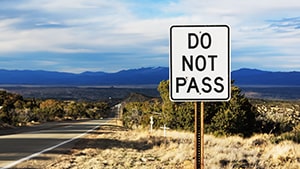
What must a driver do when encountering a rectangular white sign reading “DO NOT PASS”?

This sign indicates that the driver should _____________.
  1. A. Pass only when running behind schedule
  2. B. Do not overtake another vehicle in the restricted zone
  3. C. Stop before continuing through the zone
  4. D. Begin passing but return to the lane quickly

Correct answer: B. – Do not overtake another vehicle in the restricted zone

The DO NOT PASS sign emphasizes a restriction against overtaking and passing. It may be installed where sight distance is restricted or other conditions make passing inappropriate. The driver must remain behind the vehicle ahead rather than beginning a pass and attempting to complete it quickly.

Source: Manual on Uniform Traffic Control Devices, 11th ed. with Revision 1 — § 2B.36, “DO NOT PASS Sign (R4-1)”