


Tennessee Practice Permit Test 2

4.8 out of 5 (1017 votes)
80% Passing score
20 Questions
4 Mistakes allowed
This second Tennessee permit practice test gives you a cleaner way to work through the material before you sit for the real Class D knowledge test. Tennessee builds its permit test from the Tennessee Comprehensive Driver License Manual, so the questions are not floating around in some random “common sense” driving universe. They come from actual rules: traffic laws, road signs, signals, safe driving practices, alcohol and drug rules, and the plain responsibility of knowing what you are supposed to do when you are sharing the road with everyone else. The official Tennessee knowledge test includes 30 multiple-choice questions. You need an 80% score to pass, which means 24 correct answers, and the online version gives you 60 minutes. That sounds roomy enough, and usually it is, but the time limit is not really the thing that trips people up. It is the little details. Seat belt rules. Sign meanings that look obvious until two answers are almost the same. Safe-driving questions where the “normal” answer and the legal answer are not quite twins. This Tennessee DMV practice test keeps the review focused with 20 questions based on the same driver manual material used for the official permit test. It is especially useful if you are getting ready for a learner permit, applying for your first Regular Class D license as an adult, coming back to driving after a long gap, renewing and wanting a serious refresher, or helping a teen prepare without turning the whole evening into a lecture. Which, yes, tends to go poorly. For Tennessee applicants ages 15 to 17, the state allows the knowledge test online with a parent or legal guardian supervising through the Tennessee Proctor ID App. That setup comes with rules of its own: the applicant needs a computer, laptop, or tablet, cannot use a cell phone for the test, must stay on the test screen, and has to wait 24 hours after a failed online attempt. Adults and new Tennessee residents may also need a vision screening, the knowledge test, and in some cases a road skills test, depending on their license history. Use this 2026 Tennessee permit practice test as a practical check before the official exam. It will not replace the driver manual or a certified driver education course, and it should not pretend to. What it does well is show you where your knowledge is solid, where it is a little mushy, and where another pass through the rules would be the wiser move.
FREE DMV Practice Test App
Study for your Tennessee permit test or driver’s license with the NextDoorDriving app. 700+ DMV questions and answers, 100% free!
Download on the App Store

Sample Tennessee Permit Test Questions

Question 1

When traffic ahead requires you to slow, what can help prevent the driver behind from being surprised?

  1. A. Turn and watch the vehicle behind you
  2. B. Wait until the last moment to brake
  3. C. Begin braking early and apply the brakes gradually
  4. D. Keep your left foot resting on the brake pedal

Correct answer: C. – Begin braking early and apply the brakes gradually

Begin braking early and use gradual, even pressure when conditions permit. The brake lights warn drivers behind that you are reducing speed and give them more time to respond. An unnecessarily sudden stop makes it more difficult for a following driver to avoid striking the rear of your vehicle.

Source: Tennessee Comprehensive Driver License Manual — Section B, “Braking”
Question 2

Which behavior supports safer traffic flow when you pass a roadside crash scene?

  1. A. Slow sharply to examine the damaged vehicles
  2. B. Keep attention on your path and follow traffic-control directions
  3. C. Use a phone to photograph the scene
  4. D. Stop in the travel lane to determine whether help is needed

Correct answer: B. – Keep attention on your path and follow traffic-control directions

Keep your attention on driving and comply with directions from officers, signs, or traffic-control devices near the scene. The driver manual emphasizes concentration and warns against sightseeing or other distractions. Adjust speed when required by traffic or hazards, but do not divert your attention merely to observe the crash.

Source: Tennessee Comprehensive Driver License Manual — Section C, Ch. 1, “Concentration and Alertness Are Important Elements”

Question 3

On a narrow Tennessee mountain road, what should you do when meeting an oncoming vehicle?

  1. A. Immediately back down the grade
  2. B. Keep your vehicle under control and as near the right edge as reasonably possible
  3. C. Stop in the center of the roadway
  4. D. Accelerate past the other vehicle

Correct answer: B. – Keep your vehicle under control and as near the right edge as reasonably possible

Tennessee law requires a driver on a mountain highway to maintain control and remain as near the right-hand edge as reasonably possible. The state does not establish a blanket rule that one vehicle must always back based solely on whether it faces uphill or downhill. Any backing movement must be made safely and without interfering with traffic.

Source: T.C.A. § 55-8-165 – Driving on Mountain Highways, T.C.A. § 55-8-163 – Limitations on Backing

Question 4

When a large truck turns right at a multi-lane intersection, it may:

  1. A. Swing left to obtain enough room for the turn
  2. B. Remain entirely against the right curb throughout the turn
  3. C. Turn into whichever lane has the lightest traffic
  4. D. Proceed before all other road users

Correct answer: A. – Swing left to obtain enough room for the turn

Large trucks and buses need considerably more turning space than passenger vehicles. A truck may move left before making a right turn, leaving open space beside it on the right. Watch its turn signal and do not attempt to pass on the right when it may be preparing to turn.

Source: Tennessee Comprehensive Driver License Manual — Ch. C-3, “Sharing the Road with Large Trucks and Buses”

Question 5

How does a large truck's stopping ability generally compare with that of a passenger car?

  1. A. The truck usually requires more distance to stop
  2. B. Air brakes allow every truck to stop sooner
  3. C. The truck can stop in approximately half the distance
  4. D. Vehicle size has no effect on stopping distance

Correct answer: A. – The truck usually requires more distance to stop

A large truck normally takes longer to stop than a passenger car traveling at the same speed. Its size and weight also limit maneuverability, and air brakes do not produce instant stops. Avoid pulling closely in front of a truck because its driver may not have sufficient stopping distance.

Source: Tennessee Comprehensive Driver License Manual — Ch. C-3, “Sharing the Road with Large Trucks and Buses”

Question 6

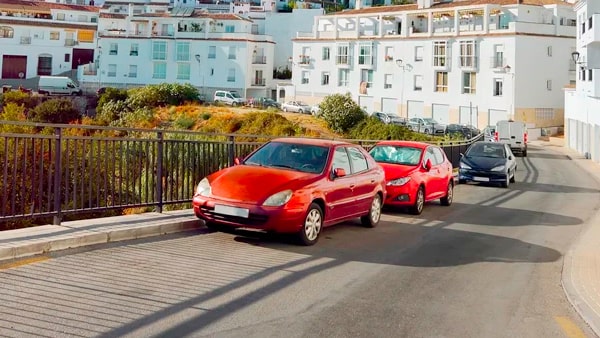
If you park uphill beside a curb, how should the front wheels be positioned?

When parking your vehicle facing uphill with a curb, you should point your front wheels:
  1. A. Turned toward the curb
  2. B. Turned away from the curb
  3. C. Pointed either direction
  4. D. Kept straight

Correct answer: B. – Turned away from the curb

For uphill parking with a curb, turn the front wheels away from the curb. If the vehicle begins rolling backward, a front wheel should contact the curb rather than allowing the vehicle to enter traffic. The Tennessee manual also directs drivers to set the parking brake and leave an automatic transmission in Park or a manual transmission in gear.

Source: Tennessee Comprehensive Driver License Manual — “Parking,” “When Parking on a Hill Follow These Rules”