Tennessee Road Signs Test 2

4.9 out of 5 (225 votes)
80% Passing score
20 Questions
4 Mistakes allowed
A Tennessee road signs practice test gives you a straightforward way to deal with the sign-and-signal material that shows up on the state’s regular Class D knowledge test. Road signs, traffic signals, pavement markings, lane markings, sign shapes, and sign colors are a big part of the larger knowledge test given by the Tennessee Department of Safety and Homeland Security, Driver Services Division. That official test is based on the Tennessee Comprehensive Driver License Manual, which means it can wander beyond signs pretty quickly. You may see questions on traffic laws, safe driving habits, alcohol and drug rules, general driver responsibility, and the sort of road-rule details that feel obvious until they are phrased in the driest possible way. The online Class D knowledge test has 30 multiple-choice questions, a 60-minute limit, and an 80% passing score. So, in plain English, you need 24 correct answers and can miss no more than 6. Not brutal, exactly, but not something to freestyle either. This Tennessee DMV road signs test keeps its attention on the visual stuff: regulatory signs, warning signs, guide signs, traffic signals, markings, colors, and shapes. Red signs usually tell you what not to do, yellow signs are there to wave a caution flag, and green signs tend to point you somewhere useful. Fine. Easy enough. Except the real value is learning what each sign wants you to do behind the wheel, because “recognize the sign” and “react correctly to the sign” are not always the same skill, annoyingly. When you finish the practice test, you get a summary of what you missed along with the correct answers. That little review section is where the studying actually gets less vague. Maybe you keep mixing up sign shapes. Maybe pavement markings are the sneaky problem. Maybe you are great with warnings but oddly shaky on regulatory signs. It happens. This free Tennessee road signs practice test works for new drivers preparing for the Class D permit knowledge test, and it is also useful for licensed drivers brushing up before renewal. It will not replace the official manual, driver education, or the state exam itself. It will, however, make the sign portion feel a lot less like guessing with a steering wheel nearby.
FREE DMV Practice Test App
Study for your Tennessee permit test or driver’s license with the NextDoorDriving app. 700+ DMV questions and answers, 100% free!
Download on the App Store

Sample Tennessee Permit Test Questions

Question 1

A centerline has one solid yellow line and one broken yellow line. When may you pass?

You may cross a double line to pass another vehicle if the line on your side is:
  1. A When the solid line is on your side
  2. B From either direction whenever traffic is light
  3. C When the broken line is on your side and the pass can be completed safely
  4. D Only when the roadway also has a solid white edge line

Correct answer: C – When the broken line is on your side and the pass can be completed safely

A broken yellow line on your side identifies a passing zone, while a solid yellow line on your side prohibits passing. You may begin the maneuver only when it is safe and lawful. Return completely to your side of the roadway before the passing zone ends.

Source: Tennessee Comprehensive Driver License Manual — Ch. 3, “Uniform Highway Markings”

Question 2

A yellow diamond sign displays a black cross formed by two roads. What does it warn you about?

This sign shows one type of:
  1. A A crossroad intersection ahead
  2. B A series of roadway curves
  3. C A mandatory right turn
  4. D A lane shift ahead

Correct answer: A – A crossroad intersection ahead

The crossroad warning sign indicates that another road intersects the roadway ahead. It alerts you to the possibility of entering or crossing traffic. Watch for vehicles, pedestrians, and any traffic-control devices at the intersection.

Source: Tennessee Comprehensive Driver License Manual — Ch. 3, “Warning Signs—Diamond Shape (Yellow)”

Question 3

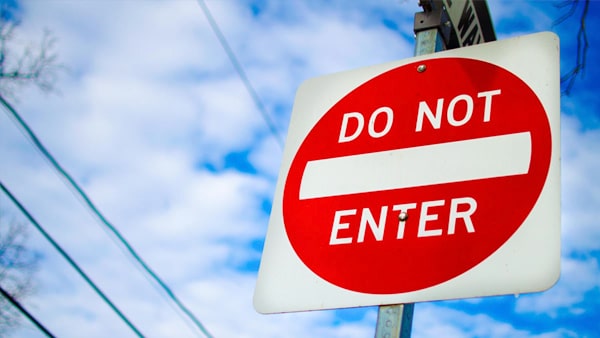
What does a red circular sign with a horizontal white bar mean?

This sign means:
  1. A Stop
  2. B No U-turn
  3. C Yield
  4. D Do not enter

Correct answer: D – Do not enter

This is a DO NOT ENTER sign. It identifies a roadway or ramp that traffic must not enter from that direction, commonly because traffic beyond the sign travels the opposite way. Do not continue past it.

Source: Tennessee Comprehensive Driver License Manual — Ch. 3, “Regulatory Signs”

Question 4

At a stop sign, where must you make your initial stop when a stop line or crosswalk is present?

  1. A Where you can first see all cross traffic
  2. B Past the crosswalk but before the intersection
  3. C Before the stop line, or before entering the crosswalk if no stop line exists
  4. D Five feet before the stop sign

Correct answer: C – Before the stop line, or before entering the crosswalk if no stop line exists

Tennessee requires a driver to stop at a clearly marked stop line. If there is no stop line, stop before entering the crosswalk. When neither exists, stop at the point nearest the intersecting roadway where you have a view of approaching traffic, without entering that roadway.

Source: TCA § 55-8-149 — Stop Signs and Yield Signs, Tennessee Comprehensive Driver License Manual — Ch. 3, “Stop Lines”

Question 5

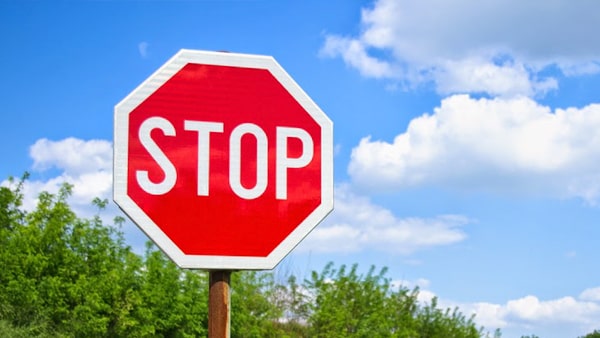
What action is required at a red, eight-sided STOP sign?

When you see this sign, you must:
  1. A Come to a complete stop and yield as required before proceeding
  2. B Slow down and continue if no vehicle is visible
  3. C Stop and remain there until a green light appears
  4. D Reduce speed only when cross traffic is present

Correct answer: A – Come to a complete stop and yield as required before proceeding

A STOP sign requires a complete stop at the designated stopping position. After stopping, yield to pedestrians and vehicles that have the right-of-way and proceed only when movement can be made safely. Merely slowing down is not a complete stop.

Source: TCA § 55-8-149 — Stop Signs and Yield Signs, Tennessee Comprehensive Driver License Manual — Ch. 3, “Octagon Shape—Stop”

Question 6

You must not cross a broken white or yellow line when:

  1. A The movement would be unsafe or interfere with traffic
  2. B Turning left into a driveway where the turn is otherwise lawful
  3. C Passing a disabled vehicle when the maneuver is lawful and safe
  4. D Changing lanes on a one-way street when the next lane is clear

Correct answer: A – The movement would be unsafe or interfere with traffic

Broken markings do not give a driver an unconditional right to cross them. A broken white line permits a lane change or pass when safe, and a broken yellow line permits passing from that direction when safe. Remain in your lane if crossing would conflict with other traffic.

Source: Tennessee Comprehensive Driver License Manual — Ch. 3, “Uniform Highway Markings” and “White Lane Markings”