


Texas Class A CDL Practice Test (TX) 8

5 out of 5 (122 votes)
80% Passing score
50 Questions
10 Mistakes allowed
Howdy, Texans! Ready to rev up your skills for the Class A CDL? Our eighth Texas CDL practice test is right here, waiting for you to grab the wheel. Picture this: 50 questions that dive deep into the essentials of driving big rigs. You gotta nail at least 40 to pass, but hey, no pressure. We're talking real-world scenarios, from gear shifting (yep, downshifting's in there too) to handling those Texas-sized hills and downgrades. But here's the kicker: we've got visual learning aids. Think of it as your personal road map, with images of signs and traffic situations to help you learn better. It's like having a co-pilot in your learning journey. And don't forget, these tests are a great sidekick to your Texas drivers ed. They're not a replacement, but they sure do make a mighty fine complement. Especially since some of y'all need to complete state-certified courses. The beauty of our Texas CDL practice test? You can take it as many times as you like. It's like a rehearsal before the main show. Get comfy with these questions, and when you're ready, you can mosey on over to the next challenge. Remember, it's about getting you prepared and confident for that big day at the DMV. So, whether you're new to the game or just brushing up, this Texas DPS permit practice test is your ticket to mastering the Class A CDL in 2026. Don't just take it from us; give it a go and see for yourself how it can steer you toward success on the actual permit test!
FREE CDL Practice Test App
Pass your Texas CDL General Knowledge test with the NextDoorDriving app. Real questions and answers—100% free and ad-free.
Download on the App Store

Sample Texas CDL Test Questions - General Knowledge

Question 1

When scanning the roadway ahead, which two broad categories should a commercial driver monitor?

  1. A Traffic and road conditions
  2. B Only vehicles and traffic signals
  3. C Only disabled vehicles and debris
  4. D Only curves and pavement damage

Correct answer: A – Traffic and road conditions

A driver should look ahead for traffic and changing road conditions. Traffic includes vehicles entering the highway, moving into the lane, turning, or braking. Texas CDL guidance emphasizes seeing these developments far enough ahead to adjust speed or position without making a sudden maneuver.

Source: Texas Commercial Motor Vehicle Drivers Handbook — § 2.4.1, “Seeing Ahead”
Question 2

What should you do before taking a curve in a commercial vehicle?

  1. A Reduce to a safe speed and select the proper gear before entering
  2. B Shift to a higher gear and accelerate before entering
  3. C Wait until you are in the curve, then brake hard

Correct answer: A – Reduce to a safe speed and select the proper gear before entering

Slow to a safe speed and downshift to the appropriate gear before entering the curve. Braking or shifting while turning can make it more difficult to maintain control. The selected gear should allow you to apply slight power through the curve and accelerate smoothly as you leave it.

Source: Texas Commercial Motor Vehicle Drivers Handbook — § 2.3.1, “Before Entering a Curve”

Question 3

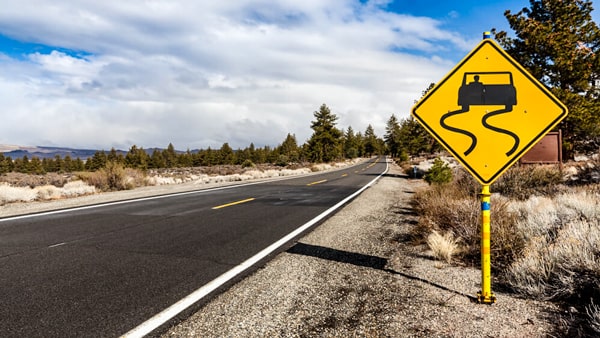
What does a SLIPPERY WHEN WET warning sign indicate?

This sign warns drivers to  _________________.
  1. A The roadway may become unexpectedly slippery when wet
  2. B Driving is prohibited whenever it rains
  3. C Vehicles may become stuck beside the roadway after rain
  4. D The roadway is slippery under all weather conditions

Correct answer: A – The roadway may become unexpectedly slippery when wet

The sign warns that unexpected slippery conditions may be present when the roadway is wet. Wet pavement reduces traction and can substantially increase stopping distance. A commercial driver should lower speed as conditions require and allow enough room to stop safely.

Source: Manual on Uniform Traffic Control Devices for Streets and Highways, 11th ed. — § 2C.30, “Surface Condition Signs (W8-5, W8-7, W8-8, W8-11, W8-13, and W8-14)”, Texas Commercial Motor Vehicle Drivers Handbook — § 2.6.2, “Matching Speed to the Road Surface”

Question 4

A school-bus route should be planned to use backing whenever convenient.

  1. A TRUE
  2. B FALSE

Correct answer: B – FALSE

Backing a school bus is strongly discouraged and should occur only when there is no other safe way to move it. The bus must never be backed while students are outside. When backing is unavoidable, Texas school-bus guidance calls for precautions such as posting a lookout, checking mirrors and rear windows, and moving slowly.

Source: Texas Commercial Motor Vehicle Drivers Handbook — § 10.7.3, “Backing”

Question 5

Under normal conditions, how should you brake a commercial vehicle equipped with ABS?

  1. A Pump the brake pedal rapidly
  2. B Brake normally, using the force needed to stop safely and maintain control
  3. C Always press the pedal as hard as possible
  4. D Release the accelerator and wait for ABS to apply the brakes

Correct answer: B – Brake normally, using the force needed to stop safely and maintain control

ABS does not change the way you normally apply the brakes. Use only the braking force needed to stop safely and remain in control, whether ABS is installed on the tractor, trailer, or both. In an emergency stop with working ABS on all axles of a straight truck or combination vehicle, the brakes may be fully applied.

Source: Texas Commercial Motor Vehicle Drivers Handbook — § 2.18.6, “Braking with ABS”

Question 6

Which statement about alcoholic beverages is correct?

  1. A Experienced drivers are not affected by alcohol
  2. B A 12-ounce 5% beer contains about as much alcohol as a 1.5-ounce shot of 80-proof liquor
  3. C Coffee and fresh air quickly remove alcohol from the body
  4. D Drinking rapidly results in a lower blood alcohol concentration

Correct answer: B – A 12-ounce 5% beer contains about as much alcohol as a 1.5-ounce shot of 80-proof liquor

A 12-ounce serving of 5% beer, five ounces of 12% wine, and 1.5 ounces of 80-proof liquor contain approximately the same amount of alcohol. Alcohol affects every driver's performance regardless of the beverage type. The body processes alcohol at a limited rate; drinking faster raises the amount present, and only time produces sobriety.

Source: Texas Commercial Motor Vehicle Drivers Handbook — § 2.22.1, “Alcohol and Driving”