


Texas CDL Practice Test (TX) 2026

4.8 out of 5 (664 votes)
80% Passing score
20 Questions
4 Mistakes allowed
Y'all ready to gear up for the Texas CDL Practice Test? Right here's your starting line. With a set of 20 questions, this permit practice test is your first step towards mastering the essentials for your CDL written test. Nail at least 16, and you're cruising! Designed with multiple choice questions, it's not just any old test. It's a powerhouse of real Texas permit test answers and study aids. Stuck on a tough one? We've got your back with hints and explanations. This ain't just for those aiming for Class A or B driver's licenses. It's the universal starting point, covering the general knowledge you need, regardless of the class or endorsements you're after. This Texas DPS written test is the same across the board, making it a solid foundation for all aspiring commercial drivers in 2026. Expect a wide array of topics, from pre-trip vehicle inspection to controlling your rig on steep downgrades. We're talking shifting gears, even the nitty-gritty of downshifting, and how to communicate with other road users - all of the things covered in a typical Texas drivers ed course. Plus, we dive into crucial topics like speed control, and the ever-important drug and alcohol awareness. Here's where it gets real interesting. Some of these Texas permit test questions throw you into the driver's seat with real-life scenarios. It's about taking that book-smarts and applying it to the asphalt and dirt roads you'll be navigating. Our Texas DPS test questions aren't just picked out of a hat. They're crafted and reviewed by professional driving instructors, folks who've been teaching Texans to drive big rigs for years. They know their stuff and they're passing that knowledge on to you. To keep you on your toes, each time you take this Texas CDL practice test, the questions shuffle. No memorization tricks here - it's all about truly understanding what you're learning. So, fire up your engine and get ready to tackle the Texas CDL Practice Test. It's your first step to hitting the highways with confidence and safety in 2026!
FREE CDL Practice Test App
Pass your Texas CDL General Knowledge test with the NextDoorDriving app. Real questions and answers—100% free and ad-free.
Download on the App Store

Sample Texas CDL Test Questions - General Knowledge

Question 1

A curve warning sign has a 40 mph advisory speed plaque. What does the plaque tell you?
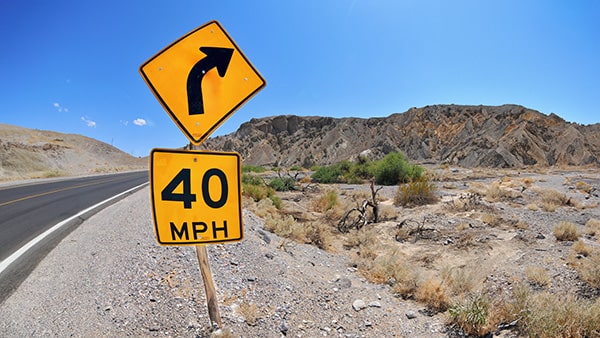
This sign warns drivers to _______________.
  1. A Stay in the right lane unless traveling faster than 40 mph
  2. B Maintain a minimum speed of 40 mph
  3. C Consider 40 mph the recommended speed for the curve
  4. D The curve has a regulatory speed limit of exactly 40 mph

Correct answer: C – Consider 40 mph the recommended speed for the curve

The 40 mph plaque advises drivers to consider that speed when negotiating the curve under normal conditions. It is not a minimum-speed sign or the same as a regulatory speed-limit sign. In Texas, advisory speed plaques supplement warning signs and alert drivers that a speed below the posted limit may be appropriate. A commercial driver must reduce speed further when the vehicle, load, weather, or road surface requires it.

Source: 2025 Texas Manual on Uniform Traffic Control Devices — § 2C.59, “Advisory Speed Plaque (W13-1P) and Confirmation Advisory Speed Plaque (W13-1aP)”.

Question 2

Which listed hazardous-material classes are subject to loading rules that keep the lading within the vehicle body rather than projecting beyond it?

  1. A Class 1 explosives
  2. B Class 4 flammable solids
  3. C Class 5 oxidizers
  4. D All three listed classes

Correct answer: D – All three listed classes

Class 1 explosive lading generally must remain entirely within the vehicle body or its horizontal outline, with any tailgate closed and secured. Class 4 and Class 5 lading generally must remain within the body, be covered, and have a closed, secured tailgate. A limited pickup-and-delivery exception applies to the Class 4 and Class 5 rule, so the exact operation and packaging must be considered.

Source: Texas Commercial Motor Vehicle Drivers Handbook — § 9.4.1, “General Loading Requirements—Use Closed Cargo Space”, 49 CFR § 177.835(h) – Class 1 (Explosive) Materials, 49 CFR § 177.838(a) – Class 4 (Flammable Solid) Materials, Class 5 (Oxidizing) Materials, and Division 4.2 (Self-Heating and Pyrophoric Liquid) Materials

Question 3

Which items deserve extra attention during a winter vehicle inspection?

  1. A Coolant level and antifreeze protection
  2. B Heating and defrosting equipment
  3. C Windshield wipers and washers
  4. D All of these items

Correct answer: D – All of these items

All three items require attention before winter driving. The cooling system needs enough coolant and antifreeze to prevent freezing, while the heater and defroster must work correctly. Wiper blades should be in good condition, and the washer system should contain suitable fluid and operate properly. The Texas handbook lists each of these checks as part of preparing a commercial vehicle for winter conditions.

Source: Texas Commercial Motor Vehicle Drivers Handbook — § 2.13.1, “Vehicle Checks”

Question 4

At a stop sign in Texas, which action is required?

When approaching this sign _____________.
  1. A Stop only when cross traffic is present
  2. B Yield without stopping if the intersection appears open
  3. C Slow down and check both directions
  4. D Come to a complete stop at the required stopping point

Correct answer: D – Come to a complete stop at the required stopping point

A driver must stop at the marked stop line. If there is no line, the stop must occur before entering the near crosswalk; if neither exists, stop at the nearest point with a view of approaching traffic. After stopping, the driver must yield to a vehicle already in the intersection or approaching closely enough to present an immediate hazard.

Source: Tex. Transp. Code § 544.010 – Stop Signs and Yield Signs, Tex. Transp. Code § 545.153 – Vehicle Entering Stop or Yield Intersection

Question 5

How should you respond when another vehicle is following your CMV too closely?

  1. A Brake sharply to warn the other driver
  2. B Flash the brake lights repeatedly
  3. C Increase the space between you and the vehicle ahead
  4. D Signal the other driver to pass

Correct answer: C – Increase the space between you and the vehicle ahead

Increase your following distance to create more space ahead. That added room reduces the chance that you will need to brake suddenly or make a quick direction change. It may also make it easier for the tailgating driver to pass. Avoid speeding up, abrupt braking, or tricks such as flashing the brake lights, because those actions can increase the danger.

Source: Texas Commercial Motor Vehicle Drivers Handbook — § 2.7.2, “Space Behind—Dealing with Tailgaters Safely”

Question 6

Compared with a flat mirror, what does a convex mirror provide?

  1. A A wider field of view
  2. B An image that makes objects appear closer
  3. C An image that makes objects appear larger
  4. D No useful difference in the viewing area

Correct answer: A – A wider field of view

A convex mirror shows a wider area than a flat mirror, helping the driver monitor areas that might otherwise be difficult to see. Objects in a convex mirror appear smaller and farther away than they actually are. Drivers must account for that distortion when judging another vehicle's distance. Convex mirrors supplement proper observation but do not eliminate every blind spot.

Source: Texas Commercial Motor Vehicle Drivers Handbook — § 2.4.2, “Seeing to the Sides and Rear—How to Use Mirrors”