What Counts as Behind-the-Wheel Driver Education?
For teen driver’s ed, Texas divides the mandatory in-car training into three parts:
- Behind-the-wheel instruction: The student drives while an instructor teaches and evaluates skills.
- In-car observation: The student watches while driving techniques are demonstrated.
- Supervised practice: The student drives with a qualified adult present to gain experience.
Texas Behind-the-Wheel Requirements at a Glance
Use this table to compare the classroom and in-car requirements for teen and adult driver’s ed in Texas.
| Requirement | Teen under 18 | Adult age 18–24 | Adult age 25+ |
|---|---|---|---|
| Driver education | 24 classroom hours | 6 classroom hours | Not generally required |
| Formal driving instruction | 7 hours | Not included | None required |
| In-car observation | 7 hours | Not included | None required |
| Supervised practice | 30 hours | No state minimum | No state minimum |
| Night driving | 10 of the 30 practice hours | No required minimum | No required minimum |
| Permit holding period | 6 months | None | None |
Teen Behind-the-Wheel Hours
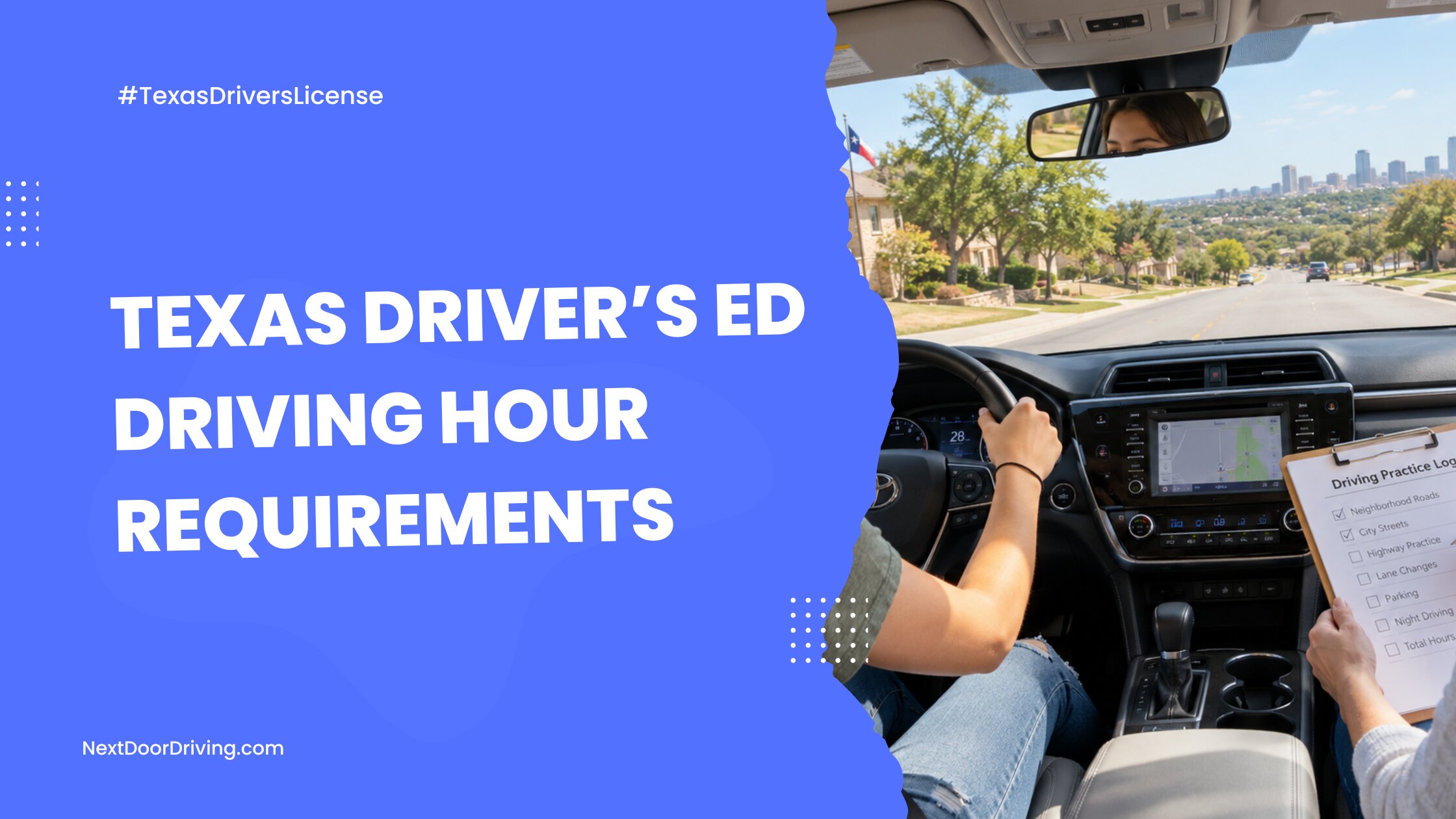
A teen completing Texas driver education must finish 44 hours of in-car training, to include:
- 7 hours of behind-the-wheel instruction
- 7 hours of in-car observation
- 30 hours of supervised practice, including 10 hours at night
During the initial seven-hour instruction phase, the student operates the vehicle while an instructor teaches core driving skills. During the seven observation hours, the student watches while the instructor or a peer demonstrates driving skills. Observation hours are not counted as student driving time.
The remaining 30 hours help the teen gain driving experience. These hours do not need to be overseen by an instructor, but must be supervised by an adult who:
- Is at least 21
- Has at least one year of driving experience
- Holds a valid driver license
- Sits in the front passenger seat
When Can a Teen Start Driving?
While teens can begin the classroom portion of driver’s ed at age 14, they cannot apply for a Learner License (permit) until they are 15 and have passed the knowledge exam. A teen cannot begin behind-the-wheel training until they hold the learner permit. Under the concurrent method (usually parent-taught), a student may qualify for a permit after the first six classroom hours and then start the in-car phase while finishing the remaining classroom hours. Under the block method, the student completes all 24 classroom hours before obtaining the permit and starting the driving phase.
How Quickly Can Teens Complete the In-Car Hours?
Texas limits how quickly teens can complete in-car training, but the daily limits depend on the type of driver education program. For a parent-taught driving course, students may complete no more than two hours of in-car instruction and two hours of supervised practice per day. Because the 30 practice hours are limited to two hours per day, they must span at least 15 calendar days. Instructor-taught driving schools follow separate state scheduling limits for formal in-car instruction. Students should follow the schedule and recordkeeping rules provided by their school or parent-taught course provider.
How Parent-Taught Driver’s Ed Works
Texas Parent-Taught Driver Education (PTDE) follows the same structure, with the student completing coursework online and the designated parent instructor conducting the initial 14 hours of in-car training using an approved parent-taught driving course curriculum. The supervising adult for the additional 30 practice hours does not have to be the designated PTDE instructor.
Note for parent-taught driving students: When you choose a Texas Parent-Taught Driver Education course, you must order the PTDE Program Guide packet from the Texas Department of Licensing and Regulation (TDLR) before any hours can legally count. The Program Guide costs $20 and will formally designate your PTDE instructor.
How are practice hours documented?
The additional practice hours must be recorded on an official 30-Hour Practice Log form. This log records the driving dates, session lengths, daytime and nighttime hours, and supervising adult information. A teen must present this completed practice log at the provisional license appointment.
Adults Ages 18–24
First-time license applicants ages 18 through 24 must complete a TDLR-approved six-hour Texas Adult Driver Education course. Adults looking for online driver’s ed can complete the course remotely through a licensed provider, whilc some local driving schools offer in-person adult courses.
Texas adult driver’s ed course requirements do not include:
- Behind-the-wheel instruction
- In-car observation
- Supervised practice hours
- A nighttime-driving requirement
- Recording hours on a log form
The streamlined six-hour course focuses on Texas traffic laws and driver responsibilities. Approved courses typically embed an official DPS knowledge test as the final exam, allowing adults to skip the in-person written test at the DPS office. After completion of the six-hour course, the provider issues an ADE-1317 certificate. The adult driver education certificate does not prove driving proficiency, so an inexperienced adult must still arrange supervised practice before taking the Texas road test.
Adults Age 25 and Older
In Texas, license applicants age 25 or older do not have to complete formal driver education. Many applicants over 25 voluntarily take the six-hour adult course to prepare for licensing and waive the DPS office knowledge test. Adults in this age range must still be prepared to pass the Texas driving test, so they must arrange sufficient practice.
How Adults Can Practice Driving
Adults who need to practice driving can file a Driver License Application (Form DL-14A) at the DPS to obtain a license with Restriction B, which acts as the Texas adult driving permit. Like a teen permit, an adult B-restricted license requires an eligible driver age 21 or older to sit in the front passenger seat.
Since Texas does not set a minimum number of practice hours, adults should continue practicing until they can drive safely without coaching. Before scheduling the road test, a new driver should be able to:
- Start, stop, and control the vehicle smoothly
- Follow signs, signals, and right-of-way rules
- Maintain a safe speed and following distance
- Check mirrors and blind spots
- Turn, back, change lanes, and park safely
- Monitor surrounding traffic
- Make independent driving decisions
Optional Driving Lessons
For teens, the required 14-hour formal in-car phase may be provided by a licensed driving instructor or an authorized parent-taught instructor, depending on their course. Adults taking the six-hour driver education course do not receive in-car instruction, unless they pair it with a lesson package at a commercial driving school. New drivers of all ages may choose to take at least a few professional lessons to build confidence, improve specific skills, or gain access to a safe practice vehicle. Driving lessons can be costly, but may be invaluable for drivers who need help perfecting certain skills, like parallel parking or highway driving.
Road Test Readiness
Completing driver education does not necessarily mean a student is ready for the Texas road test. Most teens need more than the minimum required driving hours, and since teens must hold a Learner License for 6 full months before taking the road test, there is no need to rush this practice phase. For adults, completing driver’s ed (or studying independently, if over 25) does not fully develop the practical skills needed for safe driving. Every new driver should practice as much as necessary to drive safely and independently.
The Impact Texas Drivers (ITD) Course Mandate
Before taking a Texas driving test, all applicants must complete the Impact Texas Drivers (ITD) video program on the dangers of distracted driving. Access the free video on the DPS Impact Texas Drivers (ITD) Program portal and choose the appropriate video course for your age:
- Teens: Two-hour Impact Texas Teen Drivers (ITTD)
- Adults: One-hour Impact Texas Adult Drivers (ITAD)
Certificate note: Your ITTD/ITAD completion certificate must be dated within 90 days of the driving test, and you must present a printed copy of your certificate whether you take the road test through the DPS or an authorized third-party testing provider.