
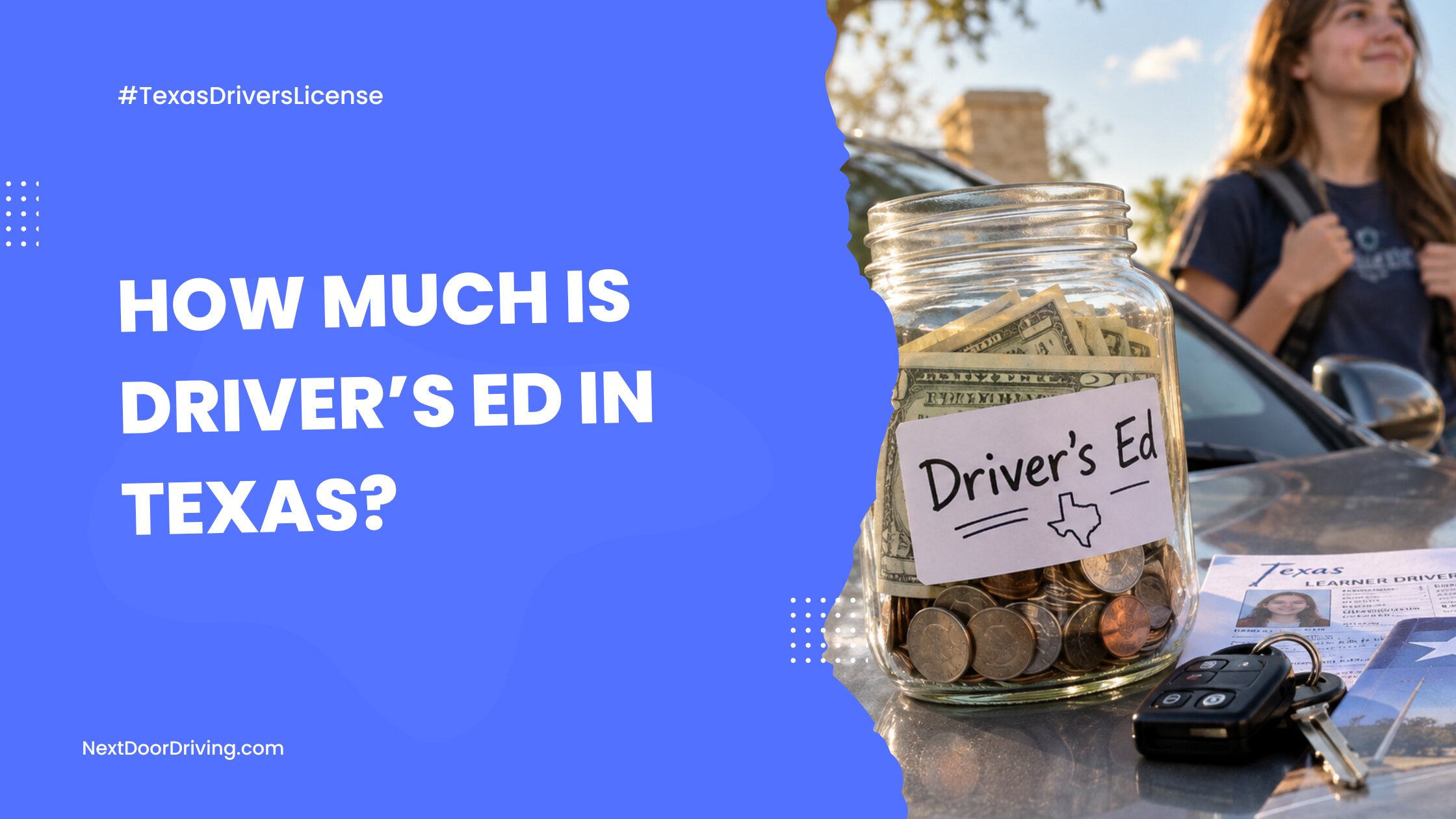
Texas Driver’s Ed Costs at a Glance
To help you estimate your out-of-pocket costs for driver’s ed, the table below compares average course tuition for each Texas driving course option alongside state and third-party administrative fees.
| Program Type | Target Age | Typical Course Price | Mandatory Third-Party and State Fees | Total Estimated Out-of-Pocket |
|---|---|---|---|---|
| Parent-Taught (PTDE) Online | Teens (14–17) | $44 – $100 | $20 TDLR Packet + $16 permit fee | $80 – $136 |
| Online Course + Commercial Lessons | Teens (14–17) | $375 – $550 | $16 permit fee | $391 – $566 |
| Commercial Driving School (In-Person) | Teens (14–17) | $350 – $800+ | $16 permit fee | $366 – $816+ |
| Adult Course Online | Adults | $24 – $75 | $33 license fee | $57 – $108 |
| Adult In-Person Classroom | Adults | $75 – $125 | $33 license fee | $108 – $158 |
| High School Program | Teens | $0 – $250 | $16 permit fee | $16 – $266 |
Driver’s Ed Program Options
Choosing the right Texas driver’s ed program comes down to the student’s age, family budget, and whether self-paced learning or hands-on coaching works best.
Texas Parent-Taught Driver’s Ed
With a Texas Parent-Taught Driver Education (PTDE) course, a qualified parent or designated adult oversees the teen’s online classroom learning and conducts the initial 14 hours of behind-the-wheel instruction using materials from an approved provider. Parent-taught students can get their learner’s permit after 6 hours and finish coursework online while practicing on the road at their own pace. The parent-taught driving path is a good choice for self-motivated teens and budget-conscious families.
Before starting a parent-taught course, families must order the PTDE Program Guide directly from TDLR for $20. The parent-trainer must meet state eligibility rules, including holding a valid driver’s license for 3 years with no DWI convictions in the past 7 years. For families comparing online drivers ed in Texas, the parent-taught driving course offers more schedule flexibility and can cost much less than a full-service private driving school.
Commercial Driving Schools
Private driving schools offer the most structured form of Texas driver education, combining classroom instruction with professional behind-the-wheel training. A commercial school may be a good choice for families who want professional driving lessons in dual-controlled vehicles. Standard packages bundle classroom theory with the initial 14 hours of behind-the-wheel instruction, while premium packages can add one-on-one driving sessions, door-to-door pickup and drop-off, and vehicle rental for the final driving exam.
Teens looking for a hybrid approach can enroll in an online Texas Instructor-Led Teen Driver Education course for the classroom portion, then hire a driving school for behind-the-wheel training. Driving schools may offer lessons for adults, and rates for teens and adults can vary.
Adult Driver Education (Ages 18+)
An approved 6-hour adult driver education course is required for first-time drivers ages 18 through 24. Most adults choose online programs that can be completed in a single sitting or taken at their own pace. While driver’s ed is optional for adults over 25, many choose to take the Texas 6-Hour Adult Driver Education course online to bypass the written test at the DPS office, since an official permit test is included within the course.
Public High School Driver Education
Select public school districts offer Texas-certified driver education courses as an elective or after-school program. Because tuition is partially subsidized by local school funds, fees for these courses can vary. Under Texas Education Agency rules, public school programs are required to offer financial hardship waivers or reduced fees for qualifying low-income students. Taking driver’s ed at school can be a good fit for students who thrive in a traditional classroom setting. However, course slots fill quickly and run on the academic calendar, making them less flexible than online alternatives.
Looking for driver’s ed in Spanish? If you or your teen prefer learning in Spanish, NextDoorDriving.com offers TDLR-certified drivers education courses with official permit tests in Spanish.
What Is–and Isn’t–Included in the Advertised Course Price
Don’t get caught off guard by hidden fees. Before purchasing a driver’s ed course, confirm what a provider’s base price actually covers.
Your driver education tuition should include:
- Access to a full state-approved curriculum (24 hours for teens or 6 hours for adults)
- An official DPS written knowledge exam
- The driver education certificate (DE-964 for teens or ADE-1317 for adults)
- Standard digital certificate delivery
Buyer Beware: How to Avoid Fake Courses and Hidden Fees
When comparing drivers ed in Texas, verify that the provider holds an active TDLR license and that the course is approved for the licensing path you need. Look for a state license number starting with “C” on their website. Be cautious of sites advertising “100% Free Driver’s Ed,” as they often supply non-approved study guides that cannot generate the official DE-964 or ADE-1317 certificates required by the DPS for a license.
Even among legitimate online providers, base prices can be misleading because of checkout add-ons. Common “hidden” fees include:
- Certificate delivery: Low advertised rates can jump if the provider charges extra fees to generate, email, or mail your official completion certificate.
- Administrative fees: TDLR does not bill students checkout fees directly, so watch out for line items labeled as mandatory “state filing” or administrative processing.
- Audio upgrades: Features like narrated audio or text-to-speech are often locked behind extra add-on fees.
- Practice test and retake paywalls: Some providers charge additional fees if you fail practice quizzes or the written knowledge test and need to take it again.
Always check your final order summary to confirm that the advertised rate covers complete course access, exam attempts, and official certificate generation without mandatory add-ons.
The Youth Driver Education Funding Program
While Texas has no universal free driver’s ed program, eligible applicants can receive coverage through the Texas Workforce Commission (TWC) Youth Driver Education Funding Program. This initiative pays for approved driver education courses and required behind-the-wheel instruction for current or former foster youth, young adults experiencing homelessness, and individuals affected by family or dating violence.
To participate, applicants submit an application to the TWC before enrolling in driver education. Once approved, the state remits payment directly to a TWC-contracted, TDLR-licensed driving school on the student's behalf. Additionally, some public school districts offer subsidized driver training or hardship fee waivers for enrolled students in need.

_thmb_360.jpg)