Quick Look: Driver’s Ed vs. Defensive Driving
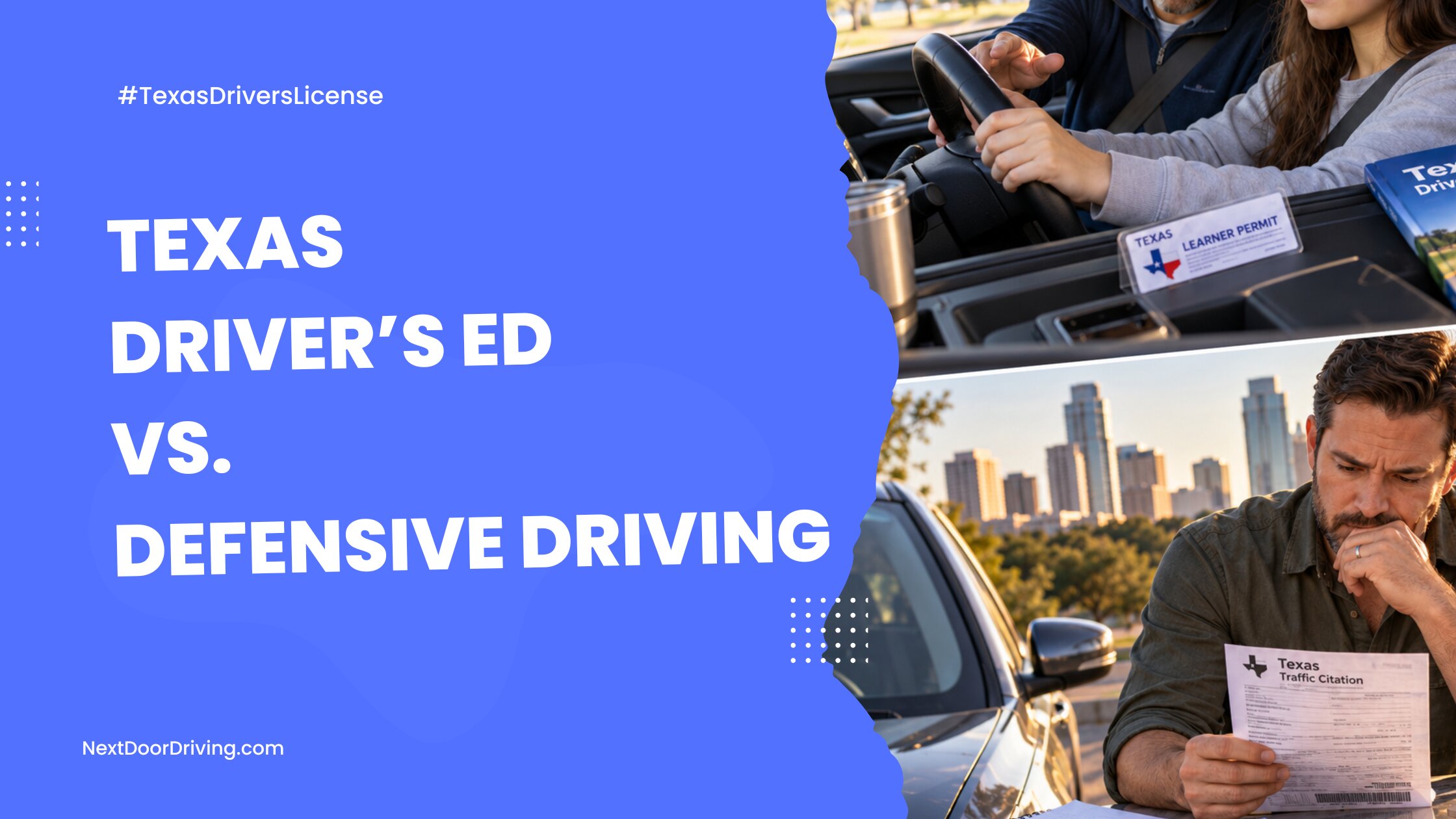
A Texas adult driver education course is required for all new license applicants aged 18–24. Defensive Driving is a supplemental training course, usually taken by licensed drivers for ticket dismissal or an insurance discount. Although both are six-hour courses, they are not interchangeable.
How Texas 6-Hour Driving Courses Compare
Although each is a 6-hour driving course, Texas ensures the two programs have different content, students, requirements, and completion certificates.
| Feature / Criteria | 6-Hour Adult Driver’s Ed (ADE) | 6-Hour Defensive Driving (DSC) |
|---|---|---|
| Primary purpose | Satisfies licensing requirements for first-time adult applicants | Resolves citations, fulfills court orders, or earns insurance discounts |
| Target audience | Unlicensed adults aged 18–24 (optional for 25+) | Licensed drivers handling a citation or seeking policy discounts |
| Official certificate | ADE-1317 | DS-230 |
| DPS written test waiver | Yes, waives the written knowledge test at the DPS office | No, does not grant a written exam waiver |
| Ticket dismissal capability | No, courts will reject this certificate | Yes, with prior authorization from the citation court |
| Course fee structure | Set by individual private providers (market rates) | State-mandated minimum course fee of $25 |
Why drivers confuse these courses: Both programs require six hours of instruction, so vendors often market them under generic labels like “Texas 6-Hour Driving Course” or “online driving class.” Drivers often assume there is no real difference, but the courses have different curricula and serve separate legal functions. To avoid taking the wrong class, always verify whether it generates an ADE-1317 Texas driver education certificate for licensing or a DS-230 certificate for ticket dismissal or insurance purposes.
What Is 6-Hour Texas Adult Driver Education?
Texas adult driver education is a classroom program designed primarily for adults earning their first driver license. Completing a TDLR-approved Texas 6-Hour Adult Driver Education course is mandatory for any first-time license applicant between the ages of 18 and 24. Adults aged 25 and older are not legally required to take driver’s ed, though many choose to do so voluntarily to skip the knowledge test at the license office. Texas authorizes both in-person and online adult driver education programs.
What You’ll Learn in Adult Driver’s Ed
An approved Texas adult driver education course covers the traffic laws, safety principles, and risk-reduction skills new drivers need before driving independently. These subjects distinguish the program from a shorter exam-prep product. The Texas adult course is also streamlined compared to the teen program, since adults are not required to have a set number of behind-the-wheel training or driving practice hours.
The DPS In-Person Exam Waiver
Major advantages of a TDLR-approved adult driver’s ed course are that it can be taken completely online and usually includes an official Texas written knowledge exam. Passing this test in your driver’s ed course waives the requirement to sit for the written knowledge exam at the DPS office.
Next Steps to Get Your Driver License
Finishing the Texas adult driver’s ed course does not grant full driving privileges. First-time applicants must complete several other requirements before receiving their license:
- Complete the free ITAD video course through the official DPS Impact Texas Adult Drivers portal. The ITAD certificate expires after 90 days, and you must present a valid one at the road test.
- Gather your required licensing documents (i.e., proof of identity, Social Security Number, two proofs of Texas residency, and ADE-1317 driver’s ed certificate).
- Pass your road test at a DPS office or third-party provider, finalizing your license application with the DPS.
What Is 6-Hour Texas Defensive Driving (Driving Safety Course)?
Unlike initial driver’s ed, Texas Defensive Driving is structured as a risk-reduction refresher for individuals who are already licensed to drive. In official Texas legal code, a defensive driving program is formally referred to as a Driving Safety Course (DSC), so you will see both terms used to refer to the same type of course.
Dismissing a Texas Traffic Ticket
The most frequent application for a driver safety course is eliminating an eligible traffic citation to prevent convictions from posting to a driver’s state record. However, enrolling in a course does not automatically dismiss a ticket. Drivers must formally request permission from the court handling their citation on or before the answer date printed on the notice.
Court Eligibility Rules
To qualify for statutory ticket dismissal under Chapter 45A of the Texas Code of Criminal Procedure (formerly Article 45.0511), drivers must meet specific legal criteria, to include:
- The driver must hold a valid Texas driver license or permit.
- Commercial Driver License (CDL) holders are strictly ineligible for ticket dismissal, even if the violation occurred in a personal vehicle.
- The driver must not have completed a driving safety course for citation dismissal within the 12 months preceding the offense date.
- The citation must not involve serious infractions, such as passing a school bus or failing to stop at an accident scene.
- Citations for speeds of 25 mph or more above the posted limit (or any speed of 95 mph or higher) are strictly ineligible.
- The offense must not have occurred in a construction or maintenance work zone when workers were present.
If Your Traffic Safety Course Request is Approved
Once the court approves your request for Defensive Driving, you are typically granted 90 days to complete the course, submit your signed DS-230 certificate, and provide a Certified Type 3A Driving Record to the court clerk. You must order this official record directly from the online Texas DPS: Driver Records portal for a $10 state fee. Courts mandate the Type 3A record alongside your completion certificate to independently verify that you have not had another ticket dismissed this way within the previous 12 months.
Course Fees
Under Texas Education Code § 1001.352, providers must charge a state-mandated minimum fee of $25 for a Defensive Driving program. When taken for ticket dismissal, drivers must also budget for court administrative fees (up to $10 per eligible charge) and the cost of acquiring their certified DPS driving record.
Insurance Discounts
When taking a Defensive Driving course voluntarily for an auto insurance discount, drivers should verify terms directly with their provider before enrolling. Under the Texas Insurance Code, auto insurance companies are permitted to offer premium discounts for completing an approved driving safety course, but they are not legally mandated to do so. Discount percentages, eligible coverage types, and policy renewal requirements vary by insurer.
Decision Guide: Which Course Do You Need Right Now?
To select the correct course, match your situation to the appropriate scenario below.
| Your Current Goal | Required Course | Action Step |
|---|---|---|
| Get a driver's license (Ages 18–24) | 6-Hour Adult Driver’s Ed | Earn an ADE-1317 certificate. |
| Dismiss a traffic ticket | 6-Hour Defensive Driving | Get court approval first, then complete the course for a DS-230 certificate. |
| Get a driver's license (Ages 25+) | 6-Hour Adult Driver’s Ed (Optional) | Optional, but waives the written DPS knowledge test. |
| Lower auto insurance rate | 6-Hour Defensive Driving | Confirm discount eligibility with your carrier before enrolling. |
How to Avoid Enrolling in the Wrong Course
Because online providers use similar marketing, checking the provider’s course code before enrolling is the single best way to avoid taking the wrong program:
- Adult Driver Education (Certificate ADE-1317): Look for course titles specifically containing “Adult Driver Education” or “License Applicants.” The course description will mention submitting completion details to the DPS to earn a driver license.
- Driving Safety Course (Certificate DS-230): Look for titles containing “Defensive Driving” or “Ticket Dismissal.” The registration process will typically ask for your citation number, court name, or auto insurance provider.
Before paying, verify the certificate code issued upon completion. State-approved vendors are legally required to list whether they issue an ADE-1317 or a DS-230 in their course registration details.