Arrested for DWI in Texas? You have 15 calendar days to request an ALR hearing and prevent an automatic suspension!
License Reinstatement: Quick Reference
- Official online portal: Driver License Eligibility System at Texas.gov
- Standard reinstatement fee: $100.00
- ALR / DWI reinstatement fee: $125.00
- ALR hearing request deadline: 15 calendar days from date of notice or arrest
- Mandatory SR-22 filing period: 2 consecutive years from conviction or action date
- Online payment processing time: Immediate to 48 hours
- Mail processing time: Up to 21 business days
Understanding Your License Status: Suspension vs. Revocation
Before taking action, it helps to understand how the DPS classifies your driving status. The state uses distinct legal terms to describe why and how your driving privileges have been restricted, which dictates the steps needed for reinstatement.
- Suspension: A temporary withdrawal of your driving privilege for a set timeframe or until specific conditions are satisfied.
- Revocation: An indefinite termination of your license.
- Cancellation: The rescinding of a driver license because you no longer qualify for it, or because it was issued based on inaccurate information.
- Denial: An administrative hold preventing you from applying for or renewing a license.
- Prohibition: An order preventing a person who does not hold a Texas license from obtaining one for a set period.
Common Reasons for License Suspension
A Texas driver’s license may be suspended for a wide variety of criminal, civil, administrative, and safety reasons. These include:
- Driving while intoxicated (DWI) and chemical test refusals
- Failure to maintain insurance
- Habitual traffic violations
- Driving while license invalid (DWLI)
- Failure to appear in court or pay fines (denial of license renewal)
- Delinquent child support
- Medical Advisory Board actions
- Controlled substance offenses
How to Reinstate Your Texas License
Restoring your driver license happens in steps, and making sure to do each one can prevent unnecessary trips and delays.
Step 1: Check Your License Status
Your first step is to visit the official Texas Driver License Eligibility Portal.
To log in, you will need your Texas Driver License or ID number, your date of birth, and the last 4 digits of your Social Security Number.
The portal provides a list of every active enforcement action against you, along with the specific compliance documents required and the DPS fees owed.
Step 2: Complete Compliance Requirements
Gather and submit all requested documentation listed in your portal report. Depending on your situation, this may include:
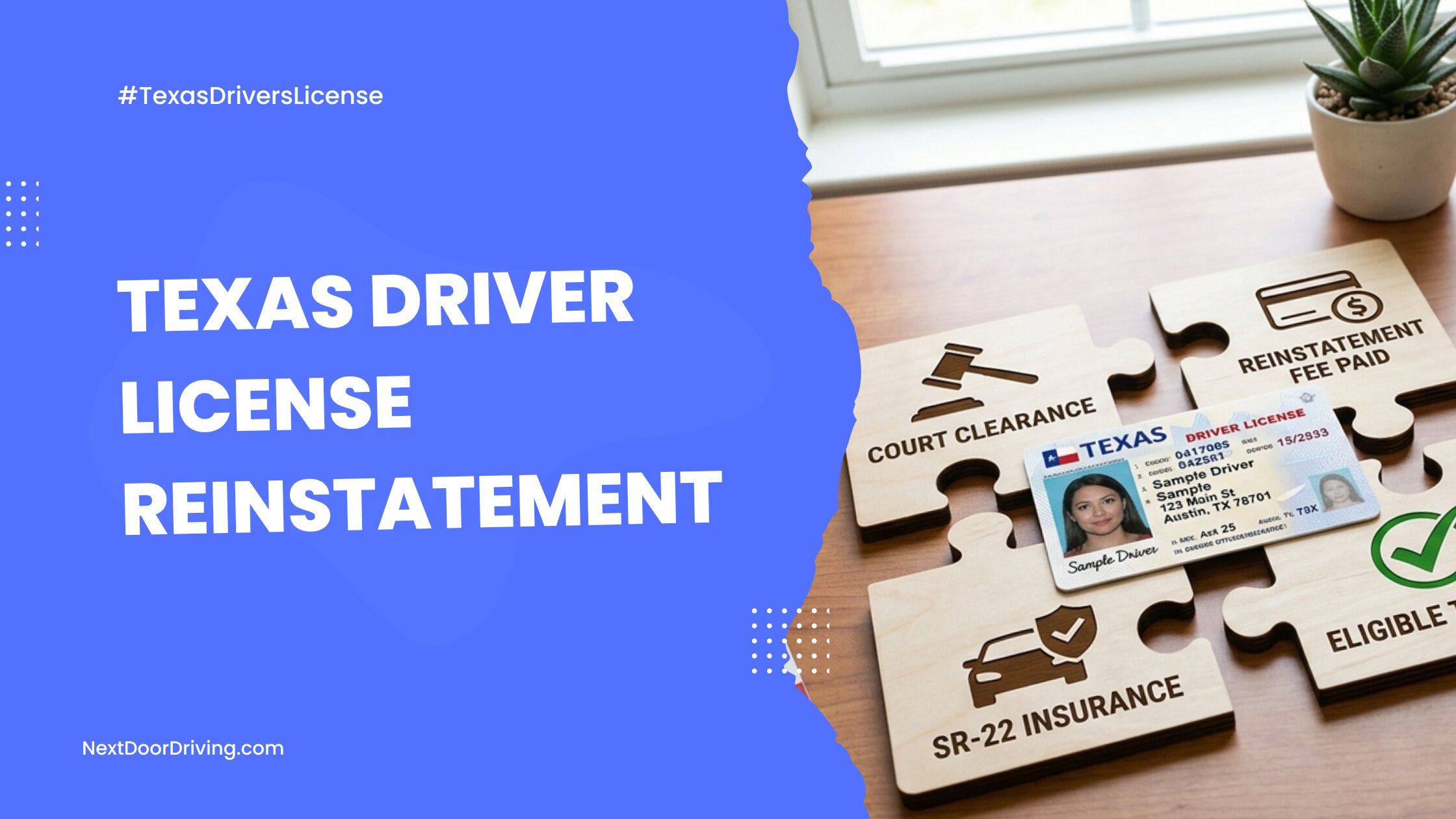
- A SR-22 Insurance Certificate
- Proof of completing a state-approved education course
- OmniBase court clearances
- Certified court orders or medical evaluations
You can upload PDF compliance documents directly through the online system, or send them via mail to the DPS.
Step 3: Pay Reinstatement Fees
Pay all outstanding administrative fees owed to the DPS. You can pay online through the portal using a major credit or debit card (subject to a $5.75 processing fee), or mail a check or money order payable to the “Texas Department of Public Safety” with your driver’s license number noted.
Step 4: Verify Your Status Has Changed to “Eligible”
Your license is not back in good standing until the DPS has cleared every enforcement action and the portal shows that you are eligible. Do not drive until your status on the portal reads “Eligible.”
Note: If your physical driver license expired or was surrendered during your suspension period, you must apply for a replacement or renewal online or in person at a DPS office before driving legally.
Alcohol and Drug Violations
Alcohol and drug offenses carry strict administrative timelines that are completely separate from your criminal court case.
Administrative License Revocation (ALR)
If you are arrested for DWI and either refuse to submit to a breath or blood test or yield a Blood Alcohol Concentration (BAC) of 0.08% or higher, the arresting officer will serve you with a notice of suspension. To contest an automatic license suspension, you must request an ALR hearing with the State Office of Administrative Hearings (SOAH).
For breath tests or refusals, you have 15 calendar days from the date of arrest to file your request. For blood test cases, the deadline begins when DPS mails you the notice. Missing your deadline results in an automatic suspension that takes effect on the 40th day.
Criminal DWI Convictions and Multi-Year Suspension
A criminal conviction for DWI triggers a separate suspension process on your driving record. To clear a conviction-based action, you must serve the court-ordered suspension period, submit proof of completion for required educational programs, pay a $100 reinstatement fee, and maintain SR-22 insurance for 2 consecutive years from the conviction date.
Financial Responsibility Proofs
Texas requires all drivers to prove they are financially responsible for potential damages or injuries they might cause on public roads. Usually, this means carrying your auto insurance card, but high-risk drivers can be asked to do more.
The SR-22 Certificate
An SR-22 is not ordinary insurance; it is an official certificate of financial responsibility that your insurance company files directly with the DPS. It guarantees that you carry the minimum Texas legal liability coverage limits:
- $30,000 for bodily injury/death of one person
- $60,000 for bodily injury/death of two or more people in one crash
- $25,000 for property damage
For most high-risk suspensions (including ALR, DWI, DWLI, or operating a vehicle without insurance), you must maintain continuous SR-22 coverage for 2 consecutive years from the date of conviction or enforcement action.
What Happens If My SR-22 Lapses?
If your SR-22 policy is canceled or lapses for any reason during your 2-year mandatory period, your insurance carrier is legally required to file Form SR-26 with the DPS. Upon receipt, the DPS will immediately re-suspend your driver license. To resolve this, you must refile a valid SR-22 and pay a new $100 reinstatement fee.
Resolving Past Damages
If your license was suspended because of an uninsured motor vehicle crash or an unpaid civil judgment resulting from an accident, the DPS requires financial resolution before restoring license eligibility. You can clear these holds by submitting one of the following:
- A notarized Release of Liability signed by the other party
- A certified court-approved Installment Agreement showing active compliance
- Proof that the court judgment has been fully satisfied
- A qualifying security deposit submitted directly to the DPS
How to Get an Occupational Driver License (ODL)
If your license is suspended, you may qualify for an Occupational Driver License (ODL). An ODL is a special restricted license issued by a court that grants you permission to drive for essential activities, such as work, school, household needs, and medical care.
ODLs come with certain restrictions:
- Texas law limits ODL driving to a standard maximum of 4 hours in a 24-hour period. However, if you show necessity, the court can extend this limit up to 12 hours per day.
- If your suspension stems from a repeat DWI conviction or chemical test refusals, the court may require an Ignition Interlock Device (IID) in your vehicle as a mandatory condition for granting the ODL.
Documents Required to Apply for an ODL
To petition a Justice of the Peace, County Court, or District Court for an ODL, you must gather and submit:
- A petition for an ODL filed in the county where you reside or where the suspension originated
- A certified copy of your complete driving record (Type AR); you can order the record through the DPS Driver Record System for $20.
- Proof of active SR-22 insurance
- An official employer affidavit or schedule justifying any additional driving hours
- Payment for court filing fees (ranging between $46 and $297)
Once the judge signs the court order granting the ODL, you must send a certified copy of the petition, court order, SR-22, and the required $10/year issuance fee to the DPS. A certified copy of the ODL order acts as your temporary driving permit for 45 days.
Non-Criminal Holds
Not all suspensions stem from major traffic offenses. Administrative holds placed by other entities can block your license renewal or trigger immediate suspensions.
Clearing Failure to Appear (FTAP) and Court Holds
Under the Failure to Appear (FTAP) program, municipal and county courts report drivers who fail to appear for a traffic court date or fail to pay an authorized fine. If this happens, OmniBase (the private vendor that maintains the administrative database) places a hold on your record that prevents license renewal.
Note that paying the DPS will not clear an OmniBase hold. You must contact the specific reporting court, resolve the ticket or court debt directly, and ensure the court sends an official clearance notification to OmniBase and the DPS. A $10 administrative reimbursement fee per citation is typically added.
Delinquent Child Support Revocations
Under the Texas Family Code, the Office of the Attorney General (OAG) can request the revocation or non-renewal of a driver license for individuals with delinquent child support payments.
To clear this hold, you must enter into an approved payment arrangement directly with the OAG Child Support Division. The DPS cannot lift the revocation until it receives an official release directly from the child support enforcement authority.
Out-of-State Traffic Convictions
Texas participates in national driver databases, so if your driving privilege is suspended or reported for unresolved citations in another state, Texas will block your eligibility until you obtain an official clearance letter from that state.
Medical Advisory Holds
If the DPS receives information that a medical, physical, or vision condition impairs your ability to drive safely, you may be required to submit a physician evaluation (Form MAB-82) or complete a driving examination before regaining your license.
License Reinstatement Fees
The following table lists current license reinstatement fees. Note that all administrative fees imposed by the DPS are statutory and cumulative, meaning if you have multiple suspension actions on your record, you must pay the fee associated with each action.
| Fee Description | Standard Amount | Key Details |
| Standard Administrative Reinstatement Fee | $100.00 | Applies to DWLI, drug offenses, point suspensions, no-insurance actions. |
| ALR / DWI Fee | $125.00 | Applies to breath and blood test failures or refusals. |
| Texas.gov Online Convenience Fee | $5.75 | Standard processing fee for online payments. |
| OmniBase / FTAP Court Reimbursement Fee | $10.00 | Fee per citation paid directly to the court. |
| Occupational License Issuance Fee | $10.00 / year | Mandatory fee paid to the DPS to issue an ODL certificate. |
| Certified Driving Record (Type AR) | $20.00 | Required for court review when applying for an ODL. |
| Court ODL Filing Fee | $46.00 – $297.00 | Local court filing costs vary widely by county and court level. |
FAQs
Can I reinstate my Texas driver’s license online?
You can complete several parts of the process online, including checking your eligibility, reviewing compliance requirements, uploading certain documents, and paying DPS fees. However, court obligations, education courses, insurance filings, or license renewal requirements may need to be completed separately, often in person.
How long does it take for the DPS to process my reinstatement?
If you pay your fees online through the portal, fee clearances update almost immediately (or within 24–48 hours). However, if you submit compliance documents (such as course completion certificates or court orders) by mail or fax, processing can take up to 21 business days.
Can I drive to work while my license is suspended in Texas?
You can only drive legally if you petition a court and obtain a certified order granting an Occupational Driver License (ODL), maintain SR-22 insurance, and fulfill all court conditions. Driving on a suspended license without an ODL can result in a charge of Driving While License Invalid (DWLI).
Is there a waiting period before an Occupational Driver License takes effect?
Texas enforces mandatory “hard suspension” waiting periods before an ODL becomes effective if you have prior drug or alcohol offenses. Installing an Ignition Interlock Device (IID) on your vehicle may waive these waiting periods under Texas law, allowing you to drive immediately.
Can I get an Occupational Driver License if I hold a Commercial Driver License (CDL)?
An Occupational Driver License cannot authorize you to operate a commercial motor vehicle during a CDL disqualification. While an ODL can sometimes grant permission to operate a non-commercial (personal) vehicle during a suspension, commercial driving privileges can only be restored after serving the full CDL disqualification period and satisfying all underlying state requirements.