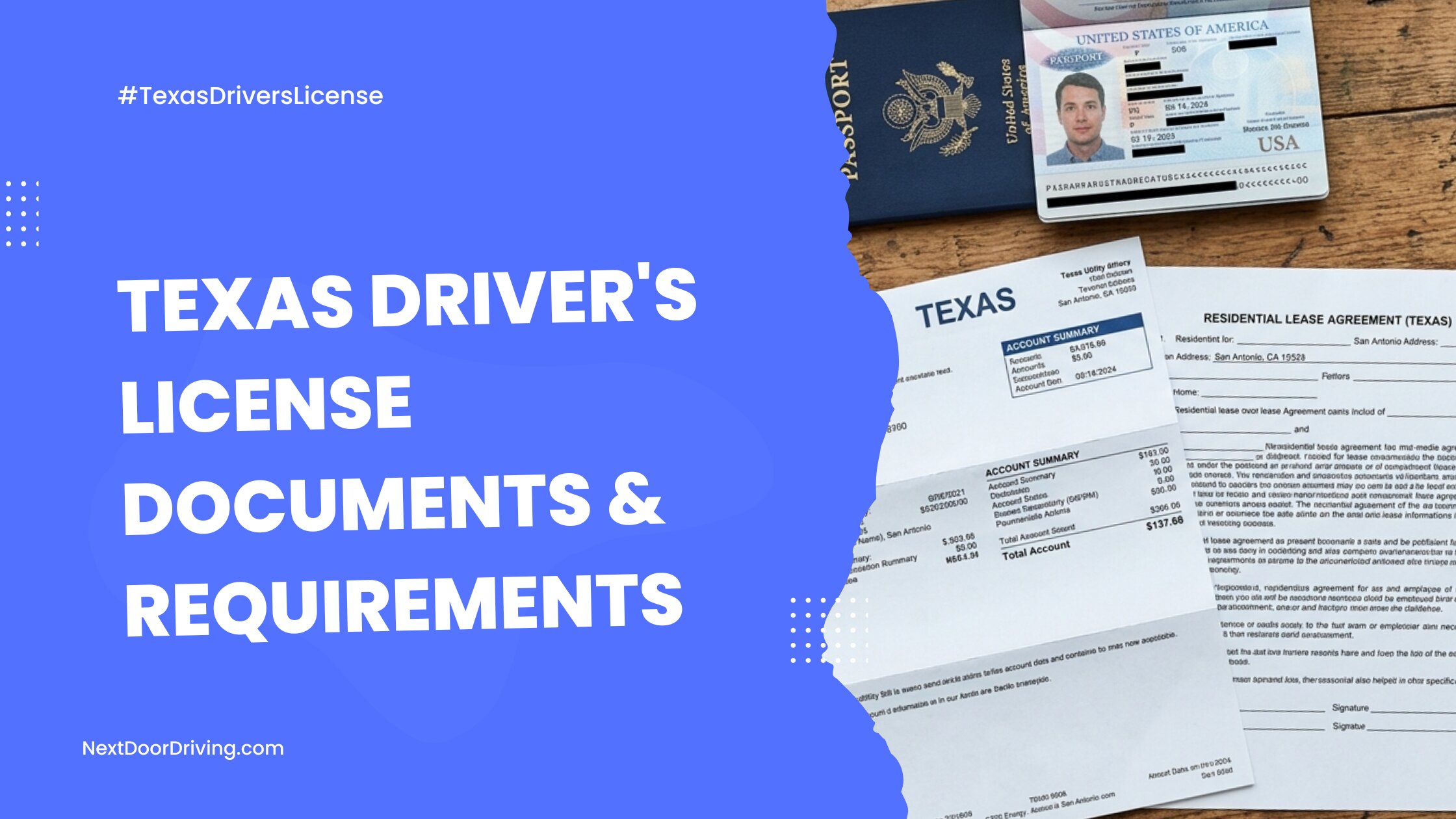
Texas Driver License Checklist: What to Bring to the DPS
Use this quick checklist to make sure you have everything you need for your Texas license appointment:
- Form DL-14A or DL-14B
- Proof of identity
- Proof of citizenship or lawful presence
- Social Security card
- Two proofs of Texas residency
- Driver Education Certificate (ages 14–24)
- Verification of Enrollment (VOE) Form (under 18)
- Printed Impact Texas Drivers (ITD) Certificate
- Texas registration and insurance (for vehicle owners)
Note: All documents must be original, paper copies. The DPS does not accept digital copies, PDFs, or phone screenshots.
Texas Driver License Eligibility: Who Needs to Apply?
If you live in Texas permanently and plan to drive, you are legally required to hold a Texas license.
New resident? If you have recently moved to Texas, you have 90 days from the date you establish residency to exchange your driver’s license without needing to take the written and road tests.
Am I exempt? Active-duty military members, their dependents, out-of-state college students, and NATO staff do not need a Texas license as long as they hold a current license from their home state or country.
Required Documents for a New Texas Driver’s License
To help your DPS appointment run smoothly, assemble a folder with all the required documents for a new Texas license. You will need to provide evidence for each of the following categories.
Proof of U.S. Citizenship or Lawful Presence
The forms you need depend on your citizenship and residency status.
- U.S. citizens should bring a certified original U.S. birth certificate, a valid U.S. passport, or a Certificate of Naturalization (Form N-550) or Citizenship (Forms N-560 and N-561).
- Non-citizens should bring a valid permanent resident card, employment authorization card (EAD), or a foreign passport attached to an approved tracking visa (Form I-94). Your Texas license will expire on the same date as your immigration documents, with a maximum term of one year.
Proof of Identity
The DPS asks you to prove your identity in one of three ways:
- Bring one secure document that contains your photo and full name. Examples include a valid U.S. Passport, a military ID card, or a current Permanent Resident Card.
- Bring two secondary records. Examples include an original U.S. birth certificate, a driver license from another state, or a military discharge record (Form DD-214).
- Bring one item from the secondary list plus two minor records, such as an official high school transcript, a Social Security card, a W-2/1099 tax form, or a signed voter registration card.
Proof of Texas Residency
Bring two unique, printed documents that list your full name and residential address.
Examples of acceptable proof include:
- Utility bill, dated within 180 days (electric, water, gas, internet, cellular, television or streaming, or lawn services)
- Active lease agreement
- Bank statement
- Paycheck stub, dated within 180 days
Key rules to remember for residency proof are:
- At least one residency document must show that you have lived in Texas for 30 consecutive days prior to your application date. This is waived for new residents surrendering a license.
- If you live with someone and do not have bills in your own name, that person must accompany you to the DPS counter and offer address proofs; you will both sign an official Texas Residency Affidavit (Form DL-5).
Social Security Number Verification
The application form will ask for your Social Security Number (SSN). While it is not universally mandatory to display your original card at the counter if the system can verify you automatically, it is a good idea to bring your physical Social Security card or a printed corporate W-2 form to avoid name discrepancies. If you do not qualify for a SSN, you must sign an official Social Security Number Affidavit.
Texas Vehicle Registration and Proof of Insurance
You must present a printed, active insurance card and Texas vehicle registration receipt for every vehicle registered in your name. If you do not own a vehicle, you will sign an affidavit certifying that you do not own one.
Driver Education and Testing Certificates
The educational certificates you need to provide depend on your age bracket:
- Under 25: Bring your official Driver Education Completion Certificate (Form DE-964 for teens or Form ADE-1317 for adults). If you took a parent-taught driving course, bring a printed copy of your PTDE receipt or confirmation email showing the date you purchased the PTDE Program Guide.
- Under 18: Bring a Verification of Enrollment (VOE) Form (DL-104) signed by your high school registrar within the last 30 days (up to 90 days during the summer). If you do not have a summer VOE, you may bring an end-of-year report card showing at least 90% attendance. If you have graduated or have a GED, bring this certificate instead.
- Age 25+: If you have a Driver Education certificate (Form ADE-1317), bring it to waive the written test.
- All ages: Anyone taking a road skills test must present a printed copy of their Impact Texas Drivers (ITD) certificate, dated within 90 days. Minors will watch the 2-hour Impact Texas Teen Drivers (ITTD) video, while adults watch the 1-hour Impact Texas Adult Drivers (ITAD) video. The videos are free and available on the DPS Impact website.
Paper-Only Policy: The DPS enforces a strict paper-only policy at every office. Agents cannot accept digital PDFs, email confirmations, or screenshots.
DPS Identity Proofs List: For a current list of acceptable identification documents, see the DPS Identification Requirements page.
Need Driver’s Ed? If you need driver education, NextDoorDriving offers fully online, TDLR-approved courses for teens and adults. All NextDoorDriving courses are available in Spanish so you can complete your driver education and official written test in your preferred language.
Your Driver License Application
Before arriving at the DPS counter, you should fill out the bulk of a driver license application (Form DL-14A/B), though you should wait to sign it in front of the agent.
Along with basic personal information, the form will ask you about health conditions that could impact your driving, your driving history, consent for voter registration and organ donation, and the automatic Selective Service registration (for eligible males ages 18–25). Providing false information on this form is a criminal offense.
Medical History Note: Checking “Yes” to a medical condition does not trigger an automatic denial. It may prompt a standard medical review or a routine restriction to keep you safer behind the wheel.
Note for Minors: If you are under 18, a parent or legal guardian must accompany you in order to sign your license application.
Texas DPS Exams
For a Texas driver’s license, you need to pass three key exams: a written knowledge test, a vision test, and a behind-the-wheel driving test.
The Written Permit Test
The written knowledge test is a 30-question, multiple-choice exam that covers Texas traffic laws, road signs, and safe driving practices. To pass, you need a score of at least 70%. Passing the written test allows you to receive a learner’s permit.
People who take driver education usually take the written test as part of their driver’s ed course. If you still need the written test, you may take it at the DPS office or with an approved third-party provider.
The Vision Test
Every driver must pass a vision test at the DPS counter to qualify for a license. The agent will simply ask you to read rows of letters on a screen or wall chart. If you have glasses or contact lenses, you should bring and wear them for this test. If you do not meet a minimum vision standard, you will be given a form to take to an eye specialist for more evaluation, and your application will be put on hold.
The Road Skills Test
At your official road test, an examiner will evaluate how well you control the vehicle, follow traffic laws, and make safe driving decisions. If you pass and all of your documents are in order, DPS will issue a temporary paper license that day, and your hard card will be mailed to you.
If you do not pass the road test, you may retake it, but Texas allows only three test attempts within 90 days before you must submit a new driver license application and pay the application fee again.
Booking Your DPS Appointment
You can choose to take your road test at a DPS location or an authorized Third-Party Skills Testing (TPST) center, scheduling both through the Texas DPS - Appointment Scheduler portal. Be aware that DPS wait times can be weeks to months, depending on the location, while third-party wait times are generally shorter. If you take the road test with the DPS, you must bring a vehicle, while a third-party center will generally provide a testing car for a small fee.
Texas Driver License Fees
A Texas license fee includes the vision screening and up to three attempts at the written and road tests within 90 days. The current fees are:
- Learner License (under 18): $16
- Provisional License (under 18): $16
- Adult license (ages 18–84): $33
- Senior license (ages 85+): $9
- Replacement or duplicate card: $11
A $1 administrative fee is included for online and in-person transactions but not for mail-in transactions.
Texas Driver License FAQs
Do Texas Driver Licenses Count as a REAL ID?
A REAL ID card has an extra layer of verification and allows for commercial travel and access to secure federal property. Since 2016, Texas has issued licenses that are fully REAL ID-compliant. When you look at a REAL ID license, you will spot a star stamped in the top right-hand corner. On older Texas designs, this appears as a gold star inside a circle; on the newly updated Texas cards, it is a black star silhouette.
Can I be seen at the DPS without an appointment?
It is advised to schedule an appointment before visiting a Texas DPS driver license office. Some offices may offer a limited number of same-day appointments, but availability is not guaranteed and these spots can fill quickly. To ensure you are seen, use the Texas DPS Appointment Scheduler ahead of time, choose the service that matches your need, and bring all required printed documents to your appointment.
Can I use residency documents that are in someone else’s name?
Yes, but you will need to use the Texas Residency Affidavit process. If you live with someone else and do not have two residency documents in your own name, that person must come with you to the DPS office, bring their own proof of identity and Texas residency documents, and sign the Texas Residency Affidavit form. The DPS will use the affidavit and the other person’s documents to help verify where you live. This process generally applies to teens living with a parent, spouses who recently moved, or adults living with a roommate.
Do I need driver education if I already know how to drive?
If you are 15–24 and applying for your first Texas driver license, yes. Texas requires everyone in this age range to complete a (teen or adult) driver education course, even if they already know how to drive. If you are 25 or older, formal driver education is optional, but you must still pass the required exams to obtain a license.
Can I take driver education online in Texas?
Yes, Texas allows eligible students to complete driver education online through a state-approved provider. Adults ages 18–24 may take the 6-hour adult driver education course online, and the course should include the written knowledge test. Teens may take the 24-hour Texas teen course online, and complete their 14 in-car instructional hours with a licensed driving school or an eligible parent-trainer through the Parent-Taught Driver Education (PTDE) program. Both adults and teens should make sure a course is approved by TDLR so it will count for licensing.