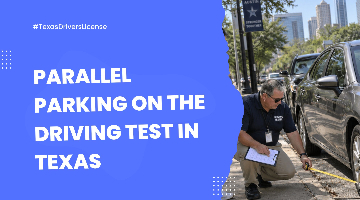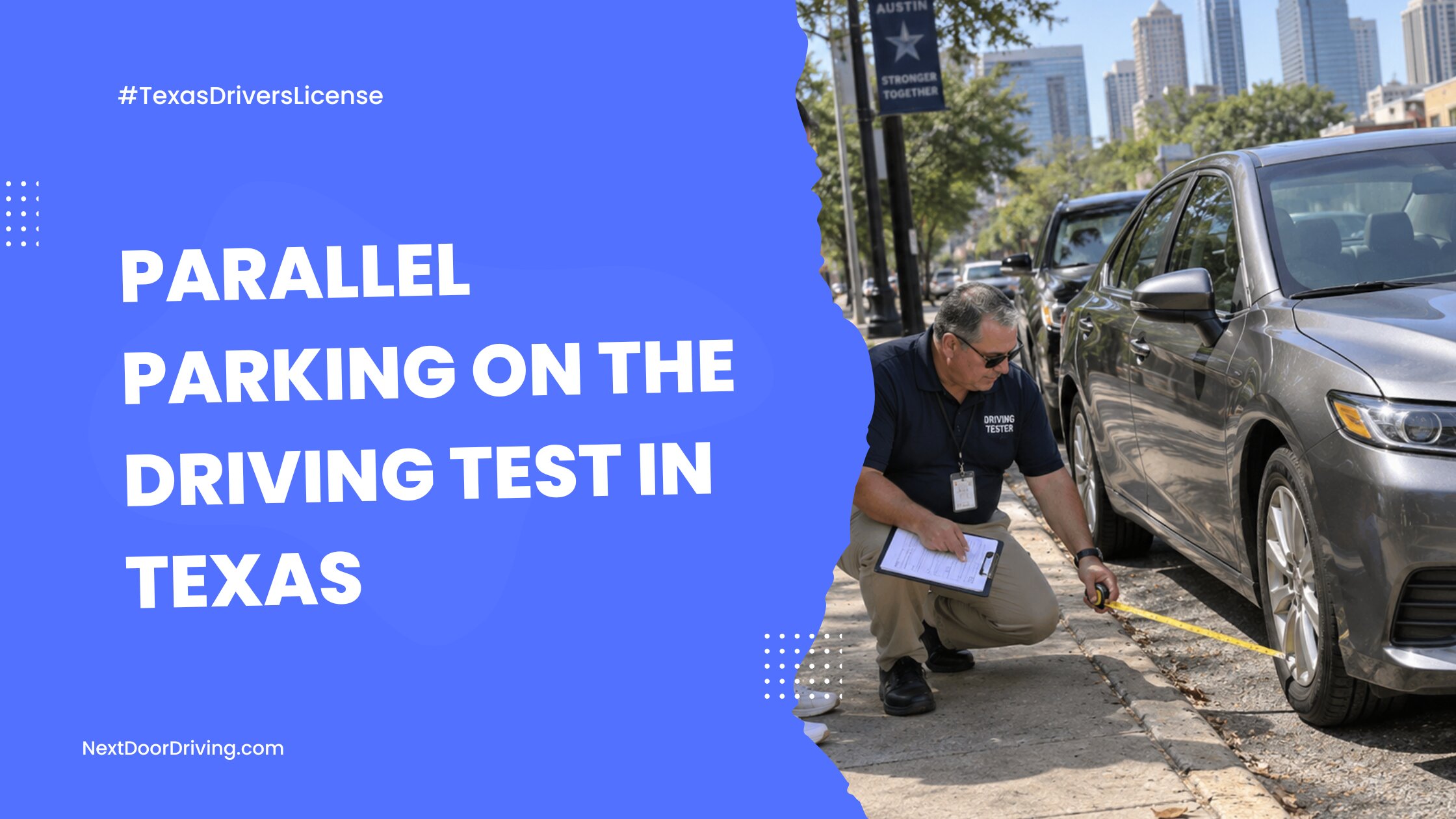
Is Parallel Parking on the Texas Driving Test?
Parallel parking is a mandatory part of the Texas Class C road test. Organized under 37 Texas Administrative Code §15.56, the road skills exam consists of three distinct evaluations: the on-street test, the backing test, and the parallel parking test. Losing too many points on any one section can lead to failure, so it’s important to practice parallel parking before taking your Texas drivers test.
Distance and Setup
Parallel parking is typically evaluated at the beginning or end of the Texas driving test, and done in a controlled setting like a parking lot. Examiners will rarely ask you to park between two passenger vehicles. Instead, DPS offices and third-party testing centers set up designated parking lanes marked by traffic cones or poles representing the rear bumper of a front car and the front bumper of a rear car. Texas also doesn’t enforce a single, fixed length for the parking test space. Instead, testing sites adjust the cones based on the size of the vehicle you use. However, state rules do inform where your car should end up in the space.
| Parameter | Texas Official Guidance and Statutory Rules |
|---|---|
| Initial Setup Distance | Approximately 2 feet out from the front vehicle or cone |
| Target Curb Distance | Approximately 6 inches from the curb (Texas Driver Handbook) |
| Maximum Legal Distance | Within 18 inches of the right-hand curb (Texas Transportation Code §545.303) |
| Final Vehicle Alignment | Must finish centered between front and rear boundary markers, parallel to the road edge |
While the DPS has guidelines for cone spacing, physical setups vary slightly between testing locations. At DPS mega centers in Dallas or Houston, parallel parking grids are typically marked out on flat concrete lots with tall, rigid poles. At smaller rural offices, you might be parking against a painted curb line with flexible rubber cones. Practicing in more than one location can help you feel prepared on test day.
Texas’ Four-Step Parallel Parking Technique
The official Texas Driver Handbook details a four-step approach for safe, controlled parallel parking. Focusing on each step allows time for steering corrections and prevents rushed turns.
When practicing parallel parking before your driving test, perform these steps in order:
- Approach the space, keeping about two feet of clearance from the front marker. Signal your intention to turn right before reaching the open space so trailing traffic understands your plan. Pull forward until your vehicle’s rear bumper is aligned evenly with the simulated vehicle beside you, maintaining approximately two feet of side clearance.
- Check all mirrors and blind spots for approaching traffic, cyclists, or pedestrians. Shift into Reverse, turn your steering wheel fully to the right (toward the curb), and begin backing up slowly.
- Reverse into the space, steering smoothly. When your front seat aligns roughly opposite the rear bumper of the simulated front vehicle, turn your steering wheel fully to the left while maintaining a slow, crawling speed. Continue backing into the space without making contact with the curb or rear marker.
- Once your vehicle is parallel to the curb, straighten your front wheels. Shift to Drive, pull forward slightly to center your vehicle between the markers, and finish parallel and close to the curb before shifting into Park.
Making one or two forward pull-ups to correct your angle is permitted and preferable to striking a boundary marker. However, excessive back-and-forth jockeying indicates weak vehicle control and will trigger cumulative point deductions.
Instructor tip for when to turn the steering wheel: In our experience with Texas driving students, the most common mistake during parallel parking is turning the steering wheel too early. From the driver’s seat, wait until your rear axle aligns with the front cone before locking the wheel to the right. If you turn while your rear bumper is still ahead of their marker, your passenger-side rear wheel will clip the curb every time.
DPS Road Test Technology Rules
Modern driver-assistance technology has changed how many drivers approach parallel parking, but the DPS emphasizes core driving skills, including manual vehicle control. Backup cameras are permitted during the Texas driving test. However, looking mainly at your screen will lead to point deductions; you must physically turn your head and perform shoulder checks throughout the maneuver. Parking sensors are allowed to operate normally, but relying on audible warnings instead of visual observation can cost you points. Any system that automatically steers or parks the vehicle is strictly prohibited and must be turned off; using one can result in an immediate test failure. The examiner needs to know that you can perform basic movements without a car doing the work for you.
Instructor tip on camera use: A common issue when preparing students for the driving test is screen fixation. We are trained to watch your chin and shoulders, not just your eyes. Even if you are checking your backup camera’s guide lines, make sure we see your physical head movement—turn your torso, look over your right shoulder through the rear glass, and check your side mirrors out loud if necessary so your examiner has zero doubt about your awareness.
How Parallel Parking is Scored
Understanding how DPS examiners grade parallel parking helps clear up common misconceptions. Under 37 Texas Administrative Code §15.56, losing more than 7 points on the parallel-parking component results in a complete test failure. The DPS does not publish a scoring rubric or how many points each individual mistake is worth. Rather than trying to count how many mistakes you can safely make or points you can afford to lose, focus on making safe, controlled movements throughout the driving test.
Common Parallel Parking Mistakes to Avoid
Small mistakes during parallel parking can quickly add up. When practicing, focus on avoiding these common errors:
- Starting too far from the front marker
- Forgetting to signal when entering and exiting the space
- Failing to scan your surroundings thoroughly
- Turning the wheel too late, leaving the vehicle stranded in the lane
- Backing up too fast, reducing reaction time
Automatic Driving Test Disqualifications
Certain critical mistakes will result in a failed Texas road test, even if the rest of your drive went well. Driving over the curb, knocking down or running over a parking marker cone, causing a collision, or forcing the examiner to intervene verbally or physically will result in an instant failure, per DPS rules.
Instructor tip on curb contact: Driving students often panic the second a tire touches a curb. From an evaluator’s standpoint, there is a clear distinction between a light tire bump and mounting the curb. If your tire lightly brushes the curb while straightening out, you may lose a few points for positioning. However, if your examiner feels the vehicle chassis lift up onto the curb, you will lose enough points to fail the test. If you feel hard resistance against the wheel, stop, shift into Drive, and pull forward to adjust rather than forcing the car backward.
How to Practice Parallel Parking Effectively
Mastering parallel parking comes down to building strong habits in a low-stress environment long before road test day. Try setting up a home practice course, placing two traffic cones, boxes, or trash cans roughly 25 feet apart on a quiet street or empty parking lot to mirror standard testing dimensions.
During your practice runs, focus on the core techniques that DPS examiners look for:
- Control your speed. Practice using only light brake pressure, letting the car move at a crawl so you have time to make gentle steering adjustments.
- Exaggerate your head checks, turning your torso enough to look out the rear window while backing, since examiners penalize drivers who focus on mirrors or screens.
- Track the curb line by angling your passenger-side mirror slightly downward so you can easily judge your distance from the curb without guessing.
Keep practicing until you can smoothly guide your car between the markers and finish within 18 inches of the curb without second-guessing your wheel position.
Choosing the Right Vehicle for Your Road Test
Your choice of vehicle can make parallel parking much easier or harder on road test day. Vehicle size, maneuverability, and visibility all affect how easily you can steer into a tight space. Compact sedans are often easier to parallel park because their shorter wheelbases and clearer sightlines make steering and positioning easier to judge. Larger vehicles, such as pickup trucks and full-size SUVs, require wider turning arcs and leave less room for error between markers. Still, your familiarity with the vehicle matters more than size. Practice parallel parking in the same vehicle you plan to drive on test day so your reference points and steering control stay consistent.
Where to Take Your Driving Test in Texas
You can take the Texas driving test directly at a DPS driver license office or through an authorized Third-Party Skills Testing (TPST) provider, usually a private driving school. The format and scoring of the Texas road test, including the parallel parking portion, will essentially be the same at the DPS and third-party schools. Fees and re-test policies are the same across DPS locations, where a Texas driver license application fee ($16 for minors or $33 for adults) includes up to three road test attempts within 90 days. Road test fees vary at driving schools, ranging from $50–$125 per attempt, so check with the provider before scheduling.
You can schedule a road skills test at a DPS office using the DPS Appointment Scheduler online portal.
Need Texas driver education? If you still need to satisfy your Texas driver’s ed requirement, NextDoorDriving.com has you covered with TDLR-approved online driver education courses for teens and adults.