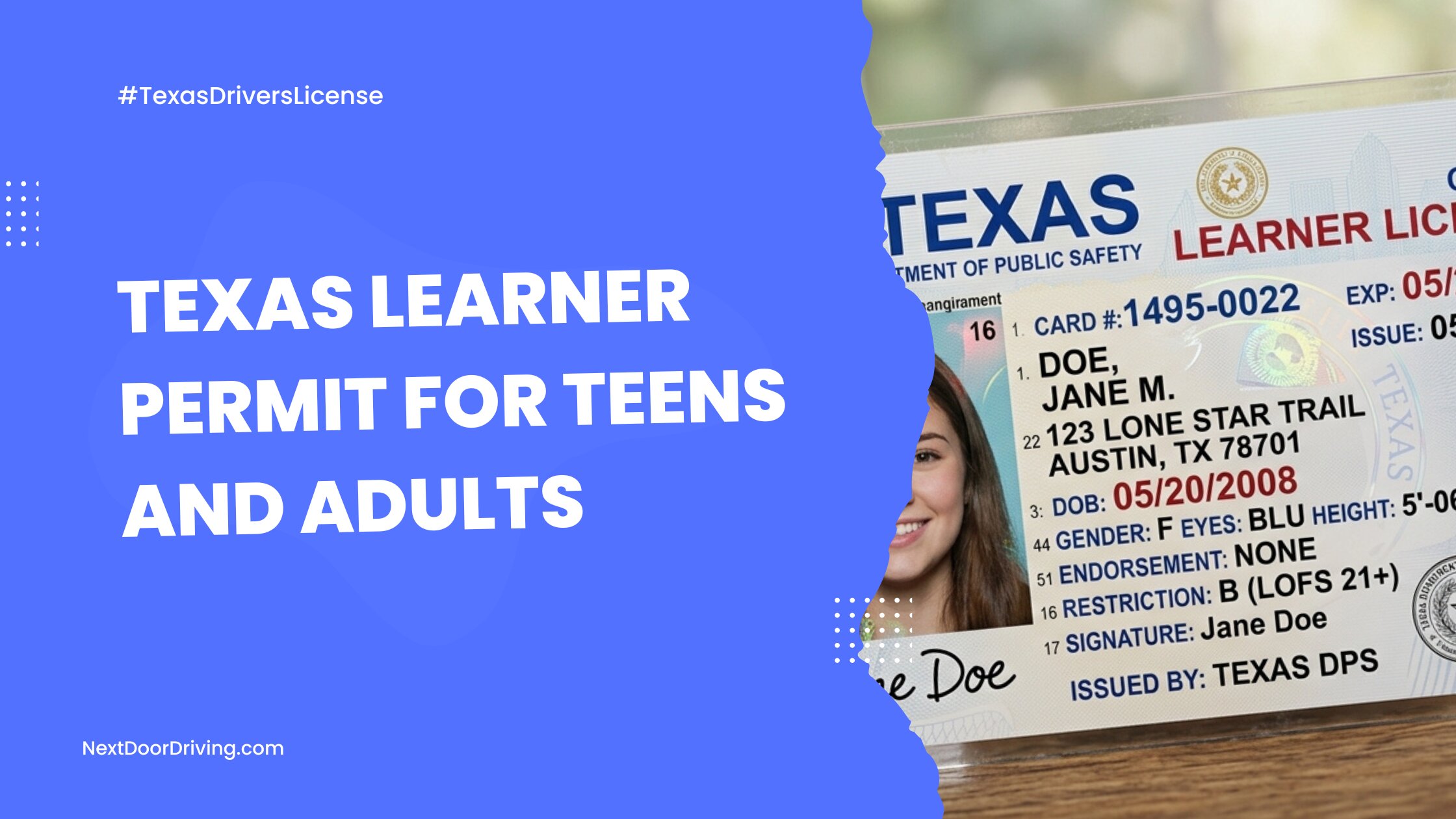
Texas Teen Learner’s Permit: Quick Reference
- Minimum age: 15 years old (can begin driver’s ed at 14)
- DPS fee: $16
- Prerequisites: First 6 hours of driver’s ed and passing the written test
- Hold time: 6 months minimum (waived at 18)
- Expiration: 18th birthday
- Supervision: Licensed driver 21+ in front passenger seat
- Cell phone rule: Strictly prohibited while driving
Who Needs a Learner’s Permit?
Anyone who wants to practice driving on public roads must first obtain a Texas drivers permit. The type of permit you need depends on your age.
Minor Driver Permit (Ages 15–17)
Minor licensing happens in stages in accord with the Texas Graduated Driver Licensing (GDL) program. You can begin the classroom portion of driver education at age 14, choosing between a Texas Parent-Taught Driver Education course or a Instructor-Led Texas Teen Driver's Ed course. Once you are 15 and have passed the written knowledge test, you can apply for a learner’s permit. A Texas teen permit allows you to practice driving when accompanied by an eligible adult. You must hold a permit for at least 6 months and finish driver education before taking a road skills test and upgrading to a Provisional License. If you turn 18, the 6-month holding period rule drops away.
Adult Driver Permit (Ages 18–24 vs. 25+)
Adults do not go through a graduated licensing program, but still have age-based requirements for driver education. New adult drivers who want to practice before the road test must apply for a B-Restricted License, the Texas learner’s permit for adults that allows you to drive with an eligible adult (over 21) in the front passenger seat. Unlike the teen permit, there is no set holding period for an adult permit.
Whether you need driver’s ed before getting a license depends on your age:
- Ages 18–24: Texas requires 6 hours of Texas Adult Driver Education.
- Ages 25 and older: Driver education is not required, but it is strongly recommended, since you must be able to pass the written and road tests.
Transferring an Out-of-State Permit to Texas
Moving to Texas with an active out-of-state learner’s permit requires an in-person exchange at a DPS office. You must surrender your former state permit and present proof of identity, Social Security Number, and Texas residency. State law requires all new residents under 18 to hold a Learner License for 6 months (or until turning 18) before scheduling a driving test, regardless of how long they held their permit in another state. If you are under the age of 25 and hold a permit, you must complete a Texas-specific driver education course for teens or adults before you can obtain a full license. While your permit can be transferred, your out-of-state driver’s ed hours do not transfer.
Texas Learner License Requirements
Before your DPS permit appointment, you must satisfy state education requirements and compile your paperwork.
Teen Driver Education: Concurrent vs. Block Methods
Texas teen driver education consists of 24 classroom hours and 44 behind-the-wheel hours, but there are two methods of instruction that can determine when you get your driving permit and begin practicing.
- With the concurrent method, you complete Module 1 (the first 6 hours), pass the written test, and receive a DE-964E certificate of partial completion which you use to get your permit. This way, you can practice driving while finishing your remaining classroom hours. This is the method of choice for parent-taught driving course students.
- Using the block method, you finish all 24 classroom hours before applying for a permit and beginning behind-the-wheel practice. This instructor-led driver's ed approach is a good choice for teens who want the academic information before getting in the driver’s seat or who plan to take professional driving lessons.
Proof of School Attendance (VOE Form)
Texas law links minor driving privileges to high school attendance. Anyone under 18 applying for a learner’s permit in Texas must bring a signed Verification of Enrollment and Attendance (VOE) form issued by their school office. VOE forms are valid for 30 days during the school year, or for 90 days during the summer. A high school diploma or GED also fulfills this requirement.
How to Apply for a Learner’s Permit
Follow these steps to successfully apply for your learner’s permit.
1. Complete Required Driver Education Hours
Teen applicants must complete at least 6 hours of classroom instruction (for concurrent instruction) or all 24 classroom hours (for block instruction). Adults ages 18–24 must complete an adult driver’s ed course (6 hours). When you have completed the required hours, which usually includes the written knowledge test, you should download and print your certificate to bring to the DPS. Parent-taught driving students should have a parent sign a Classroom Instruction Affidavit (Form DL-90A), which certifies that the parent completed the initial classroom instruction.
Looking for online driver education? If you’re ready to get your Texas learner’s permit faster, NextDoorDriving can help you get started today. Choose your course to jump-start your driving journey.
Teen Program (Ages 14–17):
- Texas Parent-Taught Driver Education (PTDE)
- Texas Instructor-Led Teen Driver Education
- Texas Parent-Taught Driving Course for Teens - Spanish
- Texas Teen Instructor-Led Driver's Ed - Spanish
Adult Program (Ages 18+):
2. Book Your DPS Appointment Online
DPS offices operate by appointment only and can book up well in advance, especially in larger cities. Plan to book your appointment to get your permit at least several weeks in advance. All scheduling is done online through the Texas Appointment Scheduler portal.
Pro Tip: If you need an earlier appointment, try checking the portal early in the morning (around 7–7:30 a.m.) for overnight cancellations. Or, check regularly throughout the day to snag a same-day appointment if they are released. Alternatively, you can walk into a DPS office and check the kiosk in the lobby for an open slot. If one is available, you can book it on the spot and return at your appointment time.
3. Gather Your Documents and Visit the DPS
Speed up your appointment by printing your license application form and filling out most of it before your visit. Wait to sign the application in front of the agent. Make sure you have the correct license application form for your age, since minors and adults use slightly different forms:
- Form DL-14B is for applicants under 17 years and 10 months of age.
- Form DL-14A is for applicants over 17 years and 10 months.
Gather your original identification, residency, and education documents, along with payment for the application fee. Applicants under 18 must also bring a parent or legal guardian to sign the permit application, unless it has been properly notarized in advance.
4. Pass the In-Office Screening
Every driver must pass a brief vision test at the DPS office. If you need glasses or contact lenses, you should wear them for this test. If you do not meet the minimum vision score, your application will be paused pending further evaluation by an eye specialist. If you pass the vision test, you will have an official license photo taken and provide your thumbprints.
You will take the written permit test at your appointment unless you have already passed it. If your driver’s ed certificate confirms that you passed the written test, you will not need to take it again.
5. Pay the Fee and Receive Your Temporary Permit
After you pay the application fee, you will receive a temporary paper Texas permit that is valid for supervised driving for 60 days. Your permanent card should arrive by mail within 2–3 weeks.
Texas Learner’s Permit Fees
License fees are set by the state. Here is the current DPS fee schedule:
- Learner License (under 18): $16
- Driver License with Restriction B (over 18): $33
- Replacement or duplicate license: $11
The DPS accepts credit cards, cash, personal checks, cashier’s checks, and money orders.
Documents Required for a Texas Permit Application
Before your DPS appointment, assemble a folder with all of the necessary documents. Note that the DPS requires original or certified documents to enter them into your official record—photocopies and screenshots are generally not accepted.
| Document Category | Accepted Items (Originals Only) |
| Citizenship / Lawful Presence | U.S. passport, birth certificate, or permanent resident card |
| Identity Verification | Primary ID (e.g., U.S. passport) or two secondary items (e.g., state ID, official transcript) |
| Social Security Number | Social Security card, W-2, or pay stub showing full SSN |
| Texas Residency (2 Proofs) | Utility bills, bank statements, or report cards dated within 90 days |
| Driver Education Certificate | Form DE-964 (teens) or Form ADE-1317 (adults 18–24). |
| PTDE Forms (Parent-Taught Only) | PTDE Program Guide Receipt and Form DL-90A
|
| School Enrollment (Under 18) | Signed VOE Form, high school Diploma, or GED transcript |
For a full list of acceptable identity documents, see the DPS Identification Requirements page.
Learner License Restrictions
Texas phases in driving privileges as teens gain experience, so the Learner License comes with strict rules to protect young drivers.
Supervising Driver Requirement
You cannot drive alone with a learner’s permit in Texas. A licensed driver who is at least 21 years old and has at least one year of driving experience must sit in the front passenger seat whenever you drive. They must be attentive, sober, and legal to drive.
Device Restrictions
Texas enforces a strict ban on wireless devices for teen permit holders. You may not use a cellphone while driving—neither handheld nor hands-free—except in a true emergency. Violations can lead to a ticket and license suspension term that is added to the 6-month permit holding period.
Seat Belt Requirement
Texas seat belt laws are always enforceable, but the state takes this seriously for new drivers. When you drive, everyone in the vehicle must wear a seat belt—with no exceptions.
Behind-the-Wheel Practice Hours
Before upgrading to a Provisional License, teens must log 44 total hours of behind-the-wheel instruction. These hours must include:
- 7 hours of behind-the-wheel instruction
- 7 hours of in-car observation
- 30 hours of supervised practice, including 10 hours at night
Your practice hours must be recorded on an official log form, which you must bring to the DPS. If you are using a Parent-Taught Driver Education course, you will also need a signed Behind-the-Wheel Instruction Affidavit (Form DL-90B), from your TDLR-issued PTDE Program Guide packet.
Next Steps: Transitioning to a Provisional License
Once you have your Learner License, you enter the final practice phase. During this time, you should:
- Hold your permit for at least 6 months before taking the driving test.
- Finish all 24 classroom hours and log your 44 behind-the-wheel hours.
- Watch the free Impact Texas Teen Drivers (ITTD) video.
The Impact Texas Drivers (ITD) Requirement
All road test applicants must complete the state’s distracted-driving awareness course, the Impact Texas Drivers (ITD) program. DPS rules state that the ITD course must be done after finishing any required driver education and before the road test. The ITD program is a free, video-based course and available online through the Impact Texas Drivers (ITD) portal.
- Teens (Under 18): Watch the 2-hour Impact Texas Teen Drivers (ITTD) video.
- Adults (18+): Watch the 1-hour Impact Texas Adult Drivers (ITAD) video.
Note: The ITD completion certificate expires after 90 days, so take the course when you are within three months of your road test. You must present a printed ITD certificate at your road test appointment.
Taking the Road Driving Test
When your learner’s permit holding period, driver’s ed course hours, practice logs, and ITD video are complete (or nearing completion), it’s time to book a road skills test at a DPS office or state-approved Third-Party Skills Testing (TPST) center. Passing the road test makes a minor eligible for a Provisional License and removes the B restriction from an adult license.
What If I Turn 18 Before My Road Test?
A Learner License automatically expires on your 18th birthday. You are no longer bound by the 6-month holding rule and can take your road test if you have satisfied all the requirements. Because your permit is no longer valid, your next step depends on where you take your road test.
- You can test at a DPS office using your expired permit. Keep in mind that someone else must drive you to the appointment.
- Driving schools require an active permit to take the road test. You must visit the DPS first to upgrade your expired card to an adult B-Restricted license before testing with a third-party provider.
Note: Driving on public roads with an expired Texas permit is illegal. If you need more practice time after turning 18, you must visit the DPS to convert your card into an adult B-Restricted license.
Texas Learner License FAQs
What is a hardship license for teens?
A Minor Restricted Driver License, commonly called a hardship license, gives certain teens ages 15 to 17 limited driving privileges before they complete the usual 6-month permit-holding period. Applicants must complete driver education, pass the driving test, submit Form DL-77, and prove a qualifying economic, medical, or vocational hardship.
Can I drive out of state with a Texas learners permit?
Most states recognize valid out-of-state learner permits through reciprocity laws. However, you must follow the driving and curfew laws of the state you are traveling through.
What if I fail the written knowledge test at the DPS office?
Your application fee covers up to 3 attempts on the written exam within 90 days. If you do not pass the test within 90 days, you must submit a new permit application and pay the fee again.
When do teen learner permits and adult B-restricted licenses expire?
A Learner License automatically expires on the driver’s 18th birthday. If a driver reaches 18 without taking their road test, they must visit a DPS office to transition to an adult B-restricted license to keep practicing legally. An adult license with Restriction B is valid up to 8 years, the standard license validity period in Texas.