What Is Restriction B on a Texas License?
A B-restricted Texas license allows an adult to drive as long as another licensed driver age 21 or older is in the front passenger seat. Driving without an eligible supervisor is a violation of the license terms—and a misdemeanor offense carrying fines up to $200 and potential license suspension (Texas Transportation Code § 521.221-c).
Unlike a teen learner’s permit, the adult B-restricted license does not have a minimum holding period and you don’t need to log a certain number of practice hours. You can hold the adult permit for as long or as short a time as you need to feel ready to pass the road skills test. If you are a proficient driver already, you can receive the adult driving permit and take the road test on the same day, upgrading to a full license immediately after passing.
Texas Permit Rules for Ages 18–24
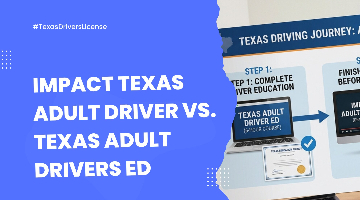
If you are between 18 and 24 years old, you must complete a six-hour Texas Adult Driver Education course for a B-restricted license. The final exam of this course acts as your official written knowledge test. Passing earns you a certificate (Form ADE-1317), which waives the written exam at the DPS office. If you completed a Teen Driver Education course before turning 18, you can present your teen completion certificate (Form DE-964) instead for your adult driving permit.
Texas Learner’s Permit Over 25
If you are 25 or older, formal driver education is optional, but recommended by the DPS. You can use the official Texas Driver Handbook as your independent study guide and take the permit test during your office appointment, or you can take an Adult Driver Education Online course to pass the written test at home and skip the in-person exam. Many older adults voluntarily take driver’s ed to learn Texas traffic laws and feel more ready for real driving. If you skip driver education, you can still receive a B-restricted license, as long as you can pass the written test.
How to Earn a Full Texas Driver License
Earning your full, unrestricted Texas driver license is usually a two-part process. First, you will satisfy all state prerequisites for your age. Unless you are already a skilled driver, maybe because you were licensed in another state or practice on private land, you will need a B-restricted license to train behind the wheel. Once you feel confident, you will take your road test and remove the B restriction for good.
Here is how the Texas license process works from start to finish.
Phase 1: Getting Your Adult Permit
Begin by taking care of your driver’s ed and the written test.
- For ages 18–24, take the Texas Adult Online Driver's Ed course and pass the written test as your final exam. Print your electronic completion certificate (Form ADE-1317) to bring to the DPS office.
- For ages 25+, take the adult driver education course online voluntarily to waive the in-person written test, and print your certificate. If you skip driver’s ed, study the Texas Driver Handbook to prepare for the written exam.
If you prefer to study and take the knowledge test in Spanish, NextDoorDriving offers a Texas Adult Driver Education - Spanish program.
Your Initial DPS Appointment
Once your driver education is squared away, book an appointment using the online DPS Appointment Scheduler system. When selecting your service, click “Apply for First Time Driver License/Permit.” Print and fill out a license application (Form DL-14A) in advance to speed up your visit, but wait to sign the form at the office.
When your DPS appointment arrives, bring physical, original copies of your identity documents. You will need your U.S. passport or birth certificate, your Social Security card, two recent proofs of Texas residency (such as utility bills or bank statements), and your driver’s ed completion certificate if you have one. If you own a vehicle, you will need to provide proof of current registration and insurance for it.
At the DPS office, you will request a B-restricted license, submit your paperwork, take a quick eye exam, give your thumbprints, and pay the $33 application fee. The DPS will print a temporary paper driving permit, and your plastic B-restricted license card will arrive by mail within two to three weeks.
Remember:
- Driver education proof (mandatory for under 25)
- Proof of citizenship/lawful presence, identity, SSN, and residency (dated 90–180 days)
- Application (Form DL-14A)
- Payment method for fee
For a complete list of required and acceptable documents at the DPS, see the official What to bring with you when applying for a Texas Driver License checklist.
Phase 2: Practice, Impact Texas Course, and the Road Test
Once you have your Texas B-restricted license, you are free to practice with your supervising driver. Because state law does not enforce a holding period or practice log for adults, you control the timeline. You can practice for three days, three months, or longer. The goal is to build skill progressively and feel confident operating in different driving environments.
When you feel ready to pass your road test, there is one critical state requirement you cannot skip: the Impact Texas Adult Drivers (ITAD) course. This is a free, one-hour online video program offered by the DPS that covers the dangers of distracted driving. You must watch this video after finishing your driver education course and print out the completion certificate. Keep in mind that the ITAD certificate expires after 90 days, and you must bring it to your road test appointment—so make sure your road test takes place within 90 days of finishing the video.
Your Final Road Test
Texas allows drivers to take the road test at the DPS office or with an authorized commercial driving school through the Third-Party Skills Testing (TPST) program. The road test itself will be the same no matter where you take it, but there are benefits and drawbacks in terms of cost and availability. At the DPS, the road test is included in your application fee, which covers three attempts in 90 days—but wait times can be longer and you will need to bring a test vehicle. Driving schools often have earlier appointments and can supply a test vehicle, but at an additional cost.
An important difference between testing locations involves the adult permit. While you do not need to get an adult permit in advance to take the road test at the DPS, driving schools cannot administer a road test to an adult who does not have a valid B-restricted license. If you plan to road test with a local driving school, you need to visit the DPS and apply for this permit first.
On the day of your road test, the examiner will conduct a quick safety check of your car. The vehicle must have a current registration sticker, two working license plates (front and back), active liability insurance covering the car, functional turn signals, working brake lights, and a horn. During the drive, the examiner will evaluate core control skills, including parallel parking into a standard space, backing straight up for 15 feet while looking over your shoulder, managing your speed, signaling early, and making smooth, complete stops at intersections.
Remember:
- Complete the free ITAD video course after driver’s ed and then take the road test within 90 days.
- Bring your official identity, residency, and vehicle documents if the DPS does not have them on file.
- If bringing a test vehicle, ensure it is safe and legal to drive.
Your Unrestricted License
When you pass the road test, the DPS will remove Restriction B from your driving record and issue an unrestricted Texas Driver License. If you take the road test at the DPS, your license application will be finalized that day. If you test at a driving school, they may report your score electronically or you may need to bring a sealed envelope with your results to the DPS to secure your new license card. The DPS will give you a temporary, paper license that is valid for 60 days, and your plastic license card will arrive by mail within a few weeks.
Texas Adult Permit FAQs
Do I need a learner’s permit over 25 in Texas?
Texas does not issue traditional instruction permits to adults, nor does it enforce a mandatory six-month permit holding period for adults like it does for minors. However, if you need to practice driving before taking your road skills test, you should apply for a standard driver license carrying Restriction B, which acts as a Texas adult learner’s permit.
What happens to my teen learner’s permit when I turn 18?
A teen learners permit, or Texas Learner License, expires automatically on your 18th birthday. It can no longer be used for legal driving, so if you need more practice, you must visit the DPS to transition to an adult driver license with Restriction B. If you are ready for the road test, the DPS will allow you to take the exam with your expired teen permit.
Can I drive alone if I have a B-restricted license?
‘Restriction B’ legally mandates that a licensed driver who is at least 21 years old is seated in the front passenger seat whenever you drive. Driving alone with a B-restricted license can result in a traffic citation and fines.
What happens if I fail the written test or the road test at DPS?
Your initial $33 license application fee covers processing, vision testing, and up to three attempts to pass both the written knowledge test and the driving skills test within a 90-day period. If you do not pass within three attempts or within 90 days, you must submit a new application.
Can I renew an adult B-restricted license?
A Class C license with Restriction B is a standard Texas driver’s license, not a separate temporary permit. Most adult licenses are valid for up to eight years. If your B-restricted license is approaching its expiration date and you still need supervised practice, you can renew the license through the normal renewal process if you are eligible. The B restriction remains in place until you pass the road test and complete the DPS process to transition to a full license.