Is Parent Taught Driver’s Ed Approved in Texas?
The PTDE program is a state-sanctioned driver’s ed path for teens, and it is regulated by two agencies: the Texas Department of Licensing and Regulation (TDLR) oversees providers, curriculum, and instructor eligibility, while the Texas Department of Public Safety (DPS) handles driver testing and issues licenses. While parent-taught driver’s ed gives families control over lesson pacing, it is not a shortcut around state standards. Like every approved form of Texas driver education, a parent-taught driving course must meet the state’s quality standards.The parent assumes full legal responsibility for delivering a TDLR-compliant curriculum, supervising in-car instruction, and maintaining accurate legal logs required by the DPS for teen licensing.
Student Eligibility: Who Can Take Parent-Taught Driver’s Ed in Texas
These age rules apply to all teens trying to get a license in Texas, including parent-taught driving students:
- Age 14: Minimum age allowed to enroll in and begin the classroom portion of a TDLR-approved PTDE course. Students cannot apply for a permit or drive on public roads at this age.
- Age 15: Minimum age to apply for a Texas Learner License (permit). The student must have completed at least Module 1 (the first six classroom hours) and passed the knowledge exam.
- Age 16: Minimum age to apply for a Texas Provisional Driver License, provided the student has held a valid learner’s permit for at least six months and completed driver’s ed.
PTDE Instructor Eligibility
Before purchasing a Texas parent-taught driver’s ed course or beginning instruction, families should verify that the proposed PTDE instructor meets the standards set by Texas Education Code §1001.112.
The instructor generally must be the student’s parent, stepparent, grandparent, step-grandparent, foster parent, or court-appointed legal guardian, and must have held a valid driver’s license for the preceding three years. If the instructor was licensed outside Texas during that period, the DPS may require an official driving record from the previous state to verify the licensing history.
An adult is not eligible to serve as a teen’s driving instructor if they:
- Have a criminally negligent homicide conviction.
- Had a DWI conviction within the past seven years.
- Had their license suspended, revoked, or forfeited for a motor-vehicle offense within the past three years.
- Had three or more moving violations—or two or more that resulted in crashes—within the past three years.
- Have Restriction B on their driver license, which requires a licensed adult in the front seat.
Rules for Designating Another Adult Instructor
If parents or legal guardians cannot conduct a teen’s in-car lessons, Texas law allows them to formally designate another adult to act as the primary PTDE instructor.
A designated instructor must:
- Be at least 25 years old.
- Possess at least seven years of continuous driving experience.
- Meet all standard driver’s record and criminal history restrictions.
- Provide instruction without charging a fee.
- Be designated via a completed, notarized TDLR instructor designation form before instruction begins.
Primary PTDE Instructor vs. Supervising Adult
It is common to confuse the primary PTDE instructor with secondary adults who assist during driving practice, but these roles have distinct qualifications and boundaries:
| Attribute | Primary PTDE Instructor | Secondary Supervising Adult |
|---|---|---|
| Primary Role | Teaches and certifies the formal 14-hour in-car training | Supervises all or part of the 30 practice driving hours |
| Minimum Age | Parent/guardian (or 25+ if designated adult) | 21 years old |
| Driving Experience | 3 years licensed (or 7 years if designated adult) | At least 1 year of continuous driving experience |
| Legal Status | Must pass all TDLR disqualification checks (7-yr DWI, 3-yr suspensions/moving violations) | Must hold a valid driver license and occupy the front passenger seat |
| Final Sign-off Authority | Certifies final completion certificates | Cannot certify the formal 14-hour instruction curriculum |
Texas PTDE Hour Rules
For parent-taught drivers ed, Texas requires foundational classroom education, formal in-car instruction, and additional supervised practice.
| Training Phase | Required Hours | Mandatory Caps and Daily Rules |
|---|---|---|
| Classroom Instruction | 24 Hours | Capped at a maximum of 6 hours per day; Module 1 (6 hours) is required for permit eligibility. |
| Formal Behind-the-Wheel Instruction | 7 Hours | Structured driver training delivered by the primary PTDE instructor. |
| Formal In-Car Observation | 7 Hours | A student observes driving techniques performed by the primary PTDE instructor. |
| Supervised Practice Driving | 30 Hours | Maximum of 2 hours per day; must have 10 hours at night |
| Impact Texas Teen Drivers (ITTD) | 2 Hours | Mandatory free DPS video course; completed after finishing driver’s ed and before the road test. |
In total, the PTDE portion of Texas driver education includes 24 classroom hours and 44 in-car hours. The separate two-hour ITTD program brings the teen’s overall education time to 70 hours.
Classroom Instruction Rules (24 Hours)
Under 16 TAC §84.500, students complete 24 academic hours across 12 core modules covering traffic laws, right-of-way, risk management, and safe driving practice. Texas requires a minimum 70% passing score on module assessments.
Note on 32-hour driver’s ed courses: Older programs may contain 32 classroom hours, but TDLR’s updated standard only requires 24 academic hours for teen driver education.
Behind-the-Wheel Training and Observation (14 Hours)
Once a student holds a valid Texas Learner License, the primary PTDE instructor delivers 14 hours of in-car training, including seven hours of observation from the passenger seat and seven hours of direct behind-the-wheel practice.
Key rules to remember:
- Record these lessons on the Behind-the-Wheel Instruction Log (form DL-91B) from your PTDE Program Guide packet.
- Only the designated PTDE instructor may teach and sign off on these 14 hours.
Supervised Practice Driving (30 Hours)
After the initial 14 hours of practical instruction, teens must record 30 additional hours of supervised driving practice, including 10 hours at night. This practice can be supervised by any licensed adult aged 21 or older with at least one year of driving experience.
Key rules for supervised practice:
- Record these hours on the official 30-Hour Behind-the-Wheel Practice Log.
- Complete logs in real time as practice occurs, since the DPS audits timestamps; hours logged prior to permit issuance or backdated entries may cause application rejection.
The Texas Parent-Taught Driving Process: Step by Step
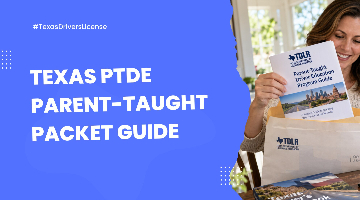
Critical rule for beginning PTDE : Texas law requires parents to purchase the PTDE Program Guide from TDLR and name a primary instructor before beginning any course modules or logging in-car driving hours. The DPS verifies purchase dates, so any driver’s ed hours logged prior to your official TDLR guide receipt date are invalid and will be rejected.
To make sure you have met all standards when you apply for a permit or provisional license at the DPS, complete the PTDE process in this specific sequence:
- Order the official $20 PTDE Program Guide from the TDLR website, and save your electronically-delivered receipt and guide packet with essential forms and instructions.
- After receiving the PTDE packet, enroll in a TDLR-approved Parent-Taught Driver Education online course.
- Finish Module 1 (six hours) and pass the embedded DPS knowledge test. Take your DE-964 certificate “For Learner License Only,” PTDE packet receipt, and required identity documents to the DPS to apply for a learner’s permit.
- Complete all remaining classroom modules and in-car training, recording hours on official log forms.
- Complete the free 2-hour Impact Texas Teen Drivers (ITTD) online video course.
- After holding the learner permit for at least six months and reaching age 16, present your final Texas driver education certificate (DE-964), signed driving logs, ITTD certificate, and VOE form at the DPS (or an authorized third-party testing center) to take the road skills test.
- Pass the Texas driving test.
- Finalize your provisional license application with the DPS.
For a complete list of required and acceptable documents, see this What it takes to Apply for a DL or ID Card brochure from the DPS.
Verification of School Enrollment and Attendance
Texas law enforces school attendance standards for driving privileges for minors. If you are under 18, you must present a high school diploma, GED, or an official Verification of Enrollment and Attendance (VOE) form when applying for a license. The VOE form is obtained through the school office and must be signed by an administrator confirming at least 90% attendance in the preceding semester. Note that a VOE form signed during the school year is valid for only 30 days, while one signed in summer months remains valid until the start of the fall semester. Since a teen must hold a learner’s permit for six months before a road test, the VOE form used to obtain a permit will expire, and the student will need a new VOE to apply for a provisional license. Parents of homeschooled teens can download and sign the VOE Form PDF directly.