
Take the real Texas written test online!

Texas DPS Practice Test 3

4.4 out of 5 (1448 votes)
80% Passing score
20 Questions
4 Mistakes allowed
A Texas DPS practice test gives you a better read on where you actually stand before you deal with the official permit process, which is useful because the knowledge test is only one piece of the whole licensing routine. There is the studying, sure, but there is also the appointment, the paperwork, the vision screening, the fee, the photo, the thumbprints, and the small but very real possibility that you forgot one document and now your day has become much longer than planned. This Texas DPS permit practice test keeps the focus where it should be: the driving rules and safety habits Texas expects you to know before you get behind the wheel. The 20 questions cover the basics that tend to matter most, including right-of-way decisions, safe driving judgment, traffic laws, and mobile-device rules. You need at least 16 correct answers to pass, so it is not just a casual click-through. It pushes you to notice the details, especially the ones that sound familiar until you have to choose between two answers that are a little too close for comfort. It also works well alongside a Texas drivers ed course. That matters because approved teen and adult driver education programs may include the required knowledge exam or final exam, depending on the course and the applicant. But even when part of the testing is handled through a course, DPS still has its own steps. First-time applicants generally need proof of identity, proof of Texas residency, proof of lawful presence or U.S. citizenship, a Social Security number, the application fee, and the required licensing information that goes with their age group. Teen applicants usually have a few extra items in the mix, including a DE-964 certificate, school enrollment or completion paperwork, and parent or guardian involvement. The vision exam is part of the process too, for both learner license and driver license applicants. Some drivers pass without restrictions, while others may need corrective lenses or other limits depending on their vision results. It is one of those details people do not always think about while studying road signs and right-of-way rules, but DPS certainly does. Use this permit test online as a practical checkpoint before the official Texas DPS knowledge test. It will not replace drivers ed, the DPS visit, or the documents you need to bring, but it can make the testing part feel a lot less like guessing and a lot more like being ready.

Skip the DPS written test. No Joke.

Pass guaranteed — or your money back.

Learn More
Promotion
Learn More

Sample Texas Permit Test Questions

Question 1

Which lights should you use while driving in fog, heavy rain, sleet, or snow?

  1. A The horn at regular intervals
  2. B Parking lights only
  3. C High-beam headlights
  4. D Low-beam headlights

Correct answer: D – Low-beam headlights

The Texas Driver Handbook instructs motorists to use low-beam headlights in fog, heavy rain, sleet, snow, or dust. Headlights also must be displayed during the legally specified nighttime period or when people and vehicles cannot be clearly seen from at least 1,000 feet. Parking lights alone are not the handbook’s recommended driving lights for poor visibility.

Source: Tex. Transp. Code § 547.302 – Duty to Display Lights, Texas Driver Handbook — Ch. 9, “Headlights”
Question 2

You are traveling slower than the normal flow in the left lane and are not passing or preparing to turn left. What should you do?

  1. A Move into the right-hand lane when the change can be made safely
  2. B Stay left until at least five vehicles form behind you
  3. C Remain left whenever you are driving at the speed limit
  4. D Turn on the hazard lights and continue in the lane

Correct answer: A – Move into the right-hand lane when the change can be made safely

Texas law requires a vehicle moving more slowly than the normal traffic speed under existing conditions to use the available right-hand lane or remain as close as practicable to the right edge. Exceptions apply when the driver is passing or preparing for a left turn. A driver should complete any move to the right only when it can be made safely.

Source: Tex. Transp. Code § 545.051(b) – Driving on Right Side of Roadway, Tex. Transp. Code § 545.103 – Safely Turning

Question 3

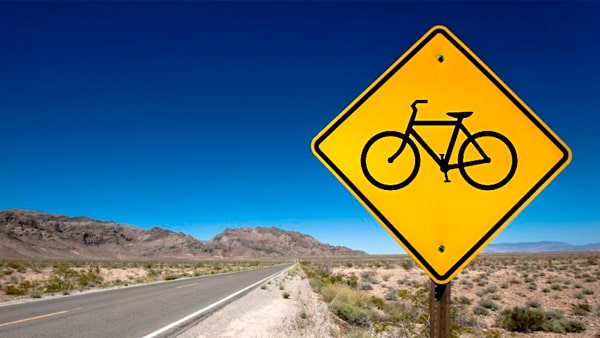
A yellow bicycle warning sign posted before a roadway crossing indicates:

This sign means:
  1. A A children’s play area
  2. B A bicycle rental facility
  3. C An entrance to a public park
  4. D A location where bicyclists may cross the roadway

Correct answer: D – A location where bicyclists may cross the roadway

The bicycle warning symbol may be used to alert road users to a location where bicyclists can enter or cross the roadway. Its yellow warning-sign design distinguishes it from signs identifying bicycle routes, parking, or rental services. Drivers should watch the crossing area for bicycle traffic.

Source: Texas Manual on Uniform Traffic Control Devices 2025 § 9C.04 – Bicycle Warning and Trail Crossing Signs (W11-1 and W11-15)

Question 4

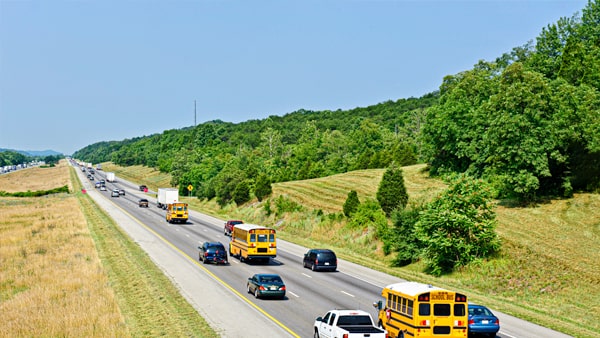
A school bus stops on the other side of a four-lane road separated only by a flush painted strip, with no barrier or non-drivable median. Under Texas law, you are:

If a school bus stops to unload children on a four-lane highway, divided by a four-foot paved strip, vehicles traveling in the opposite direction are:
  1. A Required to stop while the bus’s visual signal is operating
  2. B Required to stop briefly, then pass cautiously
  3. C Required to drive onto the shoulder before passing
  4. D Not required to stop because the bus is traveling in the opposite direction

Correct answer: A – Required to stop while the bus’s visual signal is operating

Drivers approaching a stopped school bus from either direction must stop when its required visual signal is operating. The opposite-direction exception applies only when the bus is on a different roadway separated by a non-drivable intervening space, physical barrier, or dividing section constructed to impede traffic. A flush painted strip without such separation does not meet that description.

Source: Tex. Transp. Code § 545.066(a), (b), (f) – Passing a School Bus; Offense

Question 5

In Texas, a driver must use a turn signal before:

  1. A Making a right or left turn
  2. B Changing traffic lanes
  3. C Starting from a parked position
  4. D All of the above

Correct answer: D – All of the above

The law requires a driver to signal an intention to turn, change lanes, or start from a parked position. For a right or left turn, the signal must be given continuously during at least the final 100 feet before the turn. Signaling does not remove the separate duty to ensure that the movement can be made safely.

Source: Tex. Transp. Code § 545.104 – Signaling Turns; Use of Turn Signals, Tex. Transp. Code § 545.103 – Safely Turning

Question 6

What change does a steady yellow left-turn arrow announce?

  1. A A protected left-turn phase is beginning
  2. B Drivers may turn without checking opposing traffic
  3. C The green-authorized movement is ending or a red signal is coming
  4. D The signal may be ignored if the turn lane is clear

Correct answer: C – The green-authorized movement is ending or a red signal is coming

A steady yellow arrow warns that the movement authorized by the green phase is being terminated or that a red signal will follow. It does not provide a new right-of-way or authorize drivers to accelerate through the intersection. Drivers must observe and comply with the signal indication that appears next.

Source: Tex. Transp. Code § 544.007(a), (e) – Traffic-Control Signals in General