
Take the real Texas written test online!

Texas Permit Test Practice 6

4.8 out of 5 (752 votes)
80% Passing score
20 Questions
4 Mistakes allowed
A Texas DPS practice test should do more than toss a few road-sign questions at you and call it preparation. This one is built around 20 questions, with 16 correct answers needed to pass, and it works best when you treat it like a rehearsal for the Texas permit test rather than a quick little quiz you click through once. The sixth Texas permit practice test puts extra weight on turn signals, which sounds simple enough, except signaling rules are exactly the kind of thing people half-know. You know, sort of know. Then the answer choices start splitting hairs. The point is to get comfortable with how Texas DPS-style questions are worded, especially on rules that seem obvious in daily driving but become less obvious when written in test language. Turn signals, lane changes, intersections, right-of-way situations, and general road rules all connect to the same basic skill: showing other drivers what you are about to do before you do it. That is not just test material. It is one of those quiet habits that keeps traffic from becoming a guessing game, particularly in busy areas where everyone seems to be late and nobody is especially generous about it. There is also the licensing structure behind all this, and it matters. In Texas, teen driver education can begin at 14, but a learner license is not available until age 15. Teens can take driver education through a driving school, online course, parent-taught program, or public school program. Some use the concurrent method, completing the first 6 classroom hours before taking the written exam and getting the learner license. Others finish all 24 classroom hours first through the block method. For drivers under 18, the learner license is Phase I of Texas’s Graduated Driver License program. To move to a provisional license, a teen must be at least 16, hold the learner license for at least 6 months, finish approved driver education, complete the Impact Texas Teen Drivers program within 90 days before the driving test, and pass the driving test. The behind-the-wheel requirements are specific, too: 7 hours of observation, 7 hours of driving instruction, and 30 hours of supervised practice, including 10 at night, with a licensed driver age 21 or older in the vehicle. Adults are handled differently. Ages 18 through 24 must complete a 6-hour adult driver education course before testing. At 25 or older, it is not required, though it is still recommended for first-time drivers. So this Texas practice permit test helps with the written exam, yes, but it also fits into the larger licensing path you need to follow.

Skip the DPS written test. No Joke.

Pass guaranteed — or your money back.

Learn More
Promotion
Learn More

Sample Texas Permit Test Questions

Question 1

Why is tailgating unsafe?

  1. A It cannot lead to a traffic violation
  2. B It may leave too little distance to stop without a collision
  3. C It prevents other vehicles from entering your lane
  4. D It improves traffic flow during congestion

Correct answer: B – It may leave too little distance to stop without a collision

A following driver must maintain an assured clear distance based on vehicle speed, traffic, and highway conditions. The space must allow the driver to stop without striking the vehicle ahead or swerving into another vehicle, object, or person. Tailgating may fail this requirement because it reduces available stopping distance.

Source: Tex. Transp. Code § 545.062(a) – Following Distance
Question 2

In Texas, a white parking sign with a green legend and border generally indicates:

  1. A Parking reserved only for emergency vehicles
  2. B A passenger-loading zone with no parking
  3. C Parking permitted subject to a time or manner restriction
  4. D Parking prohibited at all times

Correct answer: C – Parking permitted subject to a time or manner restriction

The statewide traffic-control manual uses green legends and borders for permissive parking signs. These signs allow parking subject to restrictions, such as a stated time limit or a required parking method. Drivers must read the sign’s specific wording to determine when and how parking is permitted.

Source: 2025 Texas Manual on Uniform Traffic Control Devices — §§ 2B.52–2B.53, “Parking, Standing, and Stopping Signs” and “Design of Parking, Standing, and Stopping Signs”

Question 3

After stopping at a stop sign, you see that traffic leaves no room beyond the intersection. What should you do?

  1. A Enter slowly and wait inside the intersection
  2. B Move close to the vehicle ahead
  3. C Remain stopped until the intersection can be entered safely
  4. D Sound the horn so traffic moves forward

Correct answer: C – Remain stopped until the intersection can be entered safely

Under Texas right-of-way law, a driver who has stopped as required may proceed only when the intersection can be safely entered without interfering or colliding with traffic using the other roadway. If congestion leaves no space beyond the intersection, remain at the stop until sufficient room becomes available.

Source: Tex. Transp. Code § 545.151(a)(1)–(2) – Vehicle Approaching or Entering Intersection

Question 4

What can happen when alcohol is combined with prescription or over-the-counter medicine?

  1. A The medicine neutralizes the alcohol
  2. B Alcohol helps the medicine work safely
  3. C The substances may produce stronger cumulative effects
  4. D They cannot interact because they are different substances

Correct answer: C – The substances may produce stronger cumulative effects

Alcohol and medicines can interact in ways that increase overall impairment. The combination may worsen poor judgment, reduced coordination, drowsiness, or slowed reactions, and alcohol may mask some drug effects. Drivers should read medicine warnings and consult a doctor or pharmacist before combining drugs, especially when alcohol is involved.

Source: Texas Driver Handbook — Ch. 10, “Alcohol and Drugs Impact on the Driving Ability”

Question 5

A clearly visible mechanical signal at a railroad crossing warns that a train is approaching. What must you do?

  1. A Stop 15 to 50 feet from the nearest rail and wait until proceeding is permitted and safe
  2. B Reduce speed and cross without stopping
  3. C Stop only after the train becomes visible
  4. D Sound the horn and continue across

Correct answer: A – Stop 15 to 50 feet from the nearest rail and wait until proceeding is permitted and safe

Texas law requires a driver to stop between 15 and 50 feet from the nearest rail when a clearly visible railroad signal warns of an approaching train or other on-track equipment. The vehicle must remain stopped until the signal permits movement and it is safe to proceed. Never enter the crossing while the warning remains active.

Source: Tex. Transp. Code § 545.251(a)(1), (b) – Obedience to Signal Indicating Approach of Train or Other On-Track Equipment

Question 6

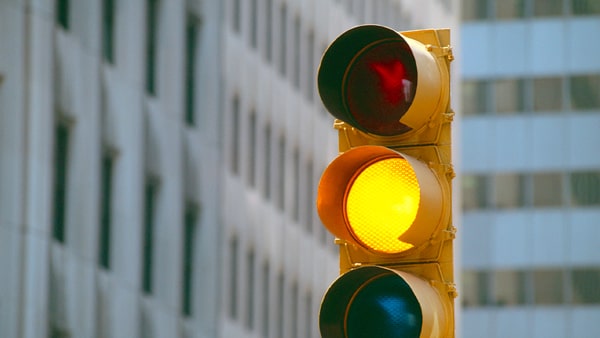
The signal changes from green to steady yellow as you approach an intersection. What is the proper response?

As you near an intersection, the traffic light changes from green to yellow. Your best action would be to:
  1. A Accelerate to enter before the red signal
  2. B Brake sharply regardless of following traffic
  3. C Plan to stop in the middle of the intersection
  4. D Prepare to stop before the intersection if you can do so safely

Correct answer: D – Prepare to stop before the intersection if you can do so safely

A steady yellow signal warns that movement authorized by the green signal is ending or that a red signal is about to appear. Stop before entering when you can do so safely. If you are already too close to stop safely, continue through cautiously rather than braking abruptly or stopping within the intersection.

Source: Tex. Transp. Code § 544.007(e) – Traffic-Control Signals in General, Texas Driver Handbook — Ch. 5, “Traffic Signals”