
Take the real Texas written test online!

Texas Drivers License Test 7

4.9 out of 5 (663 votes)
80% Passing score
20 Questions
4 Mistakes allowed
Before you walk into the Texas DPS permit test it helps to know what the test is actually trying to measure. It is pulled from the Texas Driver Handbook and it covers more than road signs and “who goes first at a four-way stop.” You are expected to know Texas traffic laws, right-of-way rules, safe driving habits, distracted driving basics, alcohol and drug laws, vehicle equipment, and the proof-of-insurance piece that Texas takes seriously, because of course it does. This seventh Texas DPS practice test gives you 20 questions aimed at that exact mix. It does not use real DPS test questions, since Texas does not publish those, but it is written to feel close to the real Texas DMV permit test experience: similar topics, similar phrasing, and the same kind of small-but-important details that tend to separate guessing from actually being ready. Some questions may feel straightforward. Others make you slow down a little, which is sort of the point. For context, the official Texas Class C knowledge test is multiple choice, and the practical format is 30 questions with a passing score of 21 correct answers, or 70%. Road signs are included in the knowledge test, not handed off to some separate road-sign-only exam for regular Class C applicants. So a useful Texas DMV practice test should not just drill signs in isolation or throw random rule trivia at you. It should move between signs, road rules, judgment, legal requirements, and the boring paperwork-adjacent facts that still matter when you are trying to get licensed. This Texas driving test practice is a good fit for teen applicants working through driver education, adults getting licensed for the first time, and anyone who would rather find the weak spots here than discover them at a driver license office appointment. Use it like a rehearsal, but not a lazy one. If you can consistently handle these questions and understand why the answers are right, the real DPS permit test should feel a lot less like a guessing game and a lot more like something you already saw coming.

Skip the DPS written test. No Joke.

Pass guaranteed — or your money back.

Learn More
Promotion
Learn More

Sample Texas Permit Test Questions

Question 1

Which habit helps other road users understand what you intend to do?

  1. A Signaling turns, lane changes, and stops in sufficient time
  2. B Avoiding eye contact and ignoring surrounding traffic
  3. C Using side streets instead of communicating your movements
  4. D Waiting until a maneuver begins before signaling

Correct answer: A – Signaling turns, lane changes, and stops in sufficient time

Signals communicate your intentions and allow other drivers to plan ahead. Use the appropriate signal before turning, changing lanes, entering or leaving a highway, pulling from a parking space, or moving to the roadside. Make sure the signal is visible and cancel it after completing the maneuver.

Source: Texas Driver Handbook — Ch. 6, “Signaling”
Question 2

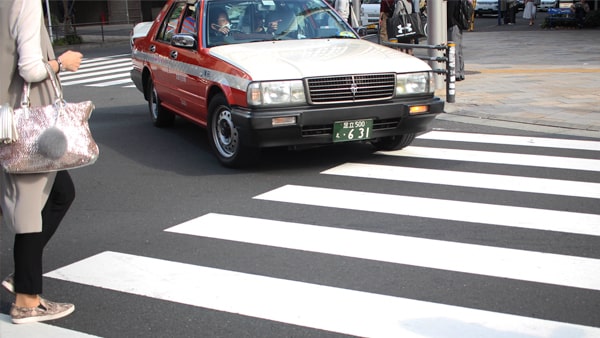
At an unsignalized Texas crosswalk, who must yield when a turning driver encounters a pedestrian crossing on the driver’s half of the roadway?

Who must yield when a driver is turning and a pedestrian is crossing without a traffic light?
  1. A Whichever person entered the intersection second
  2. B The driver
  3. C Whichever person is moving faster
  4. D The pedestrian in every situation

Correct answer: B – The driver

The driver must stop and yield when the pedestrian is on the driver’s half of the roadway or is approaching closely enough from the opposite half to be in danger. A pedestrian may not suddenly enter the path of a vehicle that is too close to stop and yield. Drivers also may not pass a vehicle stopped for a pedestrian at the crosswalk.

Source: Tex. Transp. Code § 552.003(a)–(c) – Pedestrian Right-of-Way at Crosswalk

Question 3

In Texas, what must you do before proceeding when a circular traffic signal turns green?

  1. A Wait five seconds regardless of traffic conditions
  2. B Enter immediately before cross traffic begins moving
  3. C Yield to vehicles and stop for pedestrians lawfully in or beside the intersection
  4. D Proceed because a green signal gives an unconditional right-of-way

Correct answer: C – Yield to vehicles and stop for pedestrians lawfully in or beside the intersection

A circular green signal permits you to proceed straight or turn unless a sign prohibits the turn. You must yield to vehicles lawfully in the intersection. You must also stop and yield to pedestrians or sidewalk users lawfully in the intersection or an adjacent crosswalk.

Source: Tex. Transp. Code § 544.007(b) – Traffic-Control Signals in General

Question 4

When entering a Texas highway from a private road or driveway, to whom must you yield?

  1. A Only vehicles approaching from the left
  2. B Only vehicles traveling faster than you
  3. C No one if you sound your horn before entering
  4. D Approaching highway traffic and pedestrians crossing on the sidewalk

Correct answer: D – Approaching highway traffic and pedestrians crossing on the sidewalk

A driver entering or crossing a highway from a private road or driveway must yield to vehicles approaching on that highway. A driver emerging from or entering a private road or driveway must also stop and yield to pedestrians approaching on an extending sidewalk. Enter only after these required yields can be completed safely.

Source: Tex. Transp. Code § 545.155 – Vehicle Entering Highway from Private Road or Driveway, Tex. Transp. Code § 552.006(c) – Use of Sidewalk

Question 5

If your engine stops while the vehicle is moving, which response is safest?

  1. A Maintain steering control and guide the vehicle toward a safe place off the roadway
  2. B Leave the vehicle in the traffic lane without warning other drivers
  3. C Apply the brakes abruptly before checking surrounding traffic
  4. D Turn off all exterior lights to conserve battery power

Correct answer: A – Maintain steering control and guide the vehicle toward a safe place off the roadway

Keep control of the steering and move toward a safe location outside the travel lane if the vehicle can be moved. Activate the emergency flashers to warn approaching drivers. Once safely stopped, secure the vehicle and obtain assistance rather than attempting repairs while exposed to moving traffic.

Source: Texas Driver Handbook — Ch. 9, “Some Special Driving Situations”

Question 6

Which action gives following drivers advance notice that you are about to turn?

  1. A Signal continuously for at least the final 100 feet before the turn
  2. B Reduce the space between your vehicle and the vehicle ahead
  3. C Wait until the turn begins before activating the signal
  4. D Drive significantly slower without signaling

Correct answer: A – Signal continuously for at least the final 100 feet before the turn

Texas requires a driver turning right or left to signal continuously for at least the last 100 feet before the turn. Early signaling communicates your intention and gives drivers behind you time to prepare. Continue watching surrounding traffic because using a signal does not by itself make the movement safe.

Source: Tex. Transp. Code § 545.104(a)–(b) – Signaling Turns; Use of Turn Signals, Texas Driver Handbook — Ch. 6, “Signaling”