
Take the real Texas written test online!

Texas Permit Test Simulator

4.8 out of 5 (1147 votes)
80% Passing score
30 Questions
6 Mistakes allowed
A Texas DPS practice test earns its keep when it feels like useful preparation, not a little quiz pretending to be serious. This one is built around the 30-question format used for the Texas Class C knowledge test, with multiple-choice questions that cover the material DPS expects new drivers to know: traffic laws, right-of-way, road signs, safe driving, distracted driving, alcohol and drug rules, vehicle equipment, and the everyday judgment calls that sound simple in the handbook and somehow become less simple when they are phrased as a test question. The simulator pulls 30 questions at a time and varies the set, which is important. Maybe more important than people want to admit. Running through the exact same questions over and over can make you feel prepared when really you have just memorized the furniture in the room. A stronger Texas permit test practice setup makes you recognize the rule, not just the answer. Road signs are included with the regular knowledge material for ordinary noncommercial Class C applicants, so they show up here the same way — mixed into the larger test instead of treated like a separate event. To pass the real Texas DPS knowledge test, you need 21 correct answers out of 30, or 70%. That means you can miss up to 9 questions. Yes, passing by one question still counts, technically, but it is not exactly the confidence-building approach. The practice test also fits into the larger licensing path, which is where a lot of applicants get tripped up because the written test is only one piece of the process. Teen drivers can begin driver education at 14, but they cannot apply for a learner license until at least 15. From there, Texas moves them through the Graduated Driver License program, with driver education, the knowledge exam, vision screening, supervised practice, and eventually the driving skills test before a provisional license comes into play. Adults have a different route. First-time applicants ages 18 through 24 need a 6-hour adult driver education course before testing, while applicants 25 and older are not required to take driver education, though DPS recommends it for new drivers. So the Texas DPS test online practice is not just about getting through 30 questions and feeling done. It is a cleaner way to rehearse the permit test, understand what DPS is actually asking, and step into the rest of the driver license process with fewer surprises — paperwork, appointments, vision exam, road test, all of it.

Skip the DPS written test. No Joke.

Pass guaranteed — or your money back.

Learn More
Promotion
Learn More

Sample Texas Permit Test Questions

Question 1

Which practice is an important part of defensive driving?

  1. A Keeping your vision fixed straight ahead
  2. B Staying alert and shifting your attention among roadway conditions
  3. C Expecting others to correct your driving errors
  4. D Waiting until the last moment to respond to hazards

Correct answer: B – Staying alert and shifting your attention among roadway conditions

A defensive driver must remain aware of conditions ahead, beside, and behind the vehicle. Look well ahead and shift attention between near and distant conditions rather than fixing your eyes on one point. Regular mirror checks also help maintain awareness of vehicles approaching from the sides or rear.

Source: Texas Commercial Motor Vehicle Drivers Handbook — §§ 2.4.1–2.4.2, “Seeing Ahead” and “Seeing to the Sides and Rear”
Question 2

Texas law requires low beams when you are within 300 feet of a vehicle:

  1. A You are approaching from behind
  2. B That is approaching you from behind
  3. C You have already passed and left behind
  4. D That is parked on an unoccupied shoulder

Correct answer: A – You are approaching from behind

Texas law prohibits selecting the uppermost headlight beam when approaching another vehicle from the rear within 300 feet. Using low beams reduces glare in the other driver’s mirrors. A separate 500-foot rule applies when an oncoming vehicle approaches from the opposite direction.

Source: Tex. Transp. Code § 547.333(c) – Multiple-Beam Lighting Equipment Required

Question 3

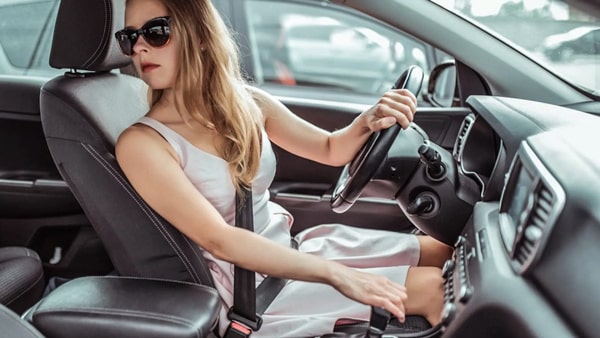
When backing out of a parking space, which action is part of the recommended procedure?

Safely backing up your vehicle includes all of the following except:
  1. A Depend only on the rearview mirror
  2. B Begin moving before checking for pedestrians
  3. C Look back before and while the vehicle is backing
  4. D Back quickly to reduce time in the traffic aisle

Correct answer: C – Look back before and while the vehicle is backing

Before leaving a parking space, check the mirrors and make sure the vehicle’s path is clear, especially of pedestrians and children. Look back before beginning and continue looking while backing. A driver should use caution throughout the maneuver rather than moving before the area has been checked.

Source: Texas Driver Handbook — Ch. 7, “Leaving a Parking Space”

Question 4

What pavement marking may direct drivers into lanes assigned to particular turning movements?

  1. A Flashing red signals
  2. B Flashing yellow signals
  3. C White edge lines along the shoulder
  4. D White directional arrows within the lanes

Correct answer: D – White directional arrows within the lanes

White arrows painted within traffic lanes show the movements assigned to those lanes, such as left turn, right turn, or straight ahead. Drivers should select the appropriate lane before reaching the intersection and follow the direction shown. Edge lines identify roadway boundaries rather than permitted turning movements.

Source: Texas Driver Handbook — Ch. 5, “Pavement Markings”

Question 5

A driver is not transporting a person with a disability, and the vehicle has no valid disabled placard or plates. What may the driver do in a reserved accessible space?

  1. A Park there briefly during an emergency
  2. B Park there while leaving the engine running
  3. C Stand there while waiting for a passenger
  4. D Neither park nor leave the vehicle standing there

Correct answer: D – Neither park nor leave the vehicle standing there

Texas prohibits unauthorized parking or standing in a space designated for persons with disabilities. The privilege generally requires qualifying disabled plates or a placard and use connected with transporting the eligible person. A basic offense under this section is a misdemeanor punishable by a fine of $500 to $750, with enhanced penalties possible for repeat violations.

Source: Tex. Transp. Code § 681.011(a), (b), (g) – Parking Offenses

Question 6

You are traveling slower than surrounding traffic in the left lane, and several vehicles are passing on your right. What should you do?

  1. A Drive onto the left shoulder
  2. B Activate the hazard warning lights
  3. C Remain in the left lane to prevent passing
  4. D Move into the right lane when the lane change can be made safely

Correct answer: D – Move into the right lane when the lane change can be made safely

Texas law requires a vehicle moving more slowly than the normal speed of traffic under existing conditions to use the available right-hand lane. Exceptions apply when the driver is passing another vehicle or preparing for a left turn. Check mirrors and blind spots, signal, and move right only when the lane change is safe.

Source: Tex. Transp. Code § 545.051(b) – Driving on Right Side of Roadway