Take the real Texas written test online!

Texas Road Signs Test 2

4.9 out of 5 (556 votes)
80% Passing score
20 Questions
4 Mistakes allowed
This Texas road signs practice test is built for the part of studying that people often rush through, even though DPS absolutely expects you to know it. The signs are familiar, sure, but familiar is not the same as ready. A red sign telling you what not to do, a yellow warning sign giving you just enough notice to adjust, a green guide sign pointing you through a mess of exits — these are the things Texas drivers read constantly, sometimes without thinking, and that is exactly why they need to be practiced with some care. You’ll work through 20 multiple-choice questions based on the Texas Driver Handbook, with signs chosen to reflect what shows up on real Texas roads and in Texas permit test practice. Regulatory signs, warning signs, guide signs, construction-zone signs, odd shapes, colors, symbols, the whole slightly overstuffed road-sign universe. It is not about memorizing one stop sign and calling yourself prepared. It is about getting comfortable with the visual language DPS expects you to recognize quickly, because on the road, nobody politely pauses traffic while you debate what a sign probably meant. For the actual Texas Class C knowledge test, road signs are tested as part of the main knowledge exam. There is not a separate road-sign-only test for ordinary noncommercial applicants. The practical format is 30 multiple-choice questions, and you need 21 correct answers to pass, which is 70%. That leaves room to miss up to 9 questions, technically, but burning those misses on signs is a sloppy way to do it. Some applicants take the knowledge exam through an approved driver education course; others take it at a Texas driver license office. Either path still leads through the same basic expectation: know the rules, know the signs, and do not treat either one like filler. The licensing process has a few more moving parts, naturally. Applicants may need a completed application, proof of identity, lawful presence, Social Security information, Texas residency documents, a photo, thumbprints, the required fee, and a vision exam. Teen applicants usually bring driver education paperwork too, including the DE-964 and school enrollment documentation. So, yes, there is paperwork. There always is. But this Texas road signs test keeps one piece of the process clear and manageable: practice the signs now, understand how they fit into the full Texas DPS knowledge test, and walk into the licensing process with fewer loose ends rattling around.

Skip the DPS written test. No Joke.

Pass guaranteed — or your money back.

Learn More
Promotion
Learn More

Sample Texas Permit Test Questions

Question 1

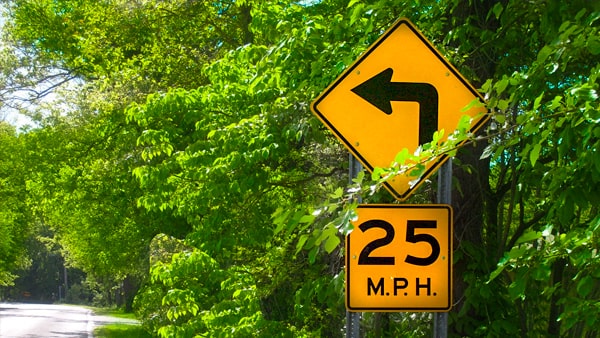
A yellow left-curve sign has a 25 MPH advisory plaque below it. What does the combination mean?

This sign means:
  1. A Left curve; minimum speed is 25 mph
  2. B Right curve; minimum speed is 25 mph
  3. C Right curve; advisory speed is 25 mph
  4. D Left curve; advisory speed is 25 mph

Correct answer: D – Left curve; advisory speed is 25 mph

The warning sign shows that the road curves left, and the plaque gives an advisory speed of 25 mph for that condition. An advisory-speed plaque is not a minimum-speed sign. It supplements the curve warning and is based on an engineering evaluation of the roadway condition.

Source: 2025 Texas Manual on Uniform Traffic Control Devices — § 2C.59, “Advisory Speed Plaque (W13-1P) and Confirmation Advisory Speed Plaque (W13-1aP)”, Texas Driver Handbook — Ch. 5, “Regulatory and Warning Signs”

Question 2

After stopping at a steady red signal, when may you turn left unless a posted sign prohibits it?

  1. A Whenever no vehicle is approaching from the opposite direction
  2. B From a two-way street onto a one-way street
  3. C From a one-way street onto another one-way street
  4. D Whenever the vehicle ahead completes the turn

Correct answer: C – From a one-way street onto another one-way street

Texas permits a left turn after stopping at a steady red signal when both intersecting streets are one-way and the left turn is otherwise permissible. Before turning, remain stopped until the intersection can be entered safely and yield to lawful traffic, pedestrians, and sidewalk users. A posted prohibition overrides this permission.

Source: Tex. Transp. Code § 544.007(d), (f) – Traffic-Control Signals in General

Question 3

How should you respond to a flashing yellow traffic signal?

  1. A Maintain speed while watching for vehicles
  2. B Make a complete stop before passing the signal
  3. C Proceed through or past the signal with caution
  4. D Wait for a steady green signal

Correct answer: C – Proceed through or past the signal with caution

Under Texas law, a driver facing a flashing yellow signal may proceed through the intersection or past the signal only with caution. Unlike a flashing red signal, it does not impose an automatic stop. Observe traffic, pedestrians, and roadway conditions before continuing.

Source: Tex. Transp. Code § 544.008(b), (c) – Flashing Signals

Question 4

After stopping at an intersection, what traffic should you check before entering?

  1. A Only traffic straight ahead and to the left
  2. B Only traffic approaching from the left and right
  3. C Traffic in every direction, including left, right, and ahead
  4. D Only traffic straight ahead and to the right

Correct answer: C – Traffic in every direction, including left, right, and ahead

Before entering, check carefully for traffic and other road users in every direction. The Texas Driver Handbook advises looking carefully in all directions where roads cross. State law permits a driver to proceed after a required stop only when the intersection can be entered safely without interfering or colliding with other traffic.

Source: Tex. Transp. Code § 545.151(a) – Vehicle Approaching or Entering Intersection, Texas Driver Handbook — Ch. 5, “Warning Signs”

Question 5

A yellow diamond sign shows an arrow making a sharp right-angle bend. What does it warn you about?

When you see this black and yellow sign, it means:
  1. A A one-way road begins on the right
  2. B A construction detour turns right
  3. C The road makes a sharp right turn ahead
  4. D A side road enters from the right

Correct answer: C – The road makes a sharp right turn ahead

This warning sign indicates that the roadway makes a sharp turn in the arrow’s direction. It is different from a side-road or detour sign. The driver handbook instructs motorists to slow down, keep right, and avoid passing when approaching this sharp-turn condition.

Source: Texas Driver Handbook — Ch. 5, “Warning Signs”

Question 6

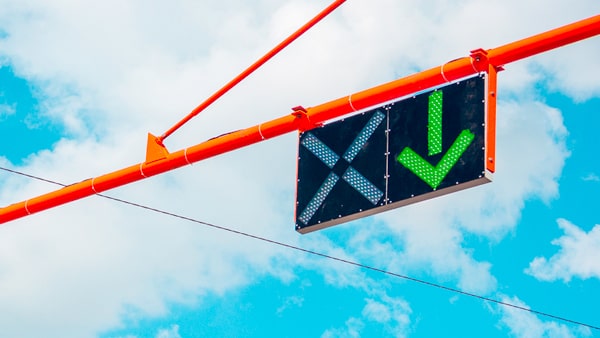
What does a steady downward green arrow above a traffic lane indicate?

This green arrow on a lane use control signal means that:
  1. A Traffic may use the lane
  2. B Traffic is prohibited from using the lane
  3. C Traffic in the lane has priority over all other road users
  4. D All drivers must merge into the lane

Correct answer: A – Traffic may use the lane

Texas law allows a vehicle to travel in a lane over which a green lane-direction signal is displayed. A red signal above a lane prohibits entering or traveling in that lane. The green arrow opens the lane for travel; it does not direct every driver to merge into it.

Source: Tex. Transp. Code § 544.009 – Lane-Direction-Control Signals, Texas Driver Handbook — Ch. 5, “Guide Signs”