Take the real Texas written test online!

Texas Road Signs Practice Test 3

4.9 out of 5 (536 votes)
80% Passing score
20 Questions
4 Mistakes allowed
A Texas DMV road sign test deserves more attention than most people give it, mostly because road signs are baked directly into the Texas driver license knowledge test. DPS builds that test from the Texas Driver Handbook, and the official material does not stop at signs. It also gets into traffic laws, right-of-way, safe driving habits, distracted driving, alcohol and drug rules, vehicle equipment, and driver responsibility. So this Texas permit test practice is not floating off by itself somewhere. It fits into the same knowledge base you are expected to understand before Texas will move you further along in the licensing process. This Texas DPS road signs test keeps the focus where a lot of missed points tend to happen: sign shape, sign meaning, and the little differences between answers that seem obvious when you are studying but somehow less obvious when the screen is asking for one correct choice. An octagon means stop. A triangle means yield. Rectangular signs may regulate, guide, or give information, which is a broad little category, and honestly that is where some drivers get sloppy. The point is not to stare at a sign until you remember a label. The point is to know what the sign is telling you to do while you are actually driving, with traffic moving around you and no one politely waiting for you to think it over. For ordinary noncommercial Class C applicants, Texas does not use a separate road-sign-only test. Road sign questions are part of the main knowledge test. The practical learner-facing format is 30 multiple-choice questions, and passing means answering at least 21 correctly, or 70%. That gives you room to miss up to 9, but not much room to treat the sign section like filler. Some students handle the knowledge test through an approved driver education course. Others, including teen applicants who did not complete the exam during the classroom portion of driver education, take it at the driver license office. And then there is the rest of the licensing trail, because of course there is. Teen applicants may need a Verification of Enrollment and Attendance form. Drivers must complete the appropriate Impact Texas Drivers program before the driving skills test. Adults and new Texas residents may need registration and insurance documents, or a statement that they do not own a vehicle. This DMV sign test helps clean up one important piece of that process early, before the paperwork, appointments, and test-day nerves start piling on.

Skip the DPS written test. No Joke.

Pass guaranteed — or your money back.

Learn More
Promotion
Learn More

Sample Texas Permit Test Questions

Question 1

What do double solid white lines separating traffic lanes mean?

  1. A You may cross them to pass when the way is clear
  2. B You must not cross them to change lanes
  3. C They mark a two-way left-turn lane
  4. D They mark the edge of a drivable shoulder

Correct answer: B – You must not cross them to change lanes

The Texas Driver Handbook states that crossing double solid white pavement lines is prohibited. These lines may be used to separate lanes where drivers must remain in their current lane. They do not mark a center turn lane or give permission to cross for passing.

Source: Texas Driver Handbook — Ch. 5, “Solid Lines”, 2025 Texas Manual on Uniform Traffic Control Devices — Fig. 3B-8, “Example of Double Solid White Line Used to Prohibit Lane Changing”

Question 2

Your signal changes from red to green, but a vehicle or pedestrian is still lawfully in the intersection. What should you do?

  1. A Proceed because the green signal gives you absolute priority
  2. B Yield until the vehicle or pedestrian is clear
  3. C Sound your horn and enter the intersection
  4. D Proceed immediately if you are traveling straight

Correct answer: B – Yield until the vehicle or pedestrian is clear

A circular green signal permits movement, but Texas law still requires drivers to yield to vehicles lawfully in the intersection. Drivers must also stop and yield to pedestrians or sidewalk users lawfully in the intersection or an adjacent crosswalk. Wait until your path is clear before proceeding.

Source: Tex. Transp. Code § 544.007(b) – Traffic-Control Signals in General

Question 3

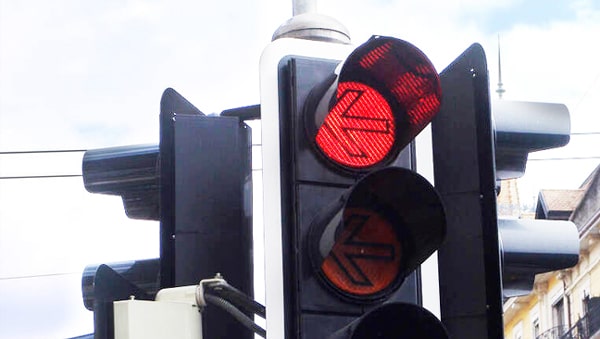
When no other signal or sign permits the turn, how does a steady red arrow differ from a circular red signal?

What is the difference between traffic lights with red arrows and those with solid red lights?
  1. A The movement shown by the red arrow must remain stopped
  2. B A red arrow controls only vehicles traveling straight
  3. C A red arrow is used only for left turns
  4. D A red arrow is used only for right turns

Correct answer: A – The movement shown by the red arrow must remain stopped

A steady red arrow requires traffic making the indicated movement to stop and remain stopped unless another signal or traffic-control device permits that movement. A circular red signal may permit a right turn, or a left turn between one-way streets, after the required stop and yielding. A posted sign may prohibit those turns in Texas.

Source: 2025 Texas Manual on Uniform Traffic Control Devices — § 4D.04, “Meaning of Vehicular Signal Indications”, Tex. Transp. Code § 544.007(d), (f) – Traffic-Control Signals in General

Question 4

What is the usual purpose of a yellow, diamond-shaped traffic sign?

A yellow and black diamond-shaped sign:
  1. A To warn of a roadway condition or hazard
  2. B To provide directions to destinations
  3. C To state a traffic law or prohibition
  4. D To identify a temporary work zone

Correct answer: A – To warn of a roadway condition or hazard

Yellow diamond-shaped signs generally warn drivers about roadway conditions or hazards ahead, such as curves, intersections, or changing pavement conditions. Regulatory signs use other common shapes and tell drivers what they must or must not do. Temporary work-zone warning signs generally use an orange background.

Source: Texas Driver Handbook — Ch. 5, “Regulatory and Warning Signs”

Question 5

What must you do when a traffic signal is present but none of its signal heads displays a light?

When a traffic signal light is not working, you should:
  1. A Stop only when another vehicle is present
  2. B Reduce speed and stop only if a conflict develops
  3. C Stop as though facing a stop sign, then proceed when safe
  4. D Continue through at your normal speed

Correct answer: C – Stop as though facing a stop sign, then proceed when safe

Texas law requires a driver to stop as if the intersection had a stop sign when an ordinary traffic signal displays no indication in any signal head. After stopping, the driver may proceed only when the intersection can be entered safely without interfering or colliding with traffic using another roadway.

Source: Tex. Transp. Code § 544.007(i) – Traffic-Control Signals in General, Tex. Transp. Code § 545.151(a)(1)(B), (a)(2) – Vehicle Approaching or Entering Intersection

Question 6

What does a red, eight-sided STOP sign require?

This sign means:
  1. A Slow and stop only when another vehicle approaches
  2. B Come to a complete stop, yield as required, and proceed when safe
  3. C Continue cautiously without stopping when the road appears clear
  4. D Stop only for traffic on the intersecting road

Correct answer: B – Come to a complete stop, yield as required, and proceed when safe

At a STOP sign, a Texas driver must make a complete stop at the stop line, before the crosswalk if no line exists, or at the proper viewing point if neither is present. After stopping, yield to vehicles already in the intersection or approaching closely enough to be an immediate hazard. Proceed when the movement can be made safely.

Source: Tex. Transp. Code § 544.010(a), (c) – Stop Signs and Yield Signs, Tex. Transp. Code § 545.153(b) – Vehicle Entering Stop or Yield Intersection