


Utah CDL Permit Test (UT) Online Simulator

5 out of 5 (38 votes)
80% Passing score
50 Questions
10 Mistakes allowed
Dive into the world of CDL preparation with our cutting-edge Utah CDL Permit Test Simulator. Unlike any other DMV permit practice test you've encountered, this simulator is your virtual testing ground, offering a dynamic and immersive experience to boost your confidence and readiness. With a vast database of over 700 CDL test questions, every session on the Utah DMV test simulator brings a fresh challenge, ensuring you're comprehensively prepared for the real deal.Imagine tackling a new set of 50 permit test questions each time, chosen at random from multiple-choice and true/false formats, mirroring the actual 2026 Utah CDL written test. This approach not only sharpens your knowledge but also hones your test-taking skills, giving you a realistic taste of what to expect. Achieving at least 40 correct DMV test answers is your goal for passing, but why stop there? Striving for excellence and targeting a higher score can only increase your odds of success on test day.But preparation doesn't stop at driver's permit practice tests. To truly excel, blend your CDL test simulator sessions with an array of study tools. Dive into the drivers handbook, engage with flashcards, and decode road sign charts. Embrace the depth of learning by enrolling in a state-certified drivers ed course or even take professional driving lessons for that extra edge.Tailored specifically for Utah, this permit test simulator takes into account the unique driving laws and signage of the Beehive State, ensuring you're not just prepared, but prepared right. Whether you're aiming for Class A or B CDL, this tool stands as your ally, ready to guide you through the nuances of Utah's road rules and regulations.
FREE CDL Practice Test App
Pass your Utah CDL General Knowledge test with the NextDoorDriving app. Real questions and answers—100% free and ad-free.
Download on the App Store

Sample Utah CDL Test Questions - General Knowledge

Question 1

A red rectangular sign reading “WRONG WAY” means:
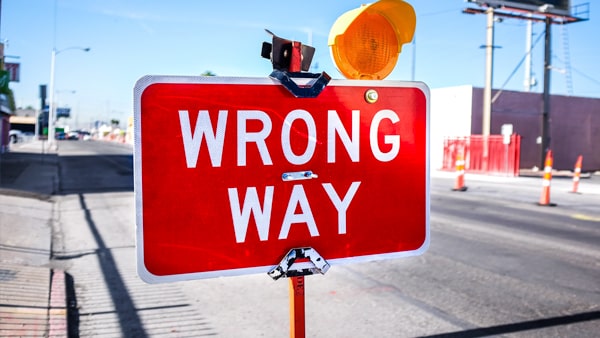
This sign warns drivers that  _________________.
  1. A An expressway begins ahead
  2. B A congested area is ahead
  3. C You are entering or traveling in a prohibited direction
  4. D You may continue after reducing speed

Correct answer: C – You are entering or traveling in a prohibited direction

A WRONG WAY sign warns that a road user is entering or traveling in the prohibited direction on a roadway or ramp. It is commonly used with DO NOT ENTER signs as part of wrong-way traffic control. It does not merely advise drivers to proceed cautiously.

Source: Manual on Uniform Traffic Control Devices, 11th ed., Revision 1 — § 2B.47, “WRONG WAY Sign (R5-1a)”

Question 2

A heavily loaded CMV is taking an off-ramp that curves downhill. What should the driver do?

  1. A Maintain highway speed because the ramp speed is intended for every vehicle
  2. B Reduce to a safe speed before reaching the curved section
  3. C Accelerate before entering the curve
  4. D Wait until inside the curve to brake and downshift

Correct answer: B – Reduce to a safe speed before reaching the curved section

The Utah handbook instructs CMV drivers to slow sufficiently before reaching the curved part of a ramp. A downhill grade makes reducing speed more difficult, while braking and turning together can be dangerous. The posted ramp speed may not be safe for a large or heavily loaded vehicle.

Source: Utah Commercial Driver License Handbook, 2025 Edition — § 2.8.2, “Off Ramps/On Ramps”

Question 3

What does the abbreviation “GVW” stand for?

  1. A Government vehicle weight
  2. B Gross variable weight
  3. C General vehicle width
  4. D Gross vehicle weight

Correct answer: D – Gross vehicle weight

GVW stands for gross vehicle weight. It should not be confused with GVWR, which stands for gross vehicle weight rating and refers to the manufacturer’s specified loaded-weight rating for a single vehicle.

Source: Utah Commercial Driver License Handbook, 2025 Edition — § 3.2.1, “Definitions You Should Know”

Question 4

Which practice helps keep your speed safe when driving at night?

  1. A Use high beams continuously
  2. B Look directly at approaching headlights
  3. C Drive slowly enough to stop within the range of your headlights
  4. D Keep the instrument-panel lights at maximum brightness

Correct answer: C – Drive slowly enough to stop within the range of your headlights

At night, adjust your speed so that your stopping distance remains within your headlight sight distance. Otherwise, a hazard may become visible too late to stop. Avoid staring at oncoming headlights, and dim the instrument lights enough to reduce glare while keeping the gauges readable.

Source: Utah Commercial Driver License Handbook, 2025 Edition — § 2.11.4, “Vehicle Factors—Headlights”

Question 5

When scanning ahead, which two broad categories should a commercial driver watch?

  1. A Traffic and roadway conditions
  2. B Vehicle colors and traffic-signal shapes
  3. C Only disabled vehicles and debris
  4. D Only curves and potholes

Correct answer: A – Traffic and roadway conditions

A driver should scan ahead for traffic and roadway conditions rather than focusing on only one type of hazard. Watch for vehicles entering, turning, changing lanes, or braking. Looking far enough ahead gives you more time to adjust your speed or lane position safely.

Source: Utah Commercial Driver License Handbook, 2025 Edition — § 2.4.1, “Seeing Ahead”

Question 6

In the handbook’s basic example, what is the minimum total stopping distance at 55 mph under ideal conditions?

  1. A 216 feet
  2. B 320 feet
  3. C 419 feet
  4. D 550 feet

Correct answer: C – 419 feet

The Utah handbook’s example uses 142 feet of perception distance, 61 feet of reaction distance, and about 216 feet of braking distance. Together, these equal a minimum of 419 feet at 55 mph under ideal conditions. An air-braked vehicle also has brake-lag distance, increasing its total stopping distance.

Source: Utah Commercial Driver License Handbook, 2025 Edition — § 2.6.1, “Stopping Distance”, Utah Commercial Driver License Handbook, 2025 Edition — § 5.4.4, “Stopping Distance”