Utah Practice Permit Test 5

4.9 out of 5 (163 votes)
80% Passing score
20 Questions
4 Mistakes allowed
DUI questions on the Utah permit test are not filler, and they are not there just to make the exam feel more official. They cover the rules that decide what happens when alcohol, driving, judgment, and Utah law all collide — which is a very serious way to say that this is one section where guessing is a bad strategy. This Utah permit practice test is the fifth test in our Utah DMV practice test series, with 20 questions focused on impaired driving, BAC limits, alcohol-related penalties, and the consequences that follow when a driver gets behind the wheel under the influence. The details can get a little dense, admittedly. One question might ask about a BAC limit; another might lean into penalties, license consequences, or how alcohol affects decision-making before a driver even realizes they are making worse decisions. That is why this Utah permit test practice keeps the focus tight. It gives you room to work through the DUI material carefully, without the pressure of the official written test sitting in front of you and without pretending that “common sense” is enough to carry you through the legal wording. This also ties directly into Utah’s licensing process. If you are 18 and applying for your first license, you must apply for a learner permit, pass the 50-question written knowledge test, pass the vision test, complete driver education, finish 40 practice driving hours with 10 after sunset, pass the driving skills test, and complete the Traffic Safety and Trends Exam if you have never been licensed anywhere in the world. Utah does not list a learner permit holding period for 18-year-old applicants, so passing the written test is one of the first serious steps, not some distant formality. For first-time applicants age 19 or older, driver education is optional, but there is a catch — and it is the kind of catch people usually notice late. Without driver education, you must hold the learner permit for 90 days and complete 40 practice hours, including 10 after sunset. With driver education, the 90-day holding period is not required, although the 40 hours still are. Clear questions, visual aids, and current Utah-focused material make this Utah practice permit test a practical way to study before moving on to the rest of licensing. After the required tests are passed, Utah issues a temporary license the same day, with the completed license mailed later. That is the path. This practice test helps you start it with fewer gaps.
FREE DMV Practice Test App
Study for your Utah permit test or driver’s license with the NextDoorDriving app. 700+ DMV questions and answers, 100% free!
Download on the App Store

Sample Utah Permit Test Questions

Question 1

Which action is a sound defensive-driving practice?

  1. A Scanning your mirrors frequently
  2. B Watching only the pavement directly ahead
  3. C Using high beams in fog
  4. D Following another vehicle by less than two seconds

Correct answer: A – Scanning your mirrors frequently

Frequent mirror checks help you monitor changing traffic and identify vehicles approaching from behind. Your eyes should also scan ahead and to the sides rather than remain fixed on one spot. Low beams should be used in fog, and adequate following distance must be maintained.

Source: Utah Driver Handbook — § 6(C), “Safe Driving Tips” and § 8, “Regular Traffic Checks/Head Checks”},{, Utah Code § 41-6a-711(2) – Following another vehicle -- Safe distance -- Exceptions -- Penalty.
Question 2

When parking downhill beside a curb, your front wheels should point:

When parking downhill and the curb is absent, your front wheels must be turned:
  1. A Away from the curb
  2. B Straight ahead
  3. C Toward the curb
  4. D Toward the centerline

Correct answer: C – Toward the curb

For downhill parking, turn the front wheels toward the curb and bring the front tire into contact with it. Place an automatic transmission in Park and set the parking brake. This wheel position helps secure the vehicle if it begins to move.

Source: Utah Driver Handbook — § 8(D), “Hill Parking”

Question 3

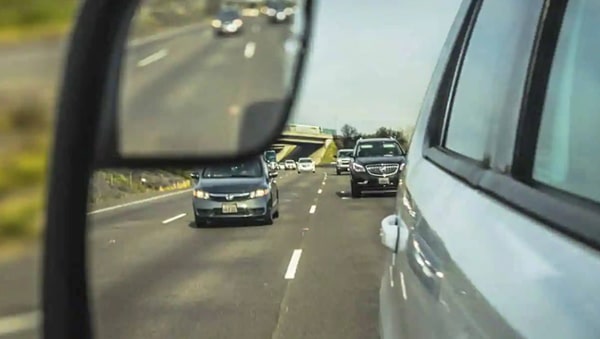
Why should you check your mirrors regularly while driving?

You should check traffic behind you:
  1. A Only to prepare for freeway exits
  2. B To monitor traffic approaching from behind
  3. C Only to determine when to brake
  4. D To avoid looking toward intersections

Correct answer: B – To monitor traffic approaching from behind

Regular mirror checks keep you informed about vehicles approaching or following from behind. The handbook directs drivers to check traffic and mirrors regularly and around intersections, turns, and lane changes. Mirror use should be combined with direct observation and head checks when necessary.

Source: Utah Driver Handbook — § 8, “Regular Traffic Checks/Head Checks”

Question 4

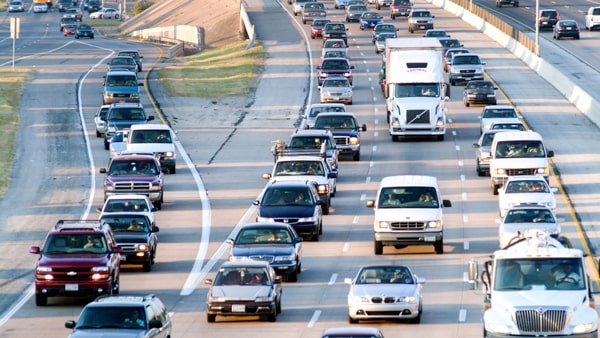
Before merging onto a freeway, how should you check for traffic in the lane you plan to enter?

When you enter a freeway, you should check traffic by using:
  1. A Use the inside mirror only
  2. B Use the outside mirrors only
  3. C Check the mirrors and look over your shoulder
  4. D Look only through the windshield

Correct answer: C – Check the mirrors and look over your shoulder

Check your mirrors and perform a head check by looking over your shoulder toward the lane you plan to enter. Blind spots are roadway areas that cannot be seen in the mirrors. After finding a suitable gap, use the acceleration lane to match traffic speed and merge safely.

Source: Utah Driver Handbook — § 1, “Definitions,” “Blind Spots” and “Head Checks”, Utah Driver Handbook — § 8(C), “Lane Changes” and § 9, “Entering a Multi-Lane Highway”

Question 5

Which warning sign tells drivers that the center divider is ending?

  1. A Lane-ends-ahead.jpg
  2. B Divided-highway-ends.jpg
  3. C Two-way-traffic-ahead.jpg
  4. D Turn-left-or-right.jpg

Correct answer: B – Divided-highway-ends.jpg

The Divided Highway Ends sign is a yellow, diamond-shaped warning sign. It indicates that the physical divider or median separating opposing traffic will end ahead. Drivers should remain to the right and prepare for a roadway where opposing traffic is no longer separated by the divider.

Source: Utah Driver Handbook — § 9, “Warning Signs”

Question 6

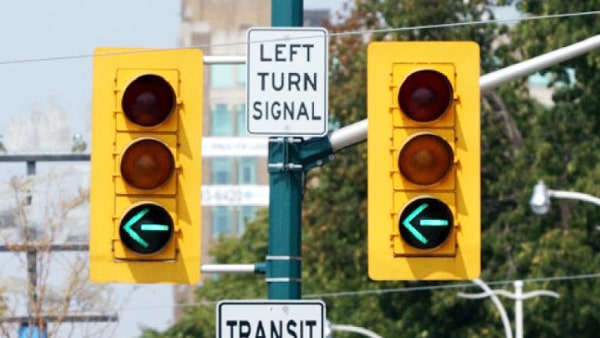
When facing a green left arrow, a driver may:

A green arrow pointing to the left on a traffic light means you may:
  1. A Proceed straight or turn left
  2. B Turn left only after making a complete stop
  3. C Turn left after yielding to lawful traffic and pedestrians still in the intersection
  4. D Turn without checking whether the intersection is clear

Correct answer: C – Turn left after yielding to lawful traffic and pedestrians still in the intersection

In Utah, a green arrow permits cautious movement only in the direction indicated. Before turning, the driver must yield to pedestrians lawfully within an adjacent crosswalk and to other traffic lawfully using the intersection. The driver should not proceed until the permitted path is clear.

Source: Utah Code § 41-6a-305(2)(b) – Traffic-control signal -- At intersections -- At place other than intersection -- Color of light signal -- Inoperative traffic-control signals -- Affirmative defense., Utah Driver Handbook — § 9(H), “Traffic Signals”