


Utah Learners Permit Practice Test 9

4.9 out of 5 (105 votes)
80% Passing score
20 Questions
4 Mistakes allowed
This Utah permit practice test is built around school bus rules, which is a narrower topic than the full exam, but it is not a throwaway section. Utah expects new drivers to know exactly when traffic must stop for a school bus, what to do when children are loading or unloading, and how to read the situation without guessing. This practice test gives you 20 questions on those scenarios, and a score of 16 correct puts you at the same 80% standard used on the official Utah knowledge test. The full first-time Utah learner permit test has 50 questions, with 40 correct answers required to pass. So, yes, this Utah DMV learner permit test is shorter, but the point is more focused than broad review. It lets you slow down on one area that often gets taught quickly, remembered vaguely, and then somehow shows up in very exact wording on the real test. That is where practice helps. Not in a dramatic way, necessarily, just in the ordinary way that seeing the rule a few different times makes it easier to trust your answer. A few licensing details are worth keeping in mind while you study. Utah lets you take the written test twice in one day, but after three failed attempts, another fee is required. The learner permit fee is $19, and your written-test score or learner permit stays valid for 18 months. Those numbers matter because the permit process is not just one test floating by itself; it is tied to deadlines, fees, documents, and the next step toward a license. For teen drivers, the path is more structured. A learner permit can begin at age 15, but drivers under 18 need driver education, 40 hours of supervised driving, and 10 of those hours after sunset. A regular Class D license can start at 16, though Utah’s graduated driver licensing rules still apply to 16- and 17-year-old drivers, including limits on late-night driving, passengers, and cell phone use. Because this learner permit test online is available anytime, it fits into real studying better than a one-time cram session. Use it before the official exam, during driver education, or when school bus rules feel a little too easy and therefore a little too easy to skim past. It will not handle your vision test, documents, or licensing appointment for you, obviously, but it will make the road-rule part feel much more familiar.
FREE DMV Practice Test App
Study for your Utah permit test or driver’s license with the NextDoorDriving app. 700+ DMV questions and answers, 100% free!
Download on the App Store

Sample Utah Permit Test Questions

Question 1

Under Utah law, how does a steady red arrow generally differ from a steady circular red signal?
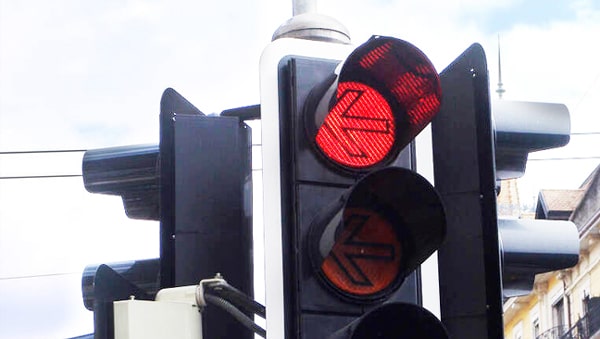
What is the difference between traffic lights with red arrows and those with solid red lights?
  1. A The arrow generally prohibits the indicated turn until another signal permits it, subject to a limited one-way-to-one-way exception
  2. B A red arrow is used only for left-turn lanes
  3. C A red arrow and circular red always permit exactly the same turns
  4. D A red arrow permits a turn whenever cross traffic appears clear

Correct answer: A – The arrow generally prohibits the indicated turn until another signal permits it, subject to a limited one-way-to-one-way exception

Both signals require a stop. After stopping, a circular red may permit a right turn or a left turn from one one-way street to another, provided the driver yields and no device prohibits it. A red arrow generally requires the driver to remain stopped, although a traffic-control device on the state highway system may permit the limited one-way-to-one-way left turn.

Source: Utah Code § 41-6a-305(4)(a), (c) – Traffic-control signal -- At intersections -- At place other than intersection -- Color of light signal -- Inoperative traffic-control signals -- Affirmative defense.
Question 2

When a roadside scene does not require you to slow, stop, or change lanes, which action helps prevent unnecessary congestion?

  1. A Reduce speed sharply to observe the scene
  2. B Keep your attention on driving instead of slowing merely to watch
  3. C Stop briefly to determine what happened
  4. D Change lanes repeatedly for a better view

Correct answer: B – Keep your attention on driving instead of slowing merely to watch

Watching a roadside scene can divert attention from driving. Drivers also may not travel so slowly that they impede normal and reasonable traffic movement unless a lower speed is necessary for safety, a grade, or compliance with a traffic-control device. Slow down whenever the scene creates a hazard or an official direction requires it.

Source: Utah Code § 41-6a-605(1) – Minimum speed regulations., Utah Driver Handbook — § 11, “Distractions and Driving Challenges”

Question 3

Which driving habit is a basic part of defensive driving?

  1. A Focus only on the vehicle directly ahead
  2. B Remain alert, scan for hazards, and check your mirrors frequently
  3. C Expect other drivers to correct your mistakes
  4. D Wait until the last moment to respond to danger

Correct answer: B – Remain alert, scan for hazards, and check your mirrors frequently

The Utah handbook advises drivers to scan for potential hazards and check their mirrors frequently. Defensive driving requires awareness of traffic, pedestrians, roadway conditions, and other objects around the vehicle. Fixing your attention on only one point can prevent you from noticing a developing hazard elsewhere.

Source: Utah Driver Handbook — § 6.C, “Safe Driving Tips”, Utah Driver Handbook — § 12.A, “Defensive Driving”

Question 4

In Utah, why may a highway authority post a minimum speed limit?

  1. A To prevent slow traffic from consistently impeding normal and reasonable movement
  2. B To report temporary pavement conditions
  3. C To identify locations for future traffic signals
  4. D To establish pedestrian crossing times

Correct answer: A – To prevent slow traffic from consistently impeding normal and reasonable movement

A highway authority may post a minimum speed after an engineering and traffic investigation finds that slow speeds consistently impede normal and reasonable traffic movement. A driver generally may not travel below the posted minimum. An exception applies when a lower speed is necessary for safe operation or otherwise authorized by law.

Source: Utah Code § 41-6a-605(3) – Minimum speed regulations.

Question 5

If another vehicle is following you too closely, which following-distance duty remains your responsibility?

  1. A Brake abruptly to make the other driver back away
  2. B Reduce the space between you and the vehicle ahead
  3. C Maintain safe space behind the vehicle ahead, including the required two-second interval
  4. D Use your horn and hazard lights continuously

Correct answer: C – Maintain safe space behind the vehicle ahead, including the required two-second interval

Utah law requires a reasonable and prudent following distance and generally at least two seconds behind the vehicle directly ahead. A close-following driver behind you does not cancel that duty. On a multilane highway, a driver being overtaken in the left general-purpose lane must move safely to a lane on the right when the legal conditions for yielding are present.

Source: Utah Code § 41-6a-711(2) – Following another vehicle -- Safe distance -- Exceptions -- Penalty., Utah Code § 41-6a-704(3)–(5) – Overtaking and passing vehicles proceeding in same direction.

Question 6

If your service brakes stop working while you are driving, which actions are recommended?

If you experience brake failure while driving, you should:
  1. A Apply the parking brake slowly
  2. B Be ready to release the parking brake if the rear wheels begin to skid
  3. C If the parking brake fails, turn off the engine and look for a safe place well off the roadway
  4. D All of the above

Correct answer: D – All of the above

If the service brakes fail, apply the parking brake slowly to reduce the chance of locking the rear wheels. Release it if the vehicle begins to skid. If the parking brake also fails, turn off the engine, maintain control, and find a safe stopping place well off the roadway. Do not continue driving a vehicle without functioning brakes.

Source: Utah Driver Handbook — § 12.B, “Braking and Brake Failure”